
The Arithmetic of Survival
When a fishing trawler capsized in the Andaman Sea in early April, claiming roughly 250 lives in a single incident, the tragedy illustrated something that refugee organizations have quietly acknowledged for years: displacement camps breed desperation, and desperation drives people toward maritime routes so lethal that a 15% fatality rate seems like reasonable odds. For the Rohingya now scattered across Bangladesh's sprawling settlements, the calculation has become unavoidable. Stay in a camp where food rations have been cut by as much as 40% and legal employment is forbidden, or risk the sea.
Why This Matters
• Thailand enters the equation: Overcrowded boats targeting Malaysia and Indonesia frequently alter course toward Thailand's southern coast, creating immediate border and humanitarian pressures.
• Funding collapse drives movement: International donors reduced refugee assistance by 40% in 2025, with 2026 pledges covering less than 20% of required needs. This shortfall translates directly into maritime departures.
• Escalating body count: Approximately 900 Rohingya died or disappeared at sea in 2025—the deadliest year on record for this route. The April 2026 sinking alone represents 25% of projected annual casualties, and the monsoon season has only begun.
The Tipping Point
Until late March 2026, the World Food Programme provided each refugee in Cox's Bazar—the world's largest refugee settlement, housing 1.2 million Rohingya—with roughly ฿400 monthly in food vouchers (approximately $12). On April 1, WFP shifted to a tiered system: ฿250 ($7) for adults classified as able-bodied, ฿335 ($10) for moderate-risk households, and ฿400 ($12) only for the most vulnerable—young children, pregnant women, elderly-headed families, and people with disabilities.
The mathematics are brutal. Two-thirds of the camp population now receives less than they did before. At ฿250 monthly, a family of five cannot purchase rice, lentils, and cooking oil in quantities sufficient to prevent hunger. Aid workers report that even at the previous ฿400 level, families regularly faced food shortages by month's end. The new thresholds have forced a binary choice: increase cash through informal—often illegal—channels or abandon the camp entirely.
Smuggling networks have capitalized ruthlessly on this despair. Brokers now circulate through camps offering passages to Malaysia, Thailand, and Indonesia for approximately ฿15,000 to ฿25,000 ($420 to $700)—roughly five to eight months of the new maximum food stipend. The pitch emphasizes factory work, domestic employment, or construction jobs. The reality, as survivors consistently report, is forced labor, debt bondage, or drowning.
When Lifeboats Become Coffins
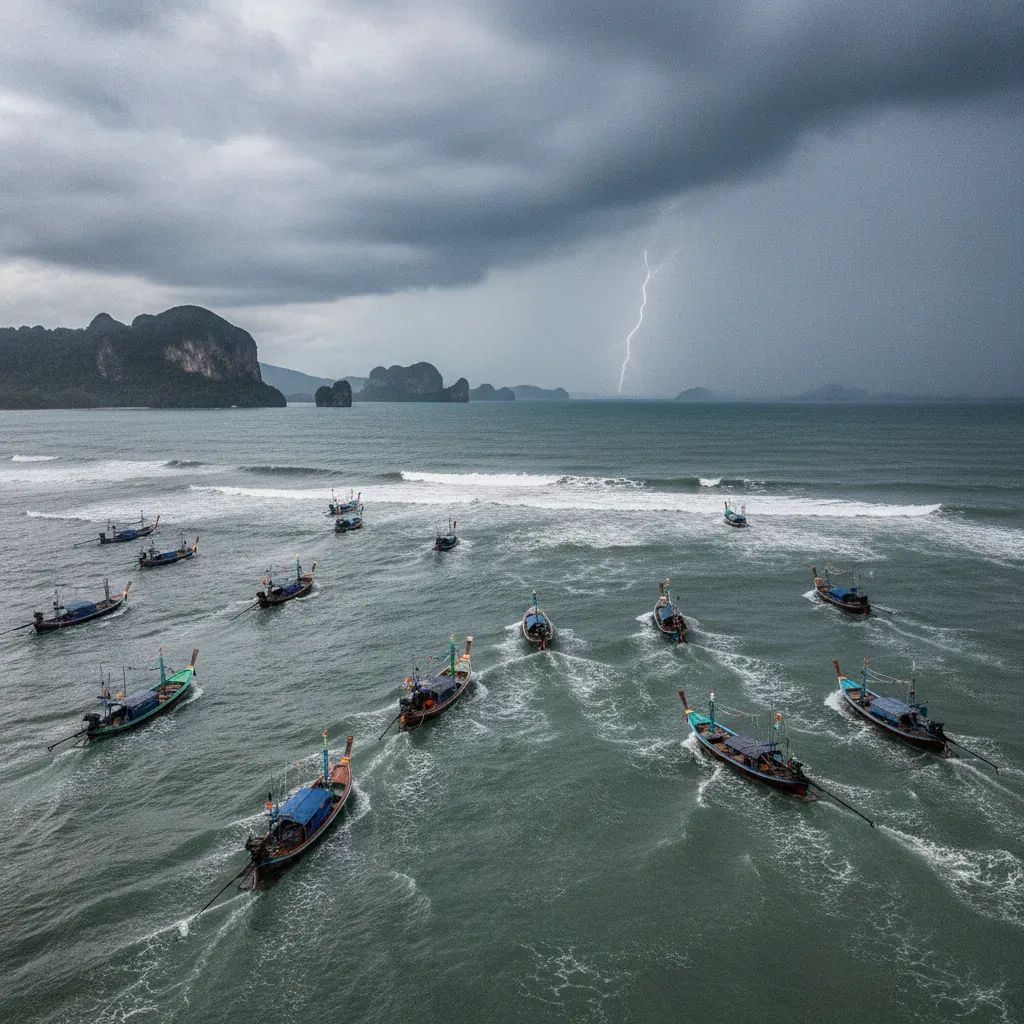
The vessel that sank in April departed Teknaf, Bangladesh on April 4, carrying approximately 280 passengers—mostly Rohingya but including some Bangladeshi migrant workers seeking the same economic escape. Strong seasonal winds, heavy swells, and gross overcrowding—boats designed to safely carry perhaps 30 people are loaded with ten times that number—created a collision of factors. The hull ruptured mid-crossing on April 9. Most passengers trapped below deck in makeshift cargo holds died as water rushed in.
Of the roughly 280 aboard, fewer than ten survivors were recovered by a Bangladesh Coast Guard patrol vessel bound for Indonesia. The Royal Thai Navy and marine police periodically encounter similar situations in Thai waters. When disabled boats drift into Thailand's territorial sea, authorities face competing legal mandates: international maritime law obligates rescue; Thailand's immigration framework does not recognize Rohingya as refugees, technically preventing legal asylum claims.
In practice, intercepted passengers are detained pending screening and eventual transfer to immigration holding facilities or informal shelters managed by UN agencies and NGOs. This limbo can last months. The process strains local healthcare, security, and administrative resources in already-stressed southern provinces like Ranong, Phang Nga, and Satun.
The Route, the Risk, the Pattern
The Andaman Sea crossing spans 1,000 to 1,500 kilometers depending on currents—a seven-to-fifteen-day journey in favorable conditions. Monsoon season, roughly April through September, turns the crossing into an obstacle course. Waves exceed five meters; visibility drops; overcrowded vessels lack navigational equipment and fail rapidly. Captains, often low-ranking operatives with minimal maritime training, navigate by GPS and frequently abandon vessels mid-voyage if patrol boats approach, leaving passengers adrift.
In 2025, one in seven people attempting this route died or disappeared—the highest fatality rate of any maritime migration corridor globally, according to UNHCR data. Approximately 6,500 Rohingya set out that year; 900 never arrived. The April 2026 sinking alone represents more than 25% of 2026's projected deaths through mid-April, yet higher-risk departure months remain ahead.
Women and children comprised over 50% of those aboard the capsized vessel—a demographic pattern consistent across intercepted boats. Interviews with survivors reveal a recurring narrative: traffickers segregate families, locking women and children below deck for faster transit. When emergencies occur, those sections flood first.
The Funding Vacuum
The Thailand Ministry of Foreign Affairs and neighboring governments cannot solve a problem rooted in international financial decisions made thousands of kilometers away. Yet those decisions have triggered cascading consequences across Southeast Asia.
The United Nations Office for the Coordination of Humanitarian Affairs reported that 2025 humanitarian appeals raised only $12 billion—the lowest total in a decade. This underfinancing left 25 million people worldwide without planned assistance. Bangladesh's 2025 Joint Response Plan for Rohingya refugees received only 53% of its target funding. For 2026, agencies estimate $852 million is needed to sustain basic services in Cox's Bazar; less than 20% has been pledged as of mid-April.
The United States, historically the largest single bilateral donor to refugee programs, cut overseas aid appropriations in its 2025 fiscal year. European governments, facing domestic budget pressures and climate-related fiscal demands, followed suit. Even as Bangladesh is classified as a "hunger hotspot" due to flooding and climate disasters affecting both local residents and refugee populations, the international humanitarian architecture has contracted rather than expanded.
WFP officials defend the tiered ration system as a rational allocation mechanism—preserving resources for the most vulnerable. Refugee advocates and camp-based NGOs counter that the policy effectively rations survival itself. Rising malnutrition rates among children, increased camp-based violence, gender-based assault, recruitment of young men by armed groups, and accelerating family separations are all documented consequences. Separately, The Thailand Ministry of Labour and provincial authorities have reported increased smuggling-network activity in border towns, suggesting traffickers are actively recruiting in camps.
The Patchwork Response
Not all international donors have retreated entirely. South Korea's government announced a $5 million assistance package through The International Organization for Migration (IOM) in April 2026, targeted at water and sanitation infrastructure improvements across seven camps and liquefied petroleum gas (LPG) distribution to 41,500 households in 17 facilities. LPG provision addresses a structural safety concern often overlooked: women and children who venture outside camps to collect firewood face sexual assault and trafficking networks. Clean cooking fuel keeps them safer and reduces environmental degradation from uncontrolled deforestation.
Japan's government contributed $2.6 million through IOM for complementary camp-improvement projects. Both contributions represent meaningful interventions but remain proportionally insufficient. Refugee assistance organizations calculate that restoring pre-2025 food-ration levels would require an additional $80 million annually. Current pledges fall short by a factor of four.
A Policy Vacuum with Tragic Consequences
Humanitarian assistance, no matter how generous or well-executed, treats symptoms rather than root causes. The underlying crisis originates in Myanmar, where the military junta continues to deny citizenship to Rohingya under the 1982 Citizenship Law. The 2017 military offensive in Rakhine State, which UN investigators described as "a textbook example of ethnic cleansing," forced 740,000 Rohingya across the border into Bangladesh in a matter of weeks.
Myanmar remains unstable. Armed clashes between the military and ethnic armed organizations continue in Rakhine, making any near-term repatriation impossible. Myanmar has offered no credible commitment to restore citizenship or guarantee safety for returning Rohingya. Without those guarantees, Bangladesh cannot facilitate repatriation, and international law prevents forced return.
Bangladesh, meanwhile, prohibits formal employment among Rohingya, rendering them aid-dependent indefinitely. The government has relocated some refugees to Bhasan Char, a low-lying island in the Bay of Bengal that floods during monsoons and remains inaccessible for most of the year. UNHCR has negotiated limited operational access but explicitly states the island is not a sustainable solution.
Thailand, Malaysia, and Indonesia have episodically accepted maritime arrivals but refuse to establish formal asylum frameworks, fearing they will become permanent host states. ASEAN—the Association of Southeast Asian Nations—has issued rhetorical statements but taken no collective action. The result is a policy vacuum: Rohingya possess no citizenship in Myanmar, temporary precarious status in Bangladesh, and no legal recognition in transit countries. Smugglers exploit this void with cold efficiency.
The Monsoon Forecast
The Andaman Sea monsoon season extends through September. Historical data indicates boat departures peak in May and June, before conditions deteriorate further. If current food rations remain depressed and funding pledges stagnate, UNHCR and IOM project 3,000 to 4,000 Rohingya will attempt the sea route by year-end—triple the 2024 figure. If historical fatality rates persist above 10%, this trajectory suggests 300 to 400 additional deaths.
For Thailand's coast guard, marine police, and border provinces, the challenge is no longer whether boats will arrive but how to manage them when they do. Enhanced naval patrols, bilateral information-sharing agreements, and improved detention facility conditions are tactical responses. A strategic solution requires dismantling the logic that pushes people seaward: restore funding to refugee camps, pressure Myanmar to create conditions for safe repatriation, and establish regional burden-sharing mechanisms that acknowledge that statelessness and permanent displacement are not local problems but regional ones.
Until the international community musters political will and financial resources to address these foundations, the seasonal cycle will continue. Each monsoon season, more boats will depart. Some will be intercepted; others will sink. The survivors will tell investigators and aid workers the same story: they had a 15% chance of dying at sea, and it seemed preferable to the certainty of another year watching rations shrink and futures disappear.


