
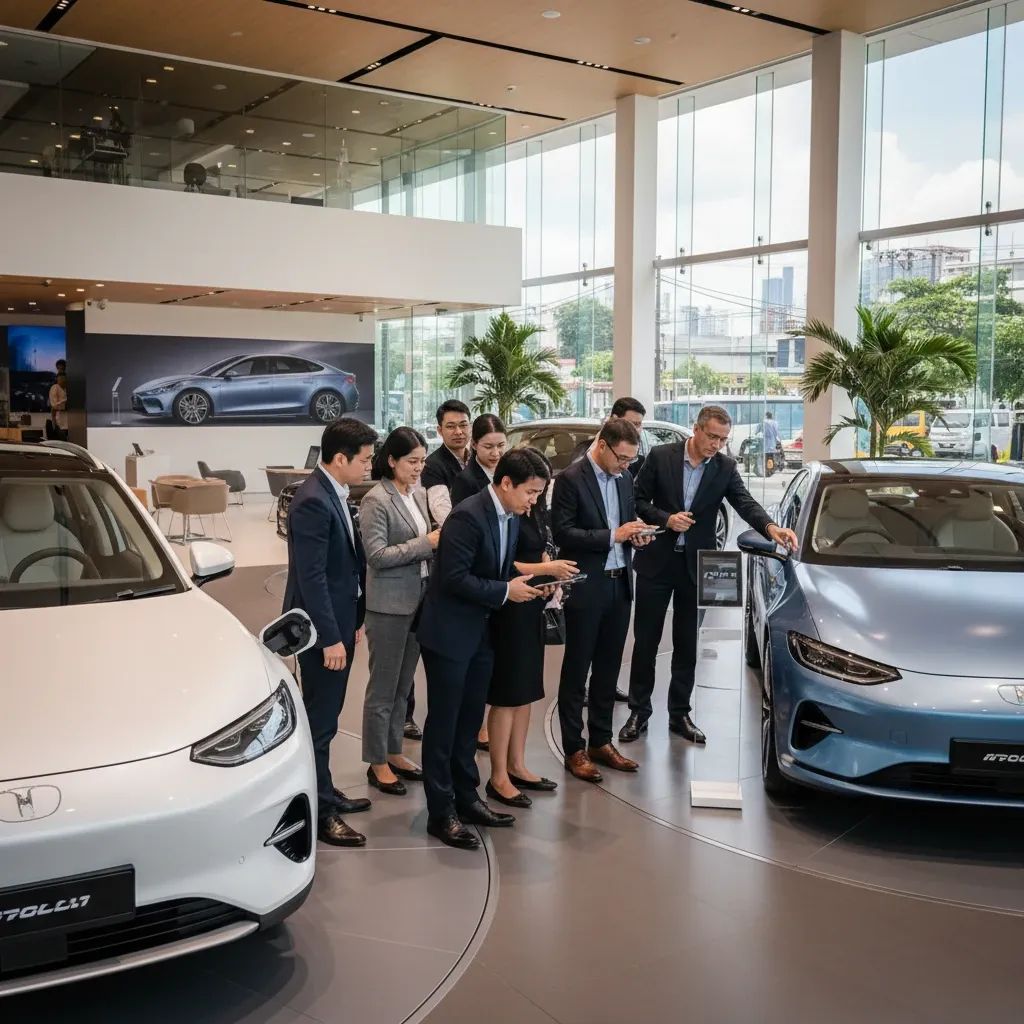
The Thailand Board of Investment's ambitious EV3.5 program, which has fueled a manufacturing surge across the country's Eastern Economic Corridor, will conclude in December 2027—leaving automakers, suppliers, and policymakers scrambling to answer a ฿140-billion question: what happens when the subsidies disappear?
What This Means for Residents and Investors
For consumers, the immediate impact is clear: subsidies of up to ฿100,000 on qualifying passenger cars remain available through 2027, alongside the reduced 2% excise rate. Electric motorcycles priced under ฿150,000 with at least 3 kWh capacity still qualify for ฿5,000-฿10,000 rebates, and the excise rate sits at just 1%. If you're planning an EV purchase, the window is narrowing—but the deals are still live.
For expats and long-term residents employed in the automotive sector or its supply chain, the stakes are higher. Thailand's auto industry historically accounts for a significant share of GDP and employment, particularly in the Eastern provinces. A shift from local assembly to imports would ripple through logistics, parts manufacturing, and skilled labor markets.
Thai auto parts suppliers are already voicing concerns that orders could dry up if foreign brands revert to shipping fully-built units from China. Property investors in Rayong, Chonburi, and neighboring industrial zones should monitor policy developments closely. The presence of BYD, BMW, and other anchor tenants has driven demand for worker housing, commercial real estate, and industrial land.
Why This Matters
• Local production obligations escalate: Foreign automakers must produce 3 locally-made EVs for every imported unit by 2027, or face penalties including subsidy clawbacks.
• Import cost advantage widens: Manufacturing EVs in Thailand is currently 30-40% more expensive than importing from China under the ASEAN-China FTA's 0% tariff.
• Market share shift accelerates: EVs captured 48% of domestic sales by early 2026, but momentum could reverse without continued incentives.
• Supply chain vulnerability: Thai auto parts manufacturers face existential pressure if foreign brands pivot back to importing fully-built vehicles post-2027.
The Incentive Architecture That Built a Regional Hub
Thailand's EV3.5 scheme, launched in 2024 as a four-year sprint toward the government's "30@30" goal—30% of all vehicle production as zero-emission by 2030—combined cash subsidies, tax relief, and mandatory localization in a package designed to lock in foreign investment. Buyers received between ฿5,000 and ฿100,000 depending on vehicle type and battery size. Excise taxes dropped from 8% to 2% for electric passenger cars under ฿7 million, while import duties on completely-built units fell as much as 40% in the program's early phase.
The formula worked. Chinese manufacturers including BYD, Great Wall Motor, Changan, and Chery committed more than $3 billion to Thai factories with combined annual capacity exceeding 600,000 units. BYD's ฿900-million Rayong plant alone targets 150,000 vehicles per year, with shipments planned for ASEAN markets, Australia, and Europe. Japanese legacy brands Mazda and Isuzu followed suit, announcing dedicated EV production lines. BMW is building a high-voltage battery facility in Rayong, aiming for locally-assembled models by mid-2025.
In April 2026, Thailand produced 15,211 passenger battery-electric vehicles in that month alone—modest when compared to global gigafactory output, but part of a trajectory that saw EV and hybrid demand lift overall March production to 133,413 units. The Federation of Thai Industries projects 1.5 million total vehicle units for 2026, with the Ministry of Transport targeting 300,000 new EVs registered this year.
The Localization Challenge: Rising Quotas and Economics
The heart of EV3.5 lies in its escalating localization mandate. In 2026, manufacturers importing vehicles under the scheme must produce two Thai-made EVs for every import. That ratio climbs to 3:1 in 2027. Miss the target, and companies must return subsidies and face penalties.
To ease this pressure, Thailand introduced an export multiplier in mid-2025: every EV manufactured domestically and shipped abroad counts as 1.5 units toward production obligations. The government also extended registration deadlines and temporarily allowed imported battery cells to count toward local content—though that credit now caps at 10% of a vehicle's factory price.
Here's the underlying problem: producing an EV in Thailand costs 30-40% more than importing a finished vehicle from China, where scale and vertical integration drive costs down. Under the ASEAN-China Free Trade Agreement, those Chinese imports enter Thailand at 0% duty. Once EV3.5 subsidies end, that cost advantage becomes a competitive chasm.
Government Response and Industry Pressure
Ten Thai automotive associations jointly petitioned the government in early 2026, urging new measures to protect domestic production before EV3.5 sunsets. Proposed reforms include restructuring the excise tax system to create a clearer penalty for imports versus locally-made vehicles and linking import quotas directly to manufacturing investment levels.
In April 2026, the Thailand Ministry of Transport outlined an action plan that included a car trade-in program targeting taxis and public transport fleets, plus annual vehicle tax reductions of up to 80% for EVs and hybrids. Separately, new hybrid electric vehicle (HEV) incentives with excise rates between 6-9% will run from 2026 to 2032, a parallel effort to keep Japanese manufacturers competitive.
Charging infrastructure is expanding rapidly, and cumulative approved investment in the EV supply chain reached ฿140 billion by October 2025, according to the Board of Investment. Yet the Federation of Thai Industries remains skeptical, warning that without a clear post-2027 policy framework, Thailand risks becoming a distribution market rather than a production hub.
The Regional Competition Context
Thailand is not alone in this race. Indonesia offers its own incentive packages, while Vietnam's VinFast is building both domestic manufacturing and export capacity. Southeast Asia's EV market is projected to grow at over 30% annually, reaching an estimated $24 billion by 2031. Chinese OEMs—BYD, Chery, and SAIC—are gaining market share across the region, while Japanese manufacturers cling to leadership through hybrid volume.
In January 2026, EVs captured 36.2% of total sales in Thailand, a 163% year-on-year jump. BYD alone held a 37.6% market share that month. Projections suggest EVs will account for over 50% of domestic sales by year-end, with the battery-electric segment topping 120,000 units. That penetration rate—approaching half the market—is impressive, but it was built on subsidies, tax cuts, and localization incentives. The question is whether demand holds when those incentives disappear.
What Comes Next
The optimistic scenario sees Thailand leveraging its manufacturing base and ASEAN connectivity to become a genuine export hub, with local plants feeding regional and global markets. The export multiplier and extended deadlines buy time. Brands that have already invested hundreds of millions in Thai factories are unlikely to walk away entirely—capital intensity creates its own lock-in.
The pessimistic scenario sees a post-2027 flood of Chinese imports undercutting local prices, factory utilization rates plummeting, and Thai suppliers bleeding orders. Without a credible replacement policy, the manufacturing momentum could stall, leaving Thailand as a high-cost assembly outpost rather than a competitive regional hub.
For now, the government's challenge is clear: design a post-EV3.5 framework that maintains localization incentives without draining the treasury or distorting the market. Industry groups are pushing for excise tax reform, tighter local-content enforcement, and import quota mechanisms. Whether those measures arrive in time—and whether they prove effective—will determine whether Thailand's EV dream survives its 2027 reality check.


