
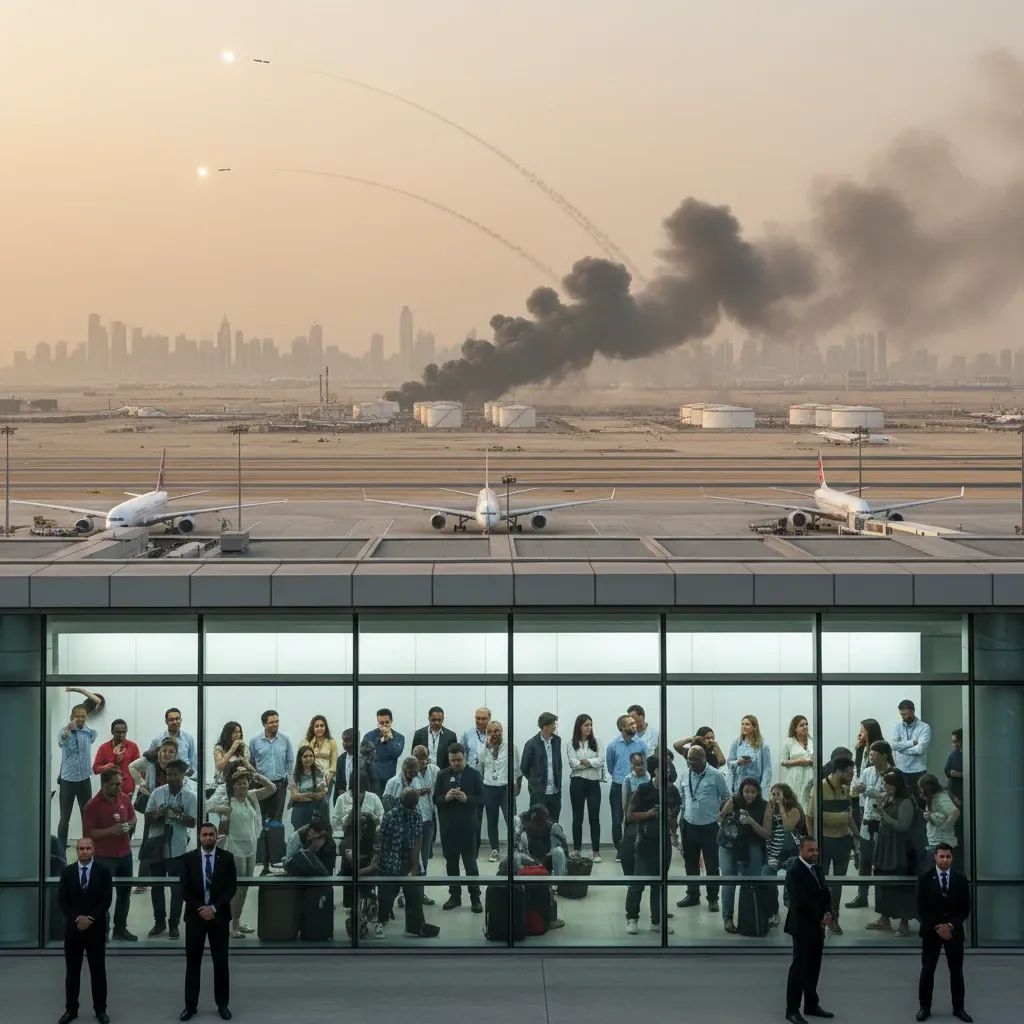
An unidentified drone struck a floating liquefied natural gas facility at Egypt's Damietta Port on July 29, triggering an immediate fire that spread to a neighboring tanker—an incident that will likely ripple through Thailand's energy markets and household budgets within the coming month as global crude prices spike and risk premiums compound.
Why This Matters
• Immediate market reaction: Brent crude surged more than 8% above $90 per barrel, the sharpest jump since early 2024, signaling trader anxiety about sustained supply disruptions.
• Thai import vulnerability: Nearly one-quarter of Thailand's natural gas arrives as LNG from Middle Eastern suppliers; any prolonged disruption cascades into electricity rates and retail fuel prices.
• Investigation stalled: No credible group has claimed responsibility, though circumstantial timing points to state-level actors in the broader U.S.-Iran proxy confrontation.
• Port resilience tested: Emergency response was swift, but the precedent of striking stationary energy terminals has rattled the insurance and shipping industries.
The Incident and Immediate Response
The Energos Winter, a floating storage and regasification vessel registered to U.S. interests, was struck while docked. The impact ignited a substantial fire that engulfed the ship and spread to the adjacent Gaslog Salem, another LNG carrier anchored nearby. Egyptian emergency crews evacuated personnel from both vessels, treated minor injuries at dockside, and contained the blaze within hours. Authorities relocated the damaged vessels offshore to clear the main terminal, and shipping operations resumed by early morning on July 30.
The Egypt Ministry of Petroleum released a terse official statement: a fire had broken out aboard two gas tankers and a fertilizer vessel at the port, with emergency teams responding immediately and port operations continuing. The ministry stopped short of confirming a deliberate attack. However, Ambrey, an independent maritime security firm, assessed the damage pattern consistent with a drone strike, not mechanical failure. The timing, precision, and scope of the fire ruled out standard engine-room malfunction, according to several maritime analysts consulted informally.
The Attribution Puzzle
No militant group or state has formally claimed the strike. Yet the context is impossible to ignore. Forty-eight hours before the attack, Iranian state television broadcast a map flagging Damietta as a potential retaliation target for what Tehran described as "Ukrainian interests," following a Ukrainian drone operation against an Iranian vessel in the Caspian Sea. When the U.S. inquiry came, President Trump alluded to Iranian involvement without naming the country directly, signaling confidence among U.S. intelligence officials.
The attack arrives amid a widening pattern of infrastructure assaults across the Middle East. Since November 2023, Houthi forces in Yemen have orchestrated over 50 documented strikes on commercial vessels transiting the Red Sea and Gulf of Aden. In July alone, the group announced expanded targeting protocols to include Saudi Arabian ports alongside existing threats to Israeli-linked shipping—a geographic expansion suggesting tactical ambitions beyond single-actor operations. Iran-backed militias in Iraq and Syria have concurrently targeted U.S. military compounds, while Israeli forces have conducted retaliatory strikes on Iranian facilities and proxy positions in Lebanon and Syria.
For most observers, Damietta represents the conflict's migration from contested waters into sovereign territory. The port sits in what should be secure Egyptian airspace; drones capable of navigating that distance suggest either drone range improvements, locally embedded operators, or both. The fact that the target was stationary infrastructure—not a transiting vessel—signals a tactical shift toward high-value infrastructure rather than opportunistic maritime targets.
Energy Markets and Global Implications
The eight-percent crude spike occurred within minutes of confirmed reports. Brent crossed $90 per barrel for the first time since March 2024, dragging West Texas Intermediate with it. European natural gas benchmarks spiked 12%, reflecting supply anxiety across the continent's winter preparedness cycle.
Damietta is no peripheral facility. It is one of Egypt's two operational LNG export terminals (the other being Idku, 200 kilometers northwest). Together, they handle both Egyptian domestic gas and imported Israeli gas destined for Europe and Asia-Pacific buyers. The combined capacity exceeds 2 billion cubic feet per day—a volume that, if disrupted for weeks, would tighten liquidity across global LNG markets and push import costs upward.
Europe's strategic pivot away from Russian gas since 2022 has made facilities like Damietta indispensable. The continent now depends on diversified LNG supply chains, and any disruption—or even the perception of vulnerability—triggers repricing across all import terminals. Asia, including Thailand, shares that exposure: when risk premiums climb in Europe, Thai importers purchasing LNG at international benchmarks face higher bills.
Thailand's Energy Equation and Household Impact
Thailand's electricity grid relies on natural gas for roughly 40% of generation, with LNG accounting for nearly 25% of total supply. The remainder comes from domestic reserves and coal. When global LNG prices rise, the Thailand Energy Regulatory Commission adjusts tariffs to reflect the higher benchmark costs. This cycle has played out three times already in 2026: April, June, and a modest adjustment in late July that preceded this incident.
For households, the translation is straightforward: a 10% increase in LNG import costs translates into a 1-2% jump in residential electricity tariffs within 60 days, assuming no offsetting adjustments to other fuel sources. For those on fixed incomes—retirees, remote workers on dollar contracts—that increase directly reduces purchasing power. For businesses reliant on natural gas feedstock—petrochemicals, fertilizers, plastics manufacturing—the squeeze reduces margins immediately.
Airlines operating in Thailand face added pressure: fuel surcharges will rise, raising ticket prices for both leisure and business travel. Freight forwarders will adjust shipping rates upward. The consumer impact compounds: groceries reflect transport-cost inflation, utilities eat into savings, and discretionary spending shrinks.
A Broader Tapestry of Regional Tension
The Damietta strike is not an isolated incident but rather a data point in an intensifying pattern. Over the past 18 months, the Middle East has experienced a documented escalation in infrastructure targeting:
In July 2025, Houthi forces sank the Magic Seas and Eternity C in the Red Sea's southern approaches, killing four sailors. A month later, they struck a Saudi-flagged vessel off Yemen's coast—the northernmost attack in their campaign to date, expanding the theater of operations. After a pause linked to Gaza ceasefire negotiations in early 2026, attacks resumed in March. By late July 2026, the group had announced a formal blockade on Saudi Arabian Red Sea ports, a direct challenge to one of the region's most powerful states.
The cumulative effect is a creeping risk premium baked into energy pricing. Insurers now calculate higher premiums for vessels calling at Egyptian, Saudi, and Israeli ports. Traders account for potential disruptions that haven't occurred yet. The pricing mechanism anticipates future strikes, not merely responding to current ones.
How Disruption Spreads Through Consumer Prices
The path from Damietta to Bangkok petrol stations is indirect but mechanical. When Brent crude rises, contract prices for LNG shipments settle at higher levels 30-60 days later, depending on delivery terms. Thai importers must absorb that cost. The Thai Energy Regulatory Commission reviews tariffs quarterly, with adjustments applied to the next billing cycle. Airlines adjust fuel surcharges immediately; oil marketing companies follow within 7-10 days for retail pricing.
Within a month, a Bangkok commuter filling a 50-liter tank would see an additional 20-40 baht (60 cents to $1.20) compared to pre-incident pricing. A household running air conditioning 8 hours daily would see electricity bills rise by 100-150 baht ($3-4.50) within the billing period. Groceries reflect transport cost increases. The effect is real, measurable, and felt across income groups.
The Precedent and Future Risk
What distinguishes Damietta from Red Sea shipping strikes is the permanence. Ships transit a dangerous zone and emerge; terminal infrastructure is fixed. Once stakeholders accept that stationary energy facilities are targetable, the calculus changes. Insurers adjust rates. Operators deploy additional security. Traders price in volatility.
Ambrey, the firm that assessed the strike, noted in preliminary analysis that the attack "signals willingness to expand targeting beyond maritime commerce." This assessment matters because it influences underwriting decisions. If underwriters believe Damietta, Idku, or Ras Lanuf (Libya's major export terminal) face elevated risk, they raise premiums, which flows directly into import costs.
Official Response and Restoration
The Egypt Ministry of Petroleum moved quickly to reassure international markets. Within 12 hours of the incident, officials confirmed that the port remained operational, that cargo schedules would be maintained, and that vessel repairs would proceed offshore. This rapid communication matters: it signals to insurers that operational disruption is contained and that future disruption risk is manageable.
However, confidence and reality have a gap. Insurers have already received notice that previously "safe" Mediterranean and Red Sea terminals are now potential targets. This shift in perception, once established, does not reverse quickly. It takes months of incident-free operations to rebuild underwriting confidence, and even then, risk premiums remain elevated relative to pre-incident levels.
Looking Forward: Stability and Volatility
The Damietta strike will not permanently disrupt Egypt's LNG exports; backup capacity and rapid repairs ensure that. But the precedent it sets—that stationary energy infrastructure is fair game in regional proxy conflicts—will shape energy market dynamics for quarters to come. Each subsequent week without a follow-up attack will marginally ease market anxiety. Each indication of expanded targeting will reignite it.
For people living in Thailand, the practical implication is straightforward: energy costs will remain volatile through the end of 2026, with upward bias whenever Middle East tensions spike. Household budgets should assume higher electricity and fuel bills as baseline costs, not anomalies. Businesses dependent on stable energy inputs should consider hedging strategies or contractual flexibility. The region's infrastructure is now part of the proxy battlefield, and Thailand's import economy will absorb the cost.


