
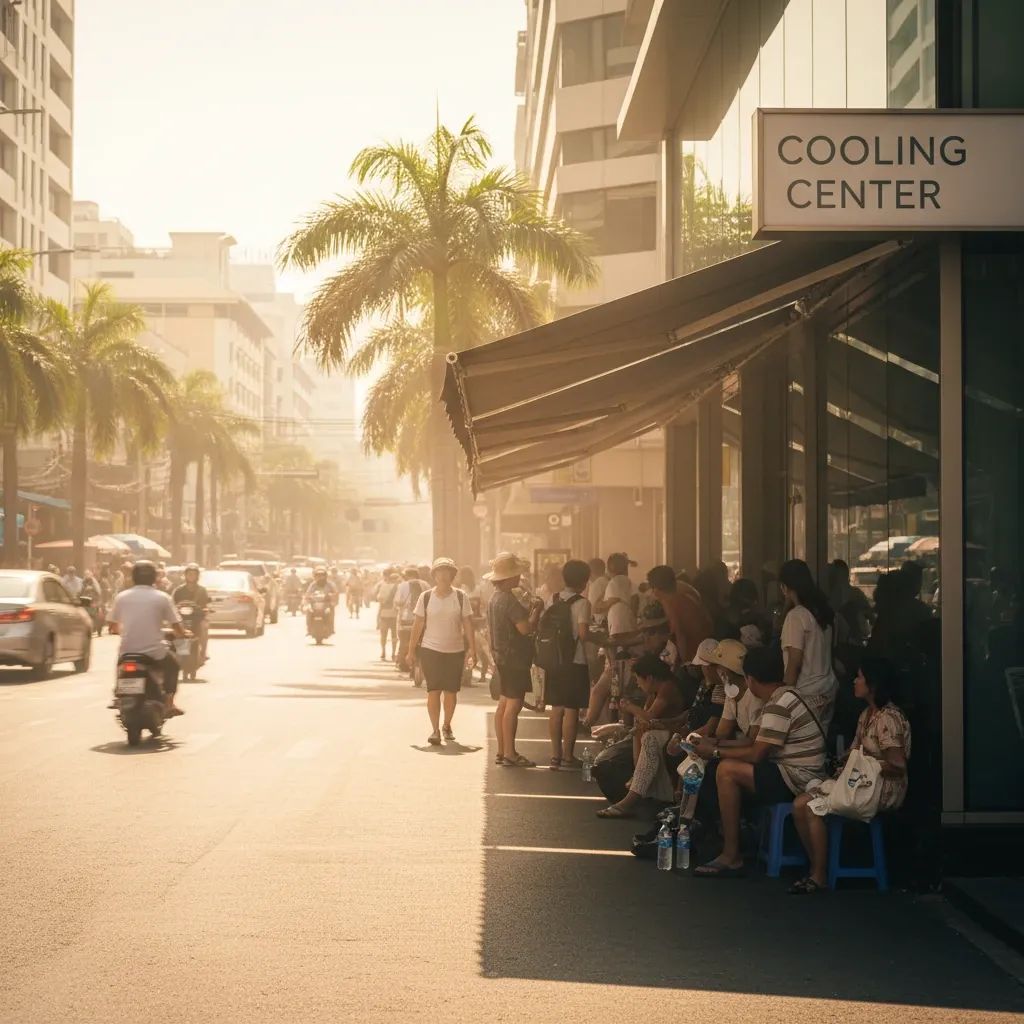
The Thailand government may soon look eastward for solutions to its own escalating heat crisis: Japan has deployed walk-in cooling chambers priced at ¥1.5M ($9,230) across workplaces and at least one city hall, offering workers and the public a five-minute respite that can drop body temperature enough to stave off heat exhaustion. The "Do Hiemon Box," as it's officially known, reflects a hardening reality for Asia's tropics—extreme heat is no longer a seasonal inconvenience but a year-round occupational and public health emergency requiring dedicated infrastructure.
Why This Matters
• Workplace safety focus: Japan prioritized heatstroke prevention at job sites, with reports suggesting significant reductions in workplace heat-related incidents—a model Thailand's Ministry of Labour could potentially adapt as outdoor construction and agriculture drive the national economy.
• Cost versus crisis: The booth's price tag is steep, but Japan has experienced severe heat-related casualties in recent years, and prevention infrastructure could help avoid costly health crises. Thailand could face similar arguments for investment.
• Portable and grid-friendly: The chamber runs on household voltage, consumes half the power of a spot air conditioner, and requires no permanent installation, making it viable for Bangkok construction sites, provincial factory yards, and open-air markets.
• Free public access pilot: Maebashi City Hall in Gunma Prefecture installed one unit as a walk-in service for residents—an approach that could translate to Thailand's district offices, bus terminals, or provincial hospitals during the hot season.
How the Technology Works
SDRS, a Japanese refrigeration specialist best known for vending machines, reverse-engineered the concept: if a soft-drink dispenser can hold cans at 5°C in 40°C ambient heat, why not scale the chamber to human size? The resulting booth stands two meters tall, weighs 293 kg, and rolls on lockable casters. Inside, the ambient air hovers at 15°C, while precision jets blast 5°C air at the head, neck, shoulders, and back—the body's primary heat-shedding zones.
Users step in fully clothed. Within five minutes, skin temperature drops noticeably; after ten minutes, core body temperature declines enough to relieve dizziness, nausea, and the early confusion that signals heat exhaustion. The system offers three fan speeds and shuts off automatically after 20 minutes to prevent shivering or cold shock when workers return to scorching outdoor conditions. The interior is stainless steel with polystyrene insulation and carries an IPX3 weather rating, meaning it can withstand spray from any angle—critical for deployment at open construction sites during the monsoon.
Operating cost runs roughly 16 yen per hour (about 4.50 baht), and the booth plugs into a standard 100-volt socket, the same supply used for office coffee makers. Trusco Nakayama, the industrial-equipment distributor handling sales, positions the unit squarely at businesses rather than households: factories, warehouses, outdoor-event organizers, and civil-engineering contractors are the primary buyers.
Real-World Deployment and Early Adoption
Only launched in April 2026, the Do Hiemon Box has already appeared at Maebashi City Hall as a free public amenity, effectively treating climate adaptation as a municipal service akin to drinking fountains or public toilets. Elsewhere in Japan, the Ikebukuro district is piloting a "Cool Place Project" that combines misting systems, spot coolers, greenery, and at least one walk-in chamber as part of a layered defense against the urban heat island effect.
The Japan Meteorological Agency underscores urgency by tracking extreme heat trends, with Japan setting ambitious targets to reduce annual heatstroke casualties in coming years. The motivation is clear: extreme temperatures have disrupted productivity across multiple sectors and driven a reassessment of workplace safety protocols.
What This Means for Thailand
Thailand faces similar heat challenges, particularly for outdoor laborers, street vendors, and vulnerable populations during peak seasons. The country could benefit from examining Japan's hardware-first approach to heat mitigation.
The Do Hiemon Box model suggests three actionable pathways worth considering:
Regulatory approach: Thailand could consider mandating cooling breaks—backed by portable infrastructure—at large construction sites and industrial parks, mirroring approaches emerging in heat-affected nations. Thailand's Ministry of Labour already requires shade and drinking water; adding a cooling-chamber provision could be a logical next step for major projects.
Public-sector pilots: Installing units at provincial health centers and high-footfall markets in the central plains and northeast could serve residents during peak heat months. A single booth could serve hundreds of people weekly while remaining relatively inexpensive to operate.
Private-sector partnership: Thailand's Board of Investment might consider import incentives for companies deploying certified cooling infrastructure. Local manufacturers already producing walk-in cold rooms for food logistics could potentially adapt the Japanese design, bringing costs down through regional supply chains.
Alternative Approaches and Their Limits
Japan's booth exists within a broader ecosystem of heat-mitigation tools, each with distinct trade-offs that matter for Thailand's employers and municipal planners.
Cooling vests—whether evaporative, phase-change, or battery-powered—offer continuous protection but lose effectiveness in high humidity. Evaporative models, popular in the Middle East, provide minimal relief once relative humidity exceeds 70%, a daily occurrence in Bangkok from May through October. Phase-change vests require refrigeration between shifts, adding logistical complexity. Ice-pack vests deliver intense but brief cooling—roughly 60 minutes—and weigh several kilograms when frozen, impairing mobility for physically demanding tasks.
Misting fans can drop perceived temperature in arid climates but struggle in the tropics, where ambient humidity inhibits evaporative cooling. Portable air conditioners consume more than double the electricity of the Do Hiemon Box, exhaust waste heat that worsens conditions for nearby workers, and require window venting or ductwork—impractical at active construction sites.
Wearable neck fans and thermoelectric coolers provide localized comfort but cannot reverse core-temperature rise once heat exhaustion begins. The walk-in booth, by contrast, addresses the body as a system, targeting the carotid arteries, spine, and shoulder girdle simultaneously—precisely the intervention needed when a worker reports confusion, cramping, or cessation of sweating.
Broader Lessons for Heat Management
Japan's shift toward dedicated heat infrastructure reflects a recognition that awareness and individual behavior change alone cannot solve the problem. The result: physical infrastructure designed to make safety automatic rather than dependent on voluntary compliance.
Thailand could consider similar integrated approaches. A cooling booth at a Nakhon Ratchasima construction site addresses immediate needs; paired with tree cover, reflective pavement, and flexible work schedules, it becomes part of a durable system. The Bangkok Metropolitan Administration has piloted cool-pavement coatings in select areas; adding walk-in coolers at health stations would complement such efforts.
Extreme heat is reshaping work and life across Asia. Japan's experience suggests that waiting for individual or organizational adaptation is costly. By investing in proven infrastructure now, Thailand could protect its workforce and economy from preventable heat-related crises while the technology is still emerging and adaptable to local conditions.


