
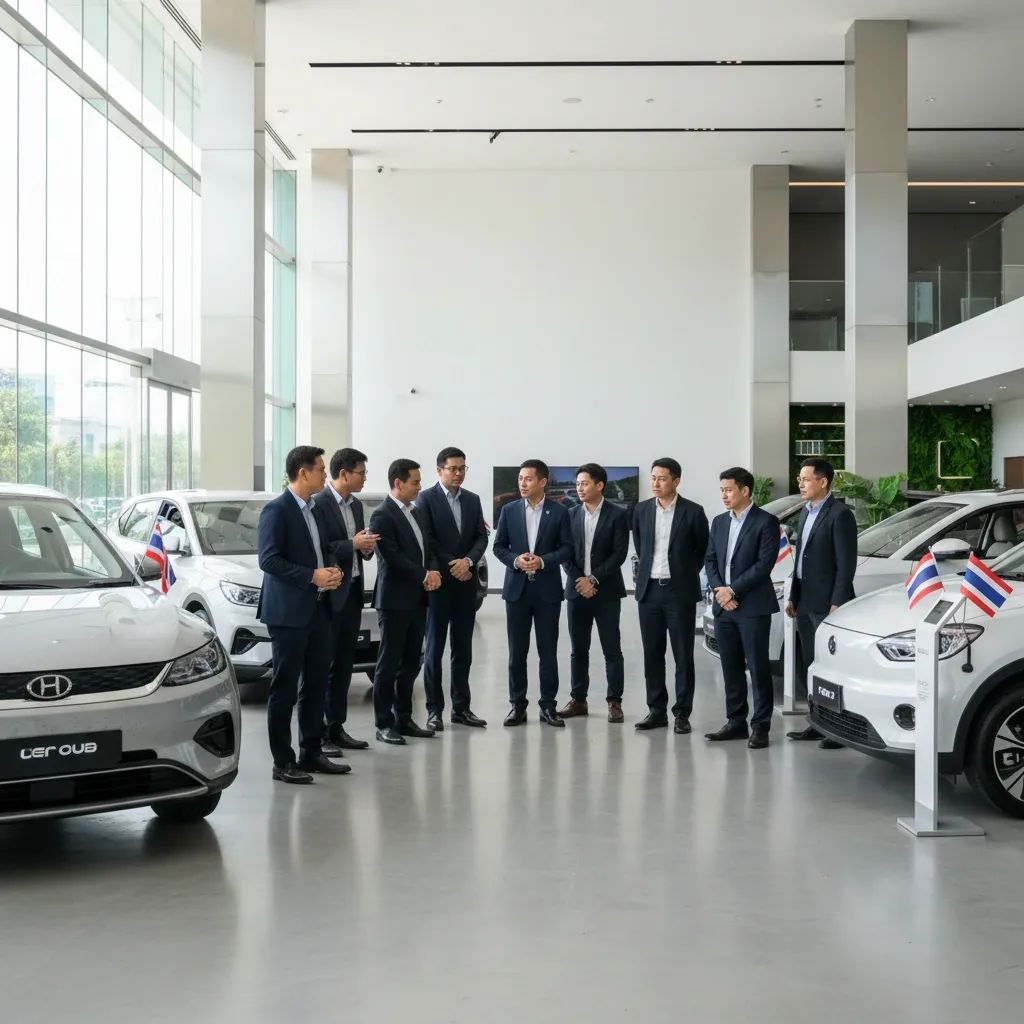
Thailand's Ministry of Finance is preparing to roll out a limited vehicle scrapping program, with rollout expected before the end of 2026, reserving the first 20,000 slots for drivers willing to retire an old combustion vehicle and switch to a domestically-manufactured electric or hybrid alternative. The initiative—part of the government's broader EV 3.5 policy framework (a tax and tariff incentive scheme designed to accelerate electric-vehicle adoption through 2026)—marks a significant pivot from subsidizing pure vehicle purchases to incentivizing fleet replacement, a move analysts say could reshape buying behavior if the economics prove favorable.
Why This Matters:
• First-come access: Only 20,000 households will qualify in the program, meaning early applicants gain an advantage.
• Local production only: The replacement vehicle must be built in Thailand, limiting choice but protecting domestic assembly jobs.
• Soft loans available: Government Savings Bank (GSB) is expected to deploy a credit facility with rates capped at 3.5% for the first two years, rising to 5% thereafter.
• PM 2.5 angle: The program doubles as an air-quality measure, targeting older vehicles that contribute disproportionately to Bangkok's fine-particle pollution.
What Qualifies and What Doesn't
While the Thailand Excise Department is still finalizing eligibility rules, early guidance suggests that combustion-engine vehicles older than 15 years will be prioritized for scrapping. Owners will surrender their registration in exchange for a government-backed subsidy, which flows through the automaker as a point-of-sale discount rather than a reimbursement. That structure mirrors Malaysia's vehicle scrapping incentive (VSI), which offers up to 8,000 ringgit (approximately ฿80,000) for retiring cars over two decades old—though Malaysia limits the benefit to domestic marques like Proton.
In Thailand's case, the subsidy amount has not been officially announced. Industry observers expect it to fall somewhere between ฿50,000 and ฿100,000 per vehicle, layered on top of the existing EV 3.5 manufacturer rebate that slides from ฿100,000 in 2024 to ฿50,000 in 2026 for battery-electric passenger cars. The cumulative discount could bring certain Thai-assembled EVs within reach of middle-income households, provided they can secure financing.
Hybrid and plug-in hybrid models will also qualify, a concession to consumer anxiety about charging infrastructure. Suraphong Paisitpattanapong, spokesperson for the Federation of Thai Industries' automotive club, praised that flexibility, noting that many buyers still regard pure EVs as impractical outside urban centers where fast-charger networks remain sparse.
Budget Reality and the EV 3.5 Squeeze
The scrapping program arrives as direct EV subsidies taper under the EV 3.5 timeline. In 2023, the government paid ฿150,000 per unit under the now-expired EV 3.0 scheme; that figure shrank to ฿100,000 in 2024 and will drop to ฿50,000 by the end of 2026. Over the life of EV 3.0, the Thai cabinet disbursed roughly ฿19 billion to support 134,000 registrations, with an outstanding obligation of another ฿7.1 billion still flowing through the pipeline.
The new trade-in mechanism is designed to allow the Finance Ministry to sustain sales momentum for local assembly plants operated by BYD, Great Wall Motor, SAIC-MG, and legacy brands like Toyota and Honda, which have committed more than ฿80 billion in combined EV-related capital expenditure.
Deputy Prime Minister Aekkanit Nitithanprapas framed the scheme as fiscally prudent, arguing that a capped quota prevents runaway spending while still delivering measurable air-quality gains. Yet the modest 20,000-unit ceiling means the program will touch less than 0.2% of Thailand's roughly 12 million registered passenger vehicles, raising questions about whether it can catalyze broader fleet turnover or merely cherry-pick the easiest retirements.
Impact on Expats and Long-Term Residents
For foreign nationals living in Thailand, the scrapping initiative presents both opportunity and friction. Watch for these factors when eligibility rules are finalized: Vehicle ownership and registration are expected to be key requirements. Expats holding a valid Thai driver's license and a car registered in their name—or a Thai spouse's name—would likely qualify, assuming the vehicle meets the age threshold.
The GSB soft-loan program typically requires proof of income and Thai tax residency. If these criteria apply, the program could exclude retirees on pension visas or digital nomads without formal employment contracts. Confirm these requirements directly with GSB when the program launches.
The "manufactured in Thailand" clause further narrows the playing field. Popular imports—Tesla Model 3, Volvo EX30, BMW iX—remain ineligible, even if they carry lower sticker prices than some Thai-assembled alternatives. That protects jobs at the Eastern Economic Corridor plants but frustrates buyers who prioritize global nameplates or specific feature sets unavailable in locally built models.
On the positive side, the program accelerates depreciation for used combustion vehicles. Owners of aging pickups—Isuzu D-Max, Toyota Hilux Vigo—may find scrapping financially attractive if the combined subsidy and trade-in value exceed private resale prices, which have softened as Thailand's 10% EV sales penetration reshapes the secondary market.
Regional Comparison: Thailand Versus Neighbors
Thailand's approach sits between aggressive and cautious when benchmarked against Southeast Asian peers. Malaysia's VSI offers a larger per-unit incentive but restricts it to national brands, effectively functioning as industrial policy rather than environmental reform. Indonesia has so far eschewed scrapping altogether, instead extending its low-cost green car (LCGC) program through 2031—a decision that environmental groups criticize as prolonging the internal-combustion era.
Vietnam has set a 2030 deadline for phasing out substandard vehicles and mandates that automakers take back end-of-life cars for recycling, shifting disposal costs to manufacturers. Cambodia recently eliminated import duties on EVs and is studying a three-wheeler scrapping scheme to reduce urban emissions. Laos cut EV registration fees by 30% and temporarily banned imports of certain gasoline passenger cars to conserve foreign reserves, though infrastructure gaps remain acute.
What distinguishes Thailand is the production-localization requirement: every scrapped combustion vehicle must be replaced by a Thai-assembled clean car, a linkage that no neighbor enforces as strictly. That tilts benefits toward established assembly hubs—Rayong, Samut Prakan, Chonburi—but risks leaving rural buyers with fewer affordable options.
Challenges: Scrap Management and Market Distortion
The logistics of handling 20,000 retired vehicles pose nontrivial questions. The Excise Department has floated the idea of exporting salvageable units to markets where 15-year-old cars retain utility—Myanmar, Laos, parts of Africa—while channeling true end-of-life hulks to licensed scrap yards. Yet Thailand lacks a comprehensive vehicle-recycling framework of the kind Vietnam is building, and informal dismantlers often siphon parts into gray channels, undermining environmental objectives.
Suraphong of the Thai Industries federation warned that poorly designed age cutoffs could strand commercial-vehicle owners. Pickup trucks dominate rural and small-business fleets, yet only a handful of Thai-built electric pickups—BYD Shark, Skywell ET5—are available, and most carry price tags north of ฿1 million, well above combustion equivalents even after subsidies.
There is also the used-car ripple effect: pulling 20,000 older vehicles off the road tightens supply in the budget segment, potentially raising prices for low-income buyers who cannot afford—or do not qualify for—the scrapping incentive. Policymakers must weigh whether accelerating EV adoption among the top quartile justifies reducing mobility options for everyone else.
What Happens Next
The Excise Department is expected to publish final rules—eligibility thresholds, subsidy amounts, application procedures—by mid-2026, with registration opening shortly thereafter. Given the first-come, first-served structure, prospective applicants should prepare documentation in advance: vehicle registration card (blue book), proof of ownership, national ID or passport, proof of address.
Dealerships are already positioning inventory. BYD Thailand recently expanded its Atto 3 and Dolphin production lines, while Great Wall Motor ramped output of the Ora Good Cat. Hybrid players—Toyota Corolla Cross HEV, Honda CR-V e:HEV—are also courting scrapping-eligible buyers, betting that range anxiety will push fence-sitters toward plug-free electrification.
The GSB loan window is expected to run through March 31, 2027, offering up to ฿2 million per borrower over a five-year term. Rates are projected to start at 3.5% for years one and two, then rise to 5%—competitive by Thai standards but still a financing hurdle for households with limited credit history.
Industry watchers caution that 20,000 units may prove symbolic rather than transformative. Thailand's automotive sector produced 1.9 million vehicles in 2025, of which roughly 190,000 were EVs or PHEVs. A scrapping scheme that retires one percent of annual output will nudge the needle but not fundamentally alter fleet composition unless future phases scale the quota into six figures.
The Bottom Line
Thailand's vehicle scrapping program offers a tangible financial path for owners of aging combustion cars to step into a Thai-built EV or hybrid, backed by preferential credit and a point-of-sale subsidy. The 20,000-unit cap ensures fiscal discipline but limits reach, and the domestic-production requirement narrows choice. For residents weighing whether to wait or act, the calculus turns on three variables: the final subsidy amount, the trade-in value of your current vehicle, and whether a locally assembled model meets your needs. Those who move early will secure a slot; those who hesitate may find the quota exhausted within weeks of launch, leaving them to navigate the next phase of Thailand's EV transition without direct government support.


