
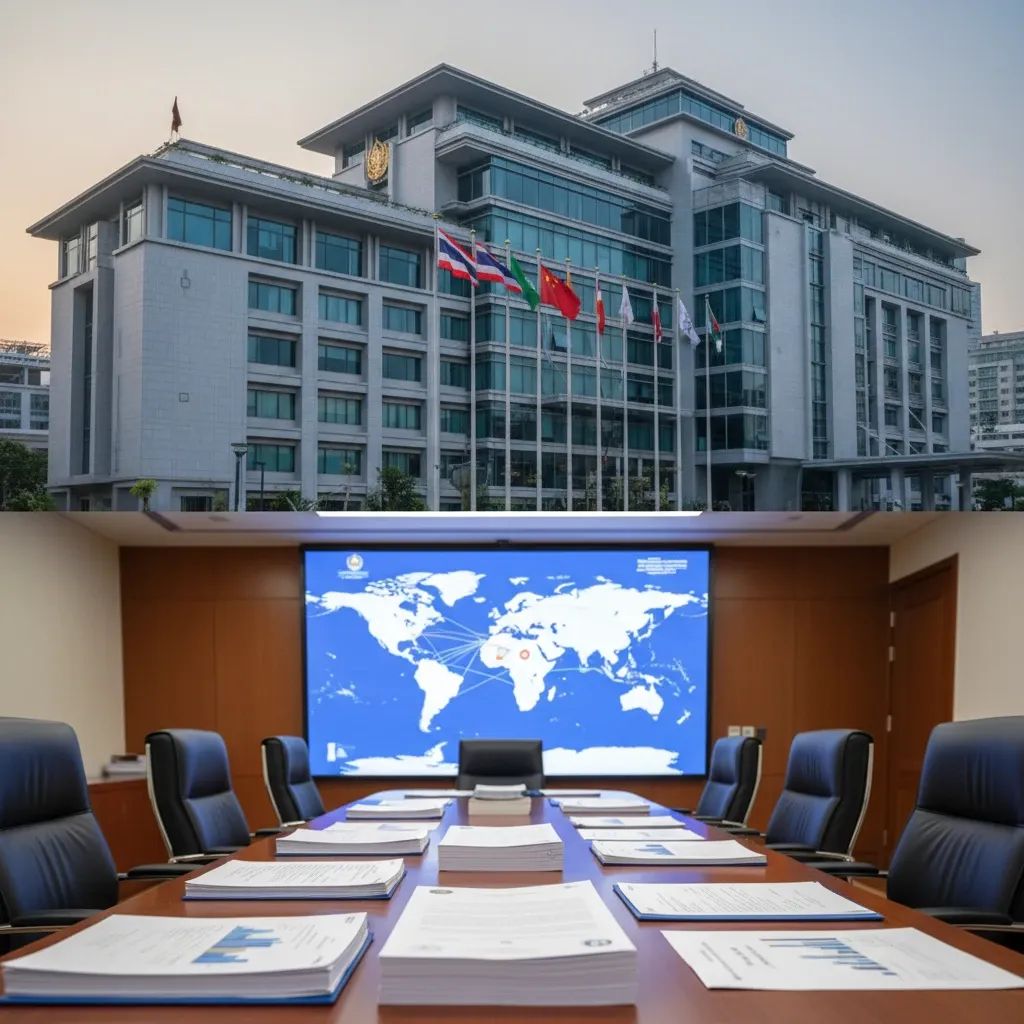
The Thailand Ministry of Foreign Affairs has rolled out a sweeping overhaul of the country's foreign policy framework. In April 2025, Foreign Minister Sihasak Phuangketkeow unveiled the initiative, branded "Thai Diplomacy 2.0," a shift designed to position Bangkok as a more assertive player amid intensifying global fragmentation and regional friction. The strategy pivots away from reactive crisis management toward a coordinated, forward-looking approach that ties diplomatic clout directly to economic competitiveness and national security.
Why This Matters:
• Economic focus: The diplomatic reset prioritizes science, trade, and innovation as core pillars, targeting emerging markets in Central Asia, the Gulf, and Africa.
• Balanced neutrality: Thailand reaffirms its "bamboo diplomacy" stance—a term referring to Thailand's historical flexibility in foreign relations, bending with prevailing winds without breaking allegiances—avoiding alignment with either Washington or Beijing while leveraging ties with both.
• Regional stability: The plan addresses Myanmar's turmoil, border tensions with Cambodia, and transnational crime networks that directly affect Thai security and commerce.
• Public accountability: A new emphasis on communication and coherence aims to make foreign policy tangible for ordinary Thais, linking global engagement to domestic benefits.
Four Pillars of the Reset
Foreign Minister Sihasak Phuangketkeow framed the reset around four operational pillars, each designed to overcome what officials acknowledge was a prolonged period of domestic political instability that hobbled consistent diplomatic execution.
Strategy
Strategy replaces ad hoc problem-solving with medium and long-term agendas. The ministry is moving away from a model where embassies primarily manage consular crises toward one where diplomatic missions actively scout investment opportunities, negotiate bilateral agreements, and coordinate with domestic agencies on industrial policy.
Speed
Speed addresses the reality that crises—from energy shocks to humanitarian emergencies—now unfold in real time. The ministry has established a "war room" to monitor flashpoints, particularly in the Middle East, where tens of thousands of Thai migrant workers remain vulnerable to regional conflict. The goal is to reduce response time for evacuations, travel advisories, and protective measures.
Coherence
Coherence tackles a long-standing weakness: fragmented messaging and overlapping mandates across ministries. Under a "Team Thailand" model, the Foreign Ministry, Commerce Ministry, and Ministry of Higher Education, Science, Research, and Innovation will coordinate on trade missions, technology partnerships, and diplomatic outreach. Thai embassies will now function as economic development hubs, not just consular offices.
Communication
Communication represents a cultural shift. Sihasak emphasized that foreign policy must be "meaningful and tangible" to the Thai public, not an elite preoccupation. The ministry plans regular briefings, public engagement campaigns, and clearer explanations of how international agreements affect jobs, prices, and security at home.
Economic Diplomacy Takes Center Stage
The reset's most tangible component is its economic ambition. Thailand is pushing to finalize stalled trade negotiations, including the Thailand-EU Free Trade Agreement by year-end and the ASEAN-Canada FTA by 2026. The plan also targets new pacts with the United Arab Emirates, Pakistan, Turkey, and Bangladesh, reflecting a deliberate effort to diversify beyond Asia.
Central to this is a bet on science and innovation diplomacy. The ministry is collaborating with the Higher Education, Science, Research, and Innovation Ministry to elevate Thailand's profile in semiconductors, artificial intelligence, the wellness economy, and green energy technologies. Officials want Thai firms and research institutions embedded in global supply chains for chips, biotech, and renewable energy—sectors where regional competitors like Vietnam and Indonesia are already making inroads.
The push into Central Asia and the Gulf Cooperation Council is particularly notable. These regions offer energy security—critical given Thailand's dependence on imported oil and gas—and access to capital for infrastructure projects. The ministry has opened channels with Kazakhstan, Azerbaijan, and Russia for energy deals, and is using Oman as a diplomatic back door to Iran to ensure safe passage of energy shipments through volatile maritime routes.
Navigating Regional Flashpoints
Thailand's geographic position means regional instability translates directly into border security risks, refugee flows, and disrupted trade. The diplomatic reset acknowledges this with specific focus on neighboring challenges.
On Myanmar, where military rule and armed resistance have created a humanitarian catastrophe, Thailand is signaling a pragmatic re-engagement with the junta while keeping channels open to ethnic armed groups along the border. Border provinces like Mae Hong Son, Tak, and Chiang Rai face direct exposure to cross-border crime, narcotics trafficking, and displaced populations that strain local resources. These conditions can affect travel patterns and security for residents near border crossings.
The Cambodia border remains a friction point. While relations have thawed since the temple disputes of the 2000s, territorial sensitivities persist. The reset plan emphasizes "security and joint development" as twin priorities, suggesting Bangkok will seek formal mechanisms to manage border tensions before they escalate.
On the South China Sea, Thailand—though not a claimant—has staked out a position as a dialogue facilitator. As a former ASEAN-China country coordinator, Bangkok is pushing for concrete progress on a Code of Conduct, framing it as a regional stability issue rather than a binary US-China contest.
The Balancing Act with Major Powers
Thailand's foreign policy has long been described as "bamboo diplomacy"—maintaining flexibility while preserving core relationships. The reset reaffirms this approach but with sharper definition.
Bangkok maintains a formal alliance with Washington, including annual military exercises and extensive intelligence-sharing. Yet it has deepening economic ties with Beijing, which remains Thailand's largest trade partner and a major source of tourists and investment.
According to ministry officials, the new approach seeks to increase bargaining power by clearly defining national interests and playing both sides strategically. Officials have signaled a more "nationalist" tone toward China, particularly on issues like Mekong water management and the influx of Chinese-owned casinos in border zones. At the same time, Thailand is adopting a more "pragmatic" posture toward the US, seeking technology transfers, defense upgrades, and trade concessions without signing on to security frameworks that would alienate Beijing.
What This Means for Residents
For expatriates, business owners, and long-term residents in Thailand, the diplomatic reset carries several practical implications, though many remain contingent on successful execution.
Trade and investment flows: According to ministry projections, trade barriers should decline if FTA negotiations with the EU, Canada, and Gulf states succeed. Easier customs procedures, mutual recognition of professional qualifications, and clearer intellectual property protections could reduce friction for foreign firms operating here.
Energy costs: Analysts suggest that Thailand's outreach to Gulf and Central Asian energy producers could stabilize prices or reduce vulnerability to global shocks. Thailand's heavy reliance on imported natural gas—which supplies much of the country's power generation—makes it vulnerable to supply disruptions; diversifying suppliers is intended as a hedge against price volatility.
Consular services: The emphasis on speed and coherence is a direct response to criticism that Thai embassies were slow to assist nationals during the pandemic and during crises in conflict zones. The "war room" model, if scaled beyond the Middle East, could mean faster evacuations and travel warnings.
Regulatory alignment: Thailand's pursuit of EU trade agreements may require adopting EU sustainability benchmarks, which could force changes in Thai labor, environmental, and corporate governance laws. This is a long-term play to attract high-value investment, but it means businesses operating here will face tighter compliance requirements.
Challenges and Skepticism
Whether "Thai Diplomacy 2.0" delivers depends on execution, not rhetoric. Thailand has announced ambitious diplomatic and economic plans before, only to see them stall in bureaucratic turf wars or evaporate with the next government reshuffle.
The "Team Thailand" model sounds elegant, but coordinating ministries with distinct mandates and entrenched interests is notoriously difficult. If the Commerce Ministry and Foreign Ministry clash over trade negotiating positions—or if the military pursues security arrangements that contradict diplomatic messaging—coherence collapses.
The emphasis on public communication is a significant bet. If the ministry can't demonstrate tangible benefits—lower prices, more jobs, safer travel—then the reset risks being dismissed as elite window-dressing.
The balancing act with major powers remains precarious. One miscalculation—a security pact that alienates Beijing, or economic concessions to China that trigger US sanctions—could leave Thailand worse off than before.
A Calculated Bet on Stability
At its core, the diplomatic reset is a bet that Thailand's current political stability—however fragile—offers a rare window to pursue a sustained foreign policy direction after years of drift. The subtext is clear: Bangkok believes it has fallen behind regional peers like Vietnam and Indonesia in leveraging diplomacy for economic gain, and it's scrambling to catch up.
For residents, the reset matters most where it intersects with daily life: energy security, trade facilitation, consular protection, and regional stability. If Thai embassies become genuine economic catalysts, if FTAs reduce costs for imported goods, if the government can navigate regional crises without getting pulled into great power conflicts—then "Thai Diplomacy 2.0" will have earned its branding.
If not, it will join the long list of Thai policy initiatives that sounded impressive at launch but faded into bureaucratic obscurity. The next 12 to 18 months will reveal which outcome is more likely.


