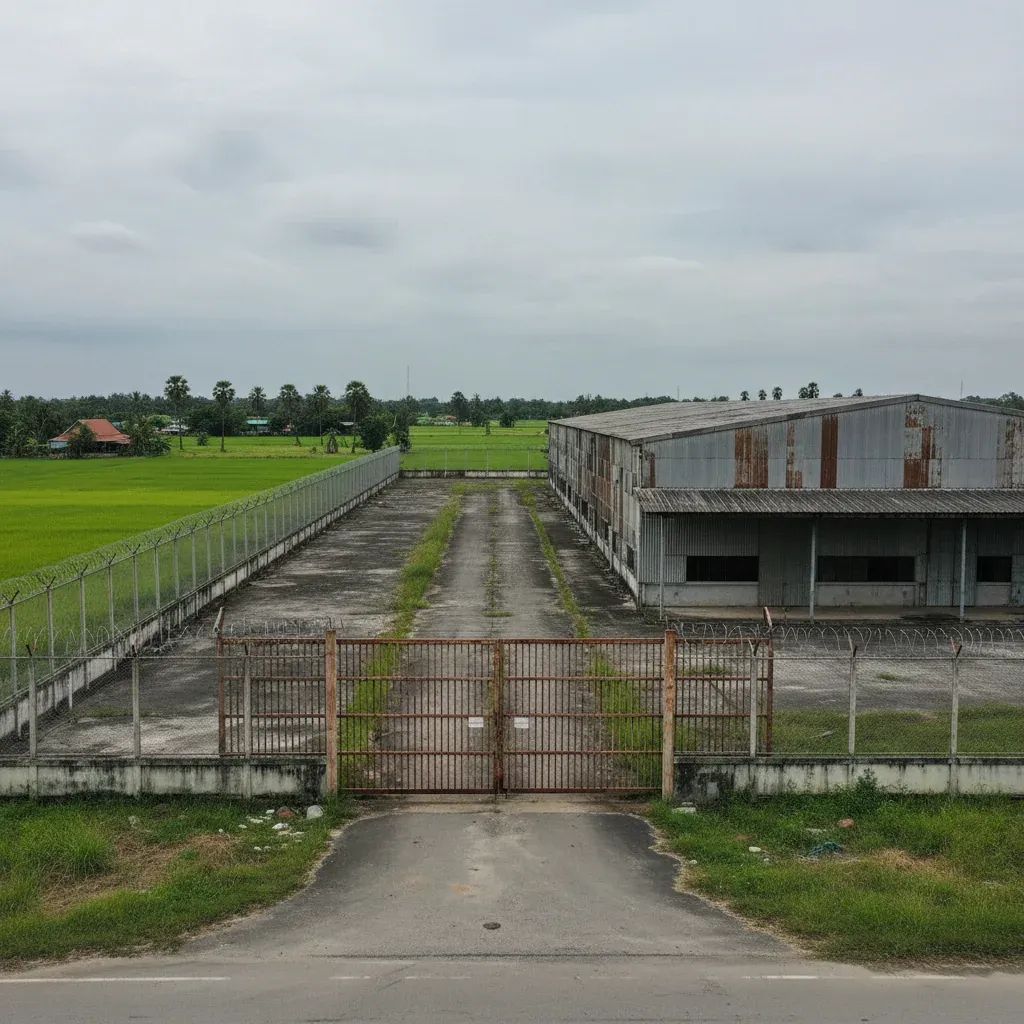
The Thailand Royal Police, alongside multiple enforcement agencies, executed a coordinated crackdown on a suspected foreign nominee scheme worth more than 5 billion baht in the coastal resort city of Pattaya, signaling an intensifying campaign to restore legal order to the country's chaotic property market and protect both foreign investors who follow the rules and Thai nationals from exploitation.
Why This Matters
• 775 luxury homes across 6 residential projects in Chonburi Province are now under investigation for illegal foreign ownership structures
• 4 Russian nationals arrested, with arrest warrants issued for 33 additional foreign shareholders suspected of using nominee arrangements
• 495 companies allegedly created to circumvent Thailand's foreign land ownership restrictions, with preliminary damage estimates reaching 235M baht from just 33 firms
• Two Thai accountants flagged for suspicious activity: one holding shares in 146 companies valued at 142M baht, another in 40 companies worth 74M baht
The Anatomy of a Nominee Network
On July 17, law enforcement from the Thailand Transnational Crime Suppression Center (ศปชก.ตร.) launched "Operation Foreign Nominee Network Phase 4," sweeping through 41 locations across Chonburi Province. The operation targeted what authorities describe as a systematic abuse of Thai corporate law, where Russian nationals allegedly partnered with Thai citizens and accountants to establish shell companies designed exclusively to hold property.
Under Thailand's Foreign Business Act and Land Code, non-Thai nationals face strict limitations on land ownership. The standard workaround involves registering a Thai limited company where Thai nationals hold 51% or more of shares. But investigators say the Pattaya network went further—creating an industrial-scale operation where Thai nominees had no genuine ownership stake, no involvement in business decisions, and in many cases, no knowledge of the foreign shareholders they were legally partnered with.
Police Commander Pol. Lt. Gen. Samran Nuanma, who directs the transnational crime unit, told reporters the operation aligns with national policy to eliminate foreign control disguised as Thai ownership. The crackdown extends prior nominee investigations in Phuket, Koh Samui, and Koh Phangan, where authorities uncovered similar patterns.
Russian Marketing and the "Russian Village"
A distinctive element of the Chonburi case involves brazen advertising on Russian-language websites, where properties in Pattaya were openly marketed as available for sale and long-term lease by Russian operators. One luxury development was explicitly branded as a "Russian village"—a designation that caught the attention of regulators who view such claims as evidence of de facto foreign control.
Investigators identified Mr. Bussia Yusup, whose family allegedly owns 6 homes within the targeted development, and another network linked to Mr. Igor. Both figures are part of a broader web connecting 435 foreign legal entities and 19 companies now confirmed to have nominee characteristics.
The Chonburi operation mirrors a May 2024 raid in Phuket, where authorities arrested Mrs. IANA, a Russian national serving as director and shareholder in 9 companies, and Ms. Tritip, a Thai national discovered holding shares in 272 companies with a combined value exceeding 268M baht.
What This Means for Residents and Investors
For foreign nationals living in Thailand, the crackdown serves as a stark reminder that nominee structures—no matter how common or widely marketed by lawyers and agents—carry serious criminal liability. Foreigners convicted of using or facilitating nominee arrangements face imprisonment, asset seizure without compensation, and potential blacklisting from future business activity in Thailand.
For Thai citizens, the risk is equally severe. Acting as a nominee violates the Foreign Business Act (Section 36) and carries penalties of up to 3 years imprisonment, fines ranging from 100,000 to 1M baht, or both. Properties held through illegal structures may be forfeited to the state.
For legitimate foreign investors, the enforcement wave offers a measure of reassurance. Authorities emphasized that Thailand welcomes foreign capital but insists on transparent, law-abiding ownership structures. Legal pathways exist: condominiums may be owned outright by foreigners within a 49% quota per building, provided funds are transferred from abroad in foreign currency with proper bank documentation (FET forms). Long-term land leases (up to 30 years with renewal options) remain a viable alternative for those seeking homes with land.
High-net-worth individuals who invest a minimum of 40M baht in approved Thai businesses and maintain that investment for at least 3 years may apply to purchase up to 1 rai of land for residential purposes, subject to approval by the Ministry of Interior.
How Authorities Detect Nominee Schemes
The Thailand Department of Business Development, Land Department, and Anti-Money Laundering Office now use AI-assisted cross-referencing to flag suspicious patterns:
• Thai shareholders with no verifiable source of capital
• Companies with no business activity beyond holding property
• Foreigners exercising de facto management control despite minority shareholding
• Funding streams entirely from foreign sources
• Accountants or agents appearing as shareholders in dozens or hundreds of unrelated companies
In Chonburi alone, authorities identified 76,343 registered legal entities with 28,463 foreign shareholders. Of these, 14,264 companies exhibit nominee characteristics. The provincial governor disclosed that roughly 350 companies clearly violate foreign land ownership laws, controlling 549 land parcels totaling approximately 1,100 rai, with an estimated baseline value exceeding 1.3 billion baht.
The Broader Economic and Legal Context
Nominee schemes undermine tax collection, market transparency, and economic stability. They distort property valuations, concentrate ownership in opaque structures, and fuel resentment among Thai citizens who see prime land effectively controlled by foreign nationals circumventing legal restrictions.
Thailand's government has made clear that enforcement will extend to law firms and accounting practices that advise clients on illegal nominee structures. Regulatory agencies are now coordinating at both the national and provincial levels, with task forces involving the Ministry of Commerce, Ministry of Finance, Bank of Thailand, Customs Department, and Excise Department.
Protecting Yourself: Practical Advice
For foreign buyers and investors considering property in Pattaya or elsewhere in Thailand:
• Engage a licensed Thai attorney specializing in real estate before signing any agreement or transferring funds
• Verify that real estate agents hold valid licenses from the Thai Real Estate Association; fake credentials and deposit scams have been reported in Pattaya as recently as April 2025
• Avoid nominee arrangements entirely, regardless of assurances from agents or developers that "everyone does it"
• For condominiums, ensure the foreign ownership quota has not been exceeded and obtain proper FET documentation for your bank transfer
• For land and houses, consider long-term leases rather than corporate ownership structures that carry legal risk
• Be wary of properties priced significantly below market—low prices often signal legal complications, poor construction quality, or unfavorable locations
For Thai nationals approached to serve as shareholders or directors in property-holding companies:
• Understand that you bear full criminal liability if the arrangement is later deemed a nominee structure
• Property held in your name may be seized by the state, even if you received no benefit
• Consult an independent lawyer before agreeing to hold shares in any company where you have no genuine investment or management role
Government's Balancing Act
Authorities have taken pains to emphasize that the crackdown targets illegal structures, not foreign investment. The Thai economy depends heavily on tourism, foreign direct investment, and the spending power of expatriates and retirees. But the nominee epidemic—concentrated in resort zones like Pattaya, Phuket, and Samui—has reached a scale that threatens regulatory credibility and fuels nationalist backlash.
The Chonburi operation represents the fourth phase of a nationwide initiative that began in 2024. Police have pledged to expand investigations and pursue all individuals involved, including any government officials found to have facilitated illegal transactions.
What Happens Next
Seized evidence—including corporate registries, accounting ledgers, computers, and mobile phones—will be analyzed to trace financial flows and identify additional network members. The 4 arrested Russian nationals face charges related to violations of the Foreign Business Act and Land Code. The 33 individuals named in outstanding warrants are expected to be summoned for questioning.
Properties found to be held through suspected illegal nominee structures will likely be subject to forced sale or state forfeiture. Legitimate buyers who unknowingly purchased into nominee-controlled developments may face uncertainty over title and valuation, underscoring the importance of rigorous due diligence before any property transaction in Thailand.
The enforcement wave has already reshaped the conversation among foreign residents and investors. Online forums and expatriate groups are filled with anxious questions about corporate structures, lease agreements, and the legal status of properties purchased years ago under arrangements that were once widely tolerated but are now subject to aggressive prosecution.
For those navigating Thailand's complex property landscape, the message from authorities is unambiguous: legal pathways exist, but shortcuts carry consequences. The 5 billion baht Pattaya operation is less a crackdown on foreigners than an assertion that Thailand's property market will operate under transparent, enforceable rules—regardless of who is buying.