
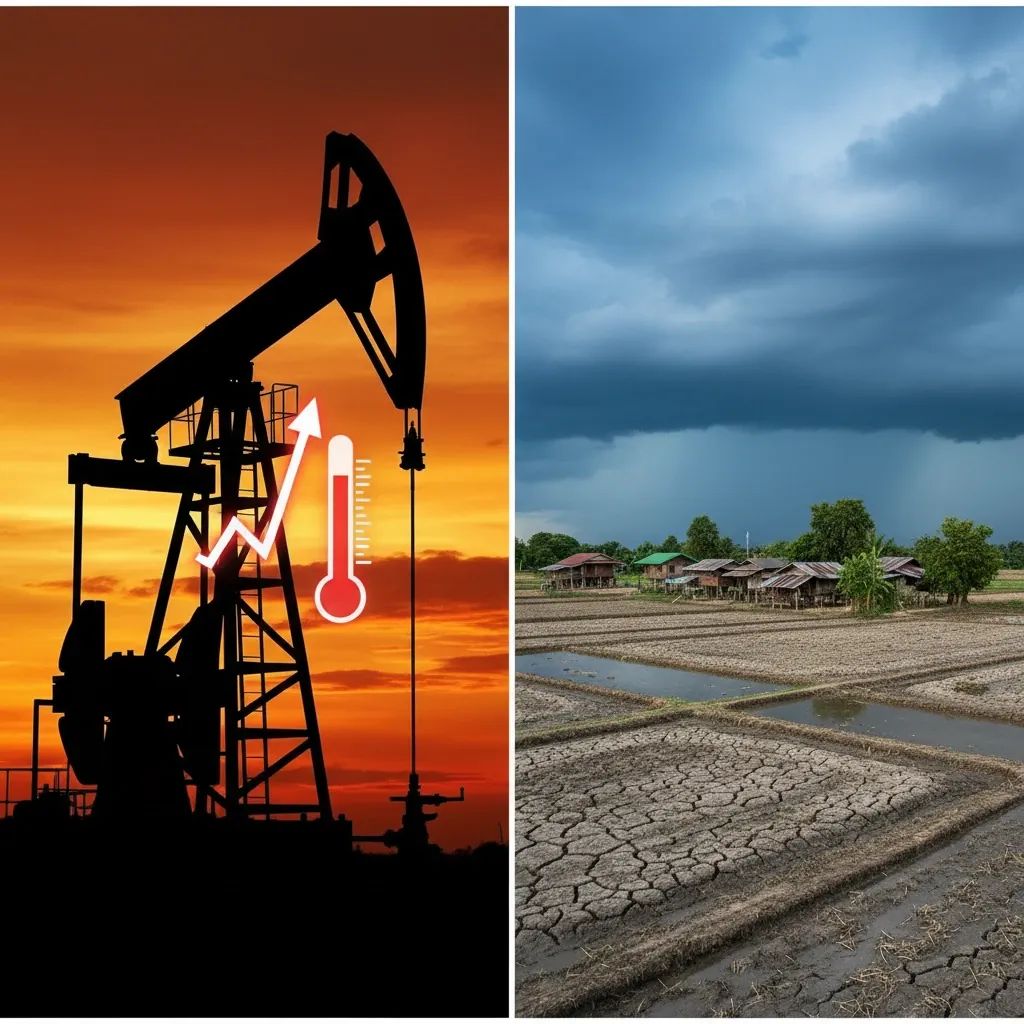
Thailand Marine Biologist Assoc. Prof. Dr. Thon Thamrongnawasawat has warned that the country faces a "double shock" scenario through the second half of 2026, as geopolitical turmoil pushes oil prices above $95 per barrel while a likely El Niño event threatens to reshape weather patterns, tourism revenue, and agricultural output. The convergence could strain household budgets, disrupt transport networks, and pressure coastal ecosystems already weakened by years of rising temperatures.
Why This Matters
• El Niño probability exceeds 60% between May and July 2026, with forecasts pointing to a potential "super El Niño" lasting into early 2027.
• Oil prices have climbed past $95/barrel on fears of Strait of Hormuz disruptions; Goldman Sachs projects spikes as high as $110 and, in extreme scenarios, $135.
• Diesel in Thailand already trades at ฿41.70 per liter and could breach ฿50 if Middle East tensions persist, raising transport costs by up to 30%.
• Tourist arrivals revised downward to 32.1M for 2026—a drop of 2M from earlier forecasts—as flight costs surge and long-haul travelers reconsider their plans.
Geopolitical Pressures Ripple Through Energy Markets
Dr. Thon, a marine and environmental scientist at Kasetsart University's Faculty of Fisheries, posted his warning on Facebook on April 20, describing a "multi-layered risk landscape" that has taken shape after the recent Songkran holiday. Unresolved conflicts—particularly around Iran negotiations—have fueled speculation about supply shocks through the Strait of Hormuz, a chokepoint that handles roughly one-fifth of global seaborne petroleum. Maritime incidents and reported drone activity have amplified market anxiety, even though details remain unconfirmed.
The knock-on effect for Thailand is immediate. Brent crude now sits at $98.13, while West Texas Intermediate trades at $85.59. Domestically, gasoline 95 retails at ฿52.04 per liter, gasohol 95 at ฿42.45, and diesel at ฿41.70—up 36% in March alone. Should hostilities escalate or shipping lanes close, analysts expect diesel to punch through ฿50, a threshold that would trigger automatic fare increases for buses and taxis and send freight haulers to the brink.
What Rising Fuel Costs Mean for Your Wallet Right Now
For residents living in Thailand, the impact is already visible at the pump and will ripple through daily life:
1. Higher Cost of LivingDiesel underpins nearly every segment of the supply chain, from farm tractors to refrigerated trucks. The Federation of Thai Land Transport announced a 10% freight-rate increase effective April 1 and warned it may rise by 30% in stages if fuel costs stay elevated. Supermarket shelves will reflect those hikes within weeks. Cooking oil, rice, noodles, and bakery products will see the sharpest increases.
2. Transport DisruptionsAirlines are already adjusting schedules. Higher jet-fuel prices and longer flight paths to avoid conflict zones have pushed long-haul ticket prices upward; the Tourism Council of Thailand trimmed its 2026 foreign-visitor forecast from 34.1M to 32.1M, with the sharpest declines expected from Europe and North America. Domestic travelers, too, are opting for shorter road trips rather than inter-provincial flights, shifting demand toward budget hotels and local attractions.
3. Electricity BillsAir-conditioning demand spikes when temperatures climb; simultaneously, hydro capacity may contract due to El Niño. The Electricity Generating Authority of Thailand will burn more diesel and natural gas, costs that eventually filter into per-unit tariffs under the fuel-adjustment clause. Combined with baseline inflation, monthly power bills could jump by double-digit percentages.
El Niño's Second Act Looms
Beyond geopolitics, Dr. Thon pointed to the accelerating probability of El Niño conditions forming by mid-year. Meteorological models from the U.S. National Oceanic and Atmospheric Administration (NOAA) and the European Centre for Medium-Range Weather Forecasts converge on a 61% chance for May–July and 93% by October–December, raising the specter of one of the strongest episodes on record. Sea-surface temperatures in the equatorial Pacific could climb more than 2.5 °C above long-term averages.
Dr. Thon emphasized that the current heatwave stems from long-term global warming rather than El Niño itself. Once the phenomenon matures, however, rainfall will drop—especially across southern Thailand, where wet and dry seasons already overlap unpredictably. At the same time, tropical storms and typhoons may intensify in the broader Asian basin, threatening flash floods in the north and northeast even as overall precipitation declines. That paradox—less rain but fiercer downpours—complicates disaster preparedness and water-resource planning.
How El Niño Will Hit Agriculture and Food Prices
Agricultural heartlands could face a pincer movement: rice, sugarcane, and oil palm require steady moisture, and any prolonged dry spell will shrink yields and lift commodity prices. Meanwhile, saltwater intrusion up the Chao Phraya River has already become a seasonal headache; lower freshwater flows would degrade drinking-water quality and irrigation supplies across the Central Plains. Hydroelectric generation may falter as reservoir levels drop, forcing utilities to rely more heavily on fossil-fuel plants at precisely the moment diesel and gas prices are climbing.
For residents, this translates to higher food bills and potential water restrictions during peak-demand hours. Industrial users—electronics manufacturers and auto plants—consume vast quantities of water; rationing or restricted pump hours could stall production lines and affect employment in manufacturing-dependent regions.
Marine Ecosystems: Recovery at Risk
Dr. Thon delivered a cautiously optimistic marine update. 2024's mass coral-bleaching event did not repeat in 2025 or early 2026, because critical warming thresholds were not crossed during the vulnerable spawning window. Along the Andaman coast, recovery rates reached 60–70%, with mortality at 30–40%; in the Gulf of Thailand, rebound hovered around 40–60%, and mortality at 30–50%. Shallow reefs bore the brunt, but no new widespread bleaching has been detected this year.
The Department of Marine and Coastal Resources is deploying a "4R" strategy—Reduce, Restructure, Restore, Rewilding—to accelerate reef rehabilitation. Plans call for planting 24 rai (approximately 3.8 hectares or roughly the size of 34 football fields) of coral and establishing 12 rai of juvenile-settlement substrate across seven provinces, alongside nurseries cultivating 60,000 coral colonies. The "Ocean for Life" initiative, a public–private partnership, is sinking sculptural structures off Koh Tao, Surat Thani, to create new dive sites that double as artificial-reef habitats.
Yet the respite may prove fleeting. A full-strength El Niño in the second half of 2026 could send sea-surface temperatures soaring again, triggering another wave of bleaching. This matters to residents because healthy reefs support dive-tourism jobs, protect coastlines from storms, and sustain fisheries that supply local seafood. Repeated thermal stress reduces the three-dimensional structure of reefs that shelters juvenile fish and invertebrates. Without that complexity, reefs lose productivity and appeal, diminishing both livelihoods and food security.
Seagrass meadows have shown modest regrowth in patches, likely aided by La Niña conditions in preceding months. Dugong populations, however, continue to decline; Dr. Thon cited recent strandings of dolphins undergoing treatment and dugong deaths, urging enhanced conservation measures and stricter enforcement against illegal fishing gear that entangles marine mammals.
Tourism Feels the Squeeze
Post-Songkran spending patterns reveal a cautious consumer base. Domestic travelers are sticking closer to home—short weekend trips by car rather than multi-day packages requiring flights. The Tourism Authority of Thailand has pivoted its campaigns around a "Stay Near Home" theme, emphasizing regional festivals, agritourism, and wellness retreats within driving distance of major cities.
International arrivals tell a bifurcated story. China, Malaysia, and India—shorter-haul markets—remain relatively robust, but European and North American bookings have softened as ticket prices climb and economic uncertainty deepens abroad. Hotels in Phuket and Krabi report uneven occupancy; boutique properties catering to luxury segments hold steady, while mid-tier chains see cancellations. The Pattaya corridor benefits from proximity to Bangkok and a loyal base of repeat visitors, yet even there operators note that guests are cutting trip lengths by a day or two to trim costs.
Airlines face their own calculus. Thai Airways, Bangkok Airways, and regional carriers have absorbed fuel surcharges so far, but prolonged high prices may force schedule cuts or route suspensions on thinner margins. Business travel—conferences, trade shows, corporate meetings—has not fully rebounded to pre-pandemic levels, leaving leisure passengers to shoulder revenue targets.
The Stagflation Specter
KKP Research and SCB Economic Intelligence Center both flagged the risk of stagflation: sluggish GDP growth coupled with persistent inflation. Thailand imports roughly 80% of its petroleum, so a sustained spike in crude hammers the trade balance and feeds consumer-price indices. At the same time, weakening global demand for electronics and automotive parts—two of Thailand's top export earners—constrains manufacturing output. Central-bank options narrow: raising interest rates to cool inflation would choke credit-dependent SMEs, while holding rates steady risks runaway price growth.
The Thai Cabinet has rolled out targeted relief: subsidies for public-transport operators and freight haulers, temporary fuel-tax reductions, and income-support transfers to low-income households. Those measures buy time but cannot offset a protracted energy crisis. If oil remains above $100/barrel into the fourth quarter and El Niño intensifies on schedule, fiscal buffers will thin rapidly.
What Residents Should Do Now
Dr. Thon closed his Facebook post with a call for vigilance and resilience. Households can take practical steps immediately:
• Stock emergency supplies: bottled water, shelf-stable food, battery packs, and first-aid kits in case extreme-weather events disrupt utilities
• Monitor weather alerts: Check Thailand Meteorological Department bulletins regularly for flood or drought warnings
• Adjust budgets: Account for higher transport, electricity, and grocery bills when planning household expenses
• Prepare for water rationing: If you live in regions dependent on reservoirs, consider storage tanks or rainwater collection
Businesses, particularly in hospitality and agriculture, should stress-test cash flows under worst-case fuel and rainfall scenarios. Farmers may consider drought-resistant crop varieties or shift planting calendars if meteorological agencies confirm El Niño's arrival. Dive operators and marine-tour companies can support coral-restoration projects—not only as a conservation gesture but as an investment in the long-term health of the reefs that underpin their livelihoods.
Government agencies face the harder task of balancing immediate relief with structural adaptation: expanding renewable-energy capacity to reduce petroleum dependence, upgrading irrigation infrastructure to capture monsoon rains more efficiently, and enforcing marine-protected-area regulations to give ecosystems breathing room. The Ministry of Natural Resources and Environment and the Ministry of Energy will need closer coordination as climate and geopolitical shocks blur the line between environmental policy and economic security.
Outlook: Navigating the Twin Pressures
No single forecast can capture every permutation of Middle East diplomacy and Pacific Ocean thermodynamics, but the central message is clear: Thailand enters the second half of 2026 more exposed than at any point in recent memory. Oil above $95, an El Niño probability exceeding 60%, and tourism arrivals falling 2M short of target create three simultaneous pressures that will test household finances, business margins, and ecological resilience.
Residents—Thai and foreign alike—should treat the next six months as a period requiring active management rather than passive optimism. Track fuel prices, watch reservoir levels, heed weather advisories, and build contingency plans. The double shock is not inevitable in its most severe form, but preparation now will determine whether communities adapt successfully when the pressures peak.


