
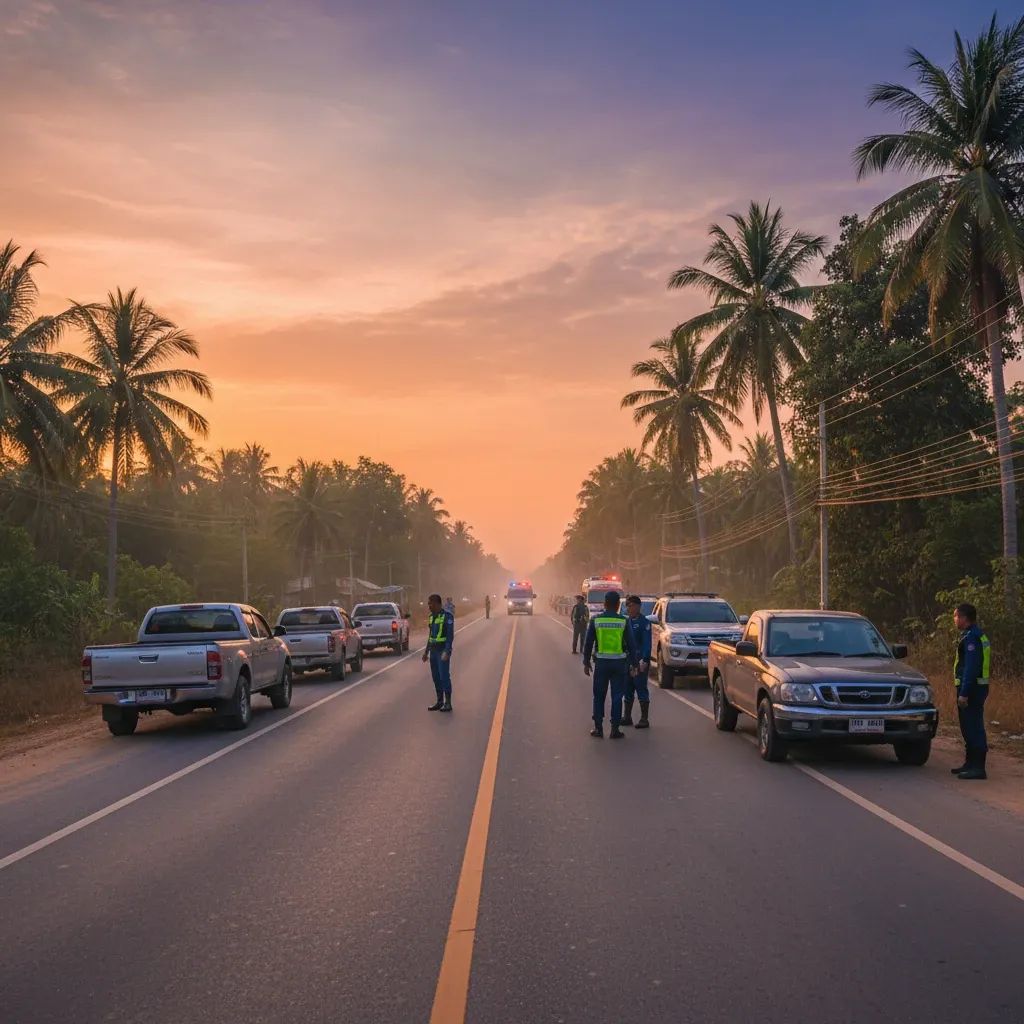
Two teenagers are dead after a predawn pickup truck crash near Udon Thani, killed during what was supposed to be Thailand's most joyful weekend of the year. The fatality underscores a stubborn reality: Songkran 2026 continues to claim preventable lives at an alarming rate, and the patterns driving those deaths—speeding, alcohol, and unsafe transport practices—remain nearly unchanged from prior years, despite heightened enforcement efforts across the kingdom.
Why This Matters
• Road deaths are tracking at concerning levels, with 154 fatalities reported as of April 13—a significant increase from previous years that underscores the ongoing severity of festival-season accidents. Concentrated police action has been deployed to address this spike.
• Pickup truck cargo beds remain a lethal norm. Riding unsecured in open truck beds during festivals is culturally normalized but statistically catastrophic—children and young adults account for the majority of ejection-related fatalities.
• Peak danger hours (3:01 PM–6:00 PM) account for nearly 1 in 4 crashes, when fatigued travelers, dehydrated drivers, and alcohol consumption converge on a single afternoon window.
• Young adults aged 20–29 represent 18% of all casualties, a demographic that bears disproportionate risk due to peer pressure, risk-taking behavior, and inexperienced riding.
The Udon Thani Incident: One Tragedy, Multiple Risk Factors
The crash occurred just after midnight on April 14, when a pickup truck transporting teenagers from Songkran celebrations lost control on Thap Than–Krok Phra Road. Two minors were killed at the scene; preliminary police reports from Thailand's Road Safety Directing Center have not yet specified whether speed, alcohol, or driver fatigue triggered the loss of control, though accident investigators say all three factors align with national crash patterns.
The tragedy is neither new nor surprising. Every Songkran season, dozens of families load teenagers into truck beds for the drive home from water-splashing zones, creating what amounts to mobile accident traps. The Thai Road Safety Operations Center has documented this repeatedly: passengers in open cargo areas face exponential ejection risk during even modest collisions, particularly when vehicles are overloaded—the standard condition during festival transport.
What distinguishes the Udon Thani deaths from routine tragedy is their timing. The incident occurred during week one of the "Seven Days of Danger," the annual road safety blitz when enforcement agencies, media, and public health officials attempt to reverse decades of embedded driving culture. As of April 13, the Thailand Road Safety Operations Center confirmed 154 fatalities, 705 injuries, and 755 accidents nationwide—a dramatic spike that reflects the ongoing challenge of managing road safety during peak festival travel periods, with fatalities significantly elevated compared to typical year-over-year patterns.
Speed and Alcohol: The Persistent Killers
When authorities dissect Songkran crashes, two culprits emerge with brutal consistency. Speeding accounts for 41.77% of all incidents, followed by drunk driving at 27.43%. The combination is particularly lethal on motorcycles, which represent 70.93% of vehicles involved in crashes—a demographic vulnerability amplified by three additional factors: riders aged 20–29 represent 18% of casualties; three in four crash victims lack valid driver's licenses; and over 34,000 helmet violations were documented in just the first two days of this year's campaign.
The geography of danger is equally predictable. Straight roads account for 81.29% of accidents, a counterintuitive statistic explained by driver overconfidence and high speeds on seemingly "safe" stretches. Local roads (39.77%) and highways (34.50%) dominate the casualty count, though urban congestion zones like Bangkok's Khao San Road and Pattaya beaches generate their own cluster of alcohol-related and violence-related incidents despite heavy police presence.
Lampang province led the four-day casualty count with 25 accidents and 25 injuries, while Bangkok recorded the highest death toll with six fatalities. A cautiously positive note: 30 provinces reported zero deaths during the initial phase, suggesting that localized enforcement and community checkpoints may be generating measurable results in specific regions.
Riding in Truck Beds: A Legal Gray Zone That Kills
Thailand's traffic laws do not explicitly prohibit passengers from riding in vehicle cargo beds. This regulatory gap transforms a obviously dangerous practice into a culturally accepted and legally tolerated norm. Every Songkran season, families rationalize the risk as temporary and festive. Every season, some families lose teenagers to preventable crashes.
The Thai Road Safety Directing Center documented at least two additional Songkran fatalities involving young passengers ejected from truck beds. A 13-year-old and a 15-year-old died in separate incidents after falling from cargo areas during festival transport—deaths that mirror the Udon Thani tragedy and underscore the predictability of a preventable category of risk.
Medical data amplifies the danger. Trauma surgeons at major hospitals report that ejection injuries during rollovers generate massive internal damage—rib fractures, organ lacerations, spinal cord injuries—that frequently prove fatal before patients reach surgical care. Rural hospitals, which absorb the majority of festival casualties, lack the specialized trauma units and neurosurgeons that urban centers maintain. The geographic gap between accident location and adequate medical intervention often determines survival.
Alcohol Enforcement: Visible Results, Persistent Gaps
The Royal Thai Police deployed aggressive checkpoints and checkpoint technology throughout April 10–13. Results are quantifiable: 27,635 speeding violations recorded by April 11 alone, with similar velocity-focused enforcement yielding high ticketing volumes. Breathalyzer testing at community checkpoints identified thousands of impaired drivers, some of whom were removed from roads before crashes occurred.
However, enforcement intensity masks a deeper compliance gap. Roadside drinking remains normalized during Songkran, particularly in designated water-play zones where revelers transition from water games directly to alcohol consumption before driving. The Thailand Ministry of Interior's "3 Do's and 5 Don'ts" framework explicitly prohibits roadside drinking, yet enforcement relies primarily on visible checkpoints rather than community-level deterrence.
On April 13, Bangkok's Pathum Wan district recorded the arrest of a foreign national accused of sexually assaulting a female reporter amid crowded street celebrations. The incident occurred despite increased police visibility and new dress code regulations that impose penalties for "inappropriate attire" and severe consequences for harassment. The fact that such an incident occurred during peak enforcement operations suggests that concentrated policing in specific zones leaves blind spots in adjacent areas where alcohol and crowds concentrate.
Violence Flares Alongside Traffic Chaos
Beyond traffic fatalities, Songkran 2026 has documented isolated but serious incidents of interpersonal violence that underscore broader public safety challenges during the festival period. On April 14, in Udon Thani's provincial administrative zone, authorities allege that a suspect identified as "Mr. Aam from Khao Phawaeng" orchestrated a revenge attack against rival youth groups using firearms, bladed weapons, and improvised explosive devices commonly referred to as "ping-pong ball bombs." The assault resulted in multiple injuries and prompted police to issue outstanding arrest warrants, though suspects remain at large.
The incident reflects a pattern documented over multiple festival seasons: alcohol, crowded public spaces, and preexisting neighborhood tensions converge during Songkran, occasionally triggering violence that authorities classify separately from traffic deaths but that shares a common root cause—diminished judgment and impulse control in festive, alcohol-saturated environments.
Tourist-centric zones have generated additional conflict. Pattaya recorded a brawl between two foreign nationals and local motorcycle taxi drivers that reportedly began when the foreigners misused a public fire extinguisher in a crowded celebration area. Similar altercations, involving both sexual harassment complaints and physical confrontations between expats and locals, have been documented in Phuket and Bangkok beach areas.
The Thailand Royal Police's enforcement response includes new regulations prohibiting weapon-carrying and high-pressure water weapons, stricter dress codes, and penalties for sexual harassment. However, uneven implementation—particularly in tourism-dependent zones where economic incentives sometimes override enforcement—means that compliance remains patchy in high-profit areas like Patpong and Khao San.
Technology and Community-Level Intervention
Recognizing that traditional enforcement cannot simultaneously cover all roads and public gathering spaces, Thailand's authorities have deployed layered interventions combining technological surveillance and grassroots participation.
AI-enabled CCTV systems have been installed in high-risk urban zones to screen for individuals with outstanding arrest warrants and to monitor crowd density in real time. Bangkok's Metropolitan Police Bureau has integrated social media crowdsourcing into its command structure, allowing residents to report dangerous behavior or overcrowding via smartphone, triggering rapid police dispatch to specific locations.
At the community level, the Ministry of Interior has revived the "family checkpoint" concept—volunteer-staffed traffic stops operated by local residents, village councils, and community organizations. These informal barriers have demonstrated surprising effectiveness in rural provinces where peer pressure and local social cohesion reinforce formal traffic law compliance more effectively than distant police authority.
The Ministry of Public Health has scaled medical preparedness to match anticipated casualty volume. 24-hour Emergency Operations Centers (EOC) have been established in provincial capitals with dedicated fuel reserves for ambulances, recognizing that transport delays directly increase mortality in trauma cases. Yet the sheer volume of incidents—over 700 injuries documented in just four days—continues to strain rural hospitals that lack dedicated trauma units and specialized surgical capacity.
The Cultural Obstacle: Why Behavior Hasn't Shifted
Despite three decades of annual Songkran safety campaigns, risky practices persist because they are culturally embedded, not individually chosen. Riding unsecured in truck beds is viewed as festive communalism, not reckless endangerment. Drinking while celebrating reflects social normalcy, not deviance. Young adults aged 20–29, the demographic bearing the highest casualty burden, face peer pressure to participate in activities—late-night drives, crowded water zones, rapid highway travel—that directly correlate with accident risk.
Behavioral change requires interventions beyond enforcement. Public health researchers have advocated for mandatory insurance disclosure mechanisms—requiring insurance companies to quantify mortality and financial risk on vehicle registration certificates—as a tool to translate abstract statistics into personalized risk awareness. Stricter penalties for vendors who sell alcohol to minors, while nominally mandated by law, remain inconsistently enforced.
The Thailand Road Safety Directing Center has also proposed engineering-based interventions: rumble strips on high-risk rural roads to alert speeding drivers; elevated pedestrian crosswalks in water-play zones to separate foot traffic from vehicle lanes; and designated "alcohol-free celebration areas" with physical barriers between festive zones and traffic corridors. None of these measures have been uniformly implemented nationwide, leaving enforcement as the primary—and demonstrably insufficient—tool.
The Final Days: Where Fatality Risks Peak
With three days remaining in the "Seven Days of Danger" campaign, historical data indicates that the period ahead will likely prove deadlier than the opening phase. Fatality spikes typically occur on April 15–16, when exhausted travelers undertake long return journeys and enforcement resources become thin as police agencies redirect personnel to manage crowd dispersal and festival shutdown operations.
For residents and visitors navigating Thailand's roads during the remaining Songkran period, the calculus is straightforward and supported by data. Avoid cargo beds in pickup trucks entirely. The Udon Thani teenagers represent one incident in a recurring category of preventable death. Expect heightened enforcement at visible checkpoints, but recognize that police resources cannot cover all roads and all hours—personal judgment remains the primary safety tool. Understand the medical reality: three in four motorcycle crash victims lack valid licenses, a factor that increases fatality risk by 3–5 times, according to trauma center data.
If possible, delay travel until after 6:00 PM or before 3:00 PM, when the 3:01 PM–6:00 PM danger window—coinciding with maximum heat, congested roads, and the transition from water play to driving—has passed. Wear helmets, refuse rides from impaired drivers, carry an International Driving Permit if renting a scooter, and recognize that Songkran's deadliness is not inevitable. It is, however, entirely predictable—and therefore, within individual control.
The two teenagers killed in Udon Thani represent not statistics, but a failure repeated hundreds of times annually. Until behavioral and cultural change accompanies enforcement and infrastructure investment, Songkran will remain synonymous with both joyful celebration and preventable tragedy.


