
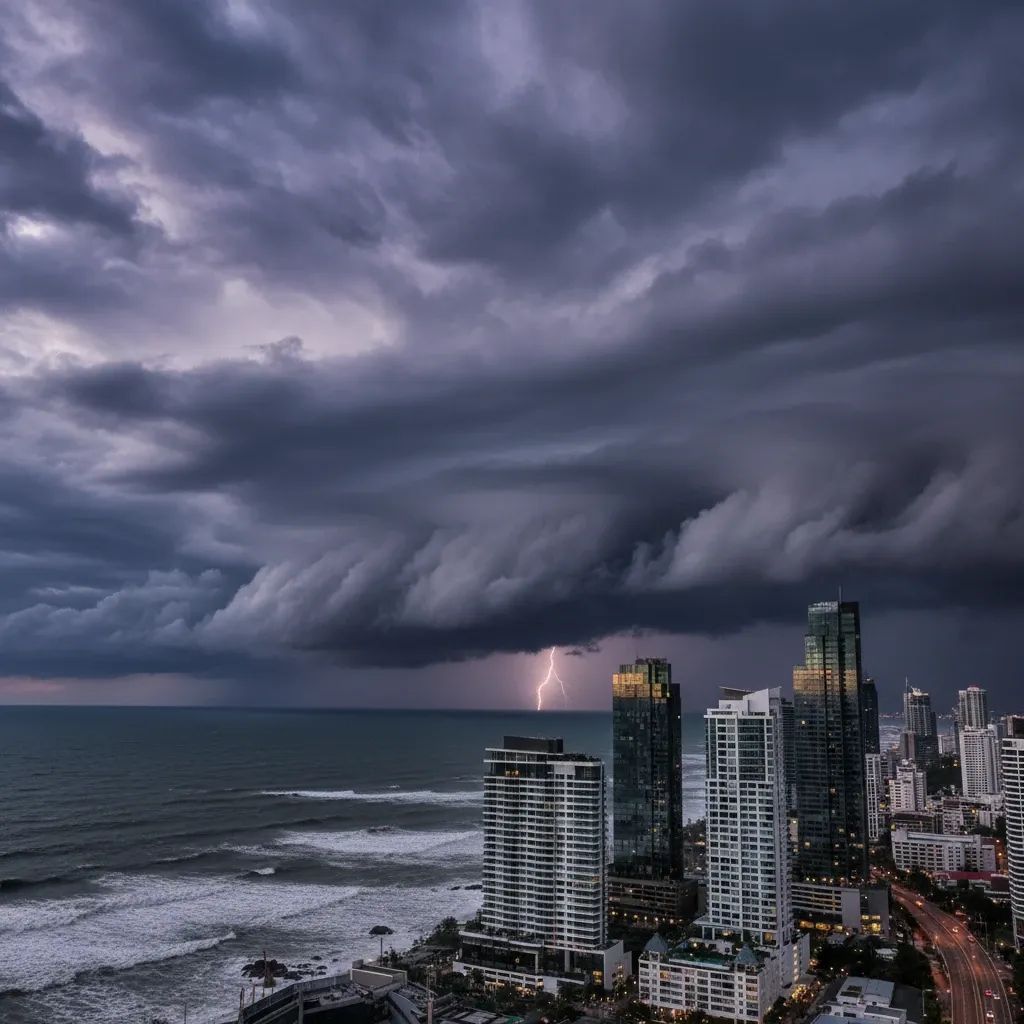
How Thailand's Four-Day Storm System Tests Your Weekend Plans and Livelihood
Thailand faces a significant weather convergence between now and June 1, with consecutive downpours expected to drench most regions while churning up dangerous seas. The Thailand Meteorological Department's updated alert applies across all major provinces, bringing the first operational test of how well residents, maritime workers, farmers, and businesses navigate the rainy season's arrival.
Why This Matters
• Flash flood zones active: Accumulated rainfall concentrated in northern highlands, central plains, eastern provinces, and the south creates immediate risk for sudden flooding, especially near waterways and sloped terrain where water runoff accelerates within hours.
• Small boats prohibited: Upper Andaman Sea conditions forecast 2-3 meter waves, exceeding 3 meters during thunderstorms—a threshold that legally grounds fishing vessels, tour boats, and transport operations, affecting income for maritime communities and travel plans.
• Farming paradox: Heavy rainfall supplies moisture needed for early-season rice transplanting, yet intensity risks seedling loss and field saturation. Timing decisions made this weekend determine crop viability through the coming months.
The Setup: When Two Weather Systems Collide
The mechanism driving this event reflects seasonal mechanics operating at maximum effect. A monsoon trough traversing northern Thailand combines with a southwest monsoon of notably forceful character flowing across the Andaman Sea and Gulf of Thailand. This arrangement—described as "fairly strong"—produces the cumulative moisture that meteorologists forecast heavy to very heavy rainfall.
The Thailand Meteorological Department divides the alert window into zones of varying intensity. From May 29 through 31, Ranong and Phangnga provinces face the most relentless downpours, while northern slopes of Mae Hong Son, Tak, and Kanchanaburi simultaneously receive copious rainfall. By May 30, eastern provinces Chanthaburi and Trat join the heavy precipitation band. June 1 sees activity diminish in northern zones but persist in the south and east.
This concentration of rain across a few days, following weeks of unusual heat retention, signals something larger unfolding atmospherically. Global ocean surfaces have warmed to near-record levels, a warming trajectory that climate monitors increasingly link to developing El Niño conditions. Climate scientists warn that conditions during this period are consistent with El Niño development patterns, which typically suppress overall monsoon precipitation and increase likelihood of erratic rainfall patterns—intense bursts interspersed with extended dry periods.
Impact on Residents and Urban Communities
Bangkok and other major cities should anticipate localized drainage congestion during afternoon and evening peak rainfall periods. The Chao Phraya River system, managed by the Thailand Royal Irrigation Department, operates within designed capacity, yet tributary saturation upstream can overwhelm treatment rates within hours.
For residents in lower-lying neighborhoods, practical steps matter now. Secure outdoor items vulnerable to strong gusts. Clear roof gutters and downspouts of accumulated debris. Position emergency drinking water (minimum 3 liters per person), non-perishable food, battery-powered radio, flashlights, and prescription medications in elevated, water-resistant storage within arm's reach.
Residents near waterways or in historically flood-prone housing should preposition sandbags and monitor hourly water-level updates accessible through provincial disaster office channels. The Thailand Department of Disaster Prevention and Mitigation has pre-positioned mobile command centers and rescue equipment across high-risk provinces, with village-level monitors linked to district coordination networks operating continuous surveillance during the alert window.
Mobility planning requires flexibility. Allow extra commute time Friday and Monday, when traffic disruptions peak. Maintain vehicle fuel above half-capacity. Avoid non-essential travel during afternoon and evening hours when downpour intensity typically concentrates. The Thailand Royal Police and highway management have identified alternate routes for flood-prone roads, with signage pre-positioned for rapid deployment.
The Thailand Meteorological Department operates a 24-hour hotline at 1182, with rainfall and flash-flood warnings updated hourly. The agency's website (tmd.go.th) displays interactive precipitation maps for individual districts—a resource more precise than general broadcast forecasts.
Maritime Operations Enter Standdown Mode
The legal restrictions on small vessel operation are calibrated to wave conditions and boat size. The Thailand Marine Department enforces restrictions that prohibit small boats from operating when the upper Andaman Sea—from Phuket northward through Ranong and Phangnga—faces wave heights exceeding 2-3 meters, with even stricter conditions during thunderstorms when waves exceed 3 meters.
The lower Andaman (Krabi southward) and upper Gulf experience comparatively moderate baseline conditions at 2 meters, though thunderstorm zones trigger temporary escalations.
Violations carry consequences beyond safety logic. Certificate suspension reaches extended periods for operators who depart during prohibition windows, a regulatory measure that translates into financial devastation for fishing families and tour operators dependent on daily operations.
The National Command Centre for Maritime Interests operates an emergency marine hotline at 1465 for distress reporting. Tour operators have begun notifying customers of probable schedule modifications or cancellations, with flexible rebooking policies implemented without penalty. Many lodge operations across Phuket, Krabi, and Phangnga have activated visitor sheltering protocols, recognizing that weather-related disruption is operationally inevitable.
The Agricultural Calculation: Blessing and Risk
Farmers across northern and eastern provinces confront a temporal dilemma. Tak and Mae Hong Son require rainfall to establish rice paddies and early vegetable transplants. Yet concentrated downpours destroy seedlings and over-saturate soil beyond immediate planting capability.
The Royal Irrigation Department coordinated water management during the alert period, yet uneven rainfall distribution means coverage remains uncertain. The Department of Agriculture issued advisory guidance suggesting farmers adjust transplantation timing based on real-time field observation—delaying in zones receiving intensive precipitation, accelerating in areas experiencing lighter falls.
Livestock operators in rural areas received instruction to relocate animals to elevated structures and preposition feed supplies before sustained rainfall begins. The Agricultural Extension Department deployed mobile advisory units to high-risk districts, offering on-site consultation regarding drainage management and salvage protocols.
The broader agricultural context introduces complication. Climate patterns indicate potential for suppressed monsoon precipitation in subsequent months, creating conditions where this weekend's rainfall becomes significant within a year-long rainfall management context. The Thailand Meteorological Department and Royal Irrigation Department have begun coordinating water management strategies. Farmers increasingly receive guidance emphasizing crop selection and irrigation efficiency, recognizing that monsoon reliability cannot be assumed during variable climate periods.
Tourism Recovery Requires Coordinated Response
The Thailand Tourism Authority coordinated with destination management entities to implement weather-responsive protocols affecting lodge operations, tour scheduling, and transportation across popular zones. Island destinations activated contingency sheltering plans, rerouting provisions, and compensation frameworks.
Marine tour operators—offering snorkeling, diving, offshore fishing—began customer notification cycles describing probable schedule modifications. The Tourist Assistance Fund, a government-backed mechanism providing emergency support to foreign nationals experiencing loss from meteorological events beyond their control, activated with enhanced staffing. Foreign embassy coordination centers in Bangkok were briefed on assistance availability for expedited support.
Multilingual weather bulletins reached major resort zones, with real-time updates integrated into hotel systems and mobile applications frequently accessed by visitors. Transportation operators—buses, minivans, airport shuttles—received continuous monitoring directives and vehicle pre-positioning orders directing operations away from flood-prone routes.
The tourism sector's economic footprint creates incentive structure beyond humanitarian concern. International travel disruption generates reputational consequences and booking delays for subsequent seasons, making transparent communication and proactive protection measures strategically rational.
Preparation Timeline and Official Channels
Residents should complete fundamental preparedness within the next 24 hours. Household-level steps include securing outdoor items vulnerable to strong wind, clearing gutters, positioning emergency supplies in elevated storage, and charging mobile devices and power banks. Travel context requires flexibility in transportation plans, monitoring weather updates before departing, maintaining vehicle fuel above half-capacity, and avoiding non-essential travel during peak rainfall hours.
Business operations—retail establishments, service providers—located in flood-prone areas should relocate ground-floor inventory to elevated storage and secure exterior displays. Power backup systems require testing and fuel stock verification.
Official information channels:
• Thailand Meteorological Department: 1182 (24-hour hotline)
• Website: tmd.go.th (hourly updates during alert periods)
• Maritime emergencies: 1465 (National Command Centre for Maritime Interests)
• Provincial disaster offices: Local emergency contact numbers accessible via directory assistance
The Thailand Department of Public Health instructed provincial health systems to activate surge capacity protocols for waterborne illness cases, which historically increase following major flooding. Water treatment facilities intensified monitoring of treated supply quality and contingency purification measures if source contamination occurs.
The Broader Context: Climate Patterns and Seasonal Risks
This rainfall event arrives within larger atmospheric shifts. Global ocean surfaces have warmed significantly, a pattern associated with El Niño development. Climate scientists note that El Niño conditions typically suppress overall monsoon precipitation, delay rainy season establishment, and increase likelihood of erratic rainfall patterns—intense bursts interspersed with extended dry periods.
For Thailand specifically, this means the current heavy rain system, while meteorologically significant and operationally demanding, does not eliminate or diminish projected drought risks for subsequent monsoon months.
Public health authorities issued supplementary guidance regarding heat-related illness risk, particularly for outdoor workers and elderly populations in areas experiencing continued high humidity above 85% alongside temperatures exceeding 35°C despite rainfall. Cooling centers in urban municipalities remain operational as backup capacity during periods when standard air-conditioning infrastructure proves insufficient.
This weekend represents Thailand's first major operational test of rainy season management in a year where significant rainfall does not eliminate drought anxiety. Preparation now—securing possessions, clearing drainage, positioning supplies—translates into reduced crisis management requirements. Government agencies, maritime authorities, agricultural advisors, and tourism operators have coordinated response frameworks. What remains is individual preparedness and adherence to technical restrictions designed for documented safety purposes.


