
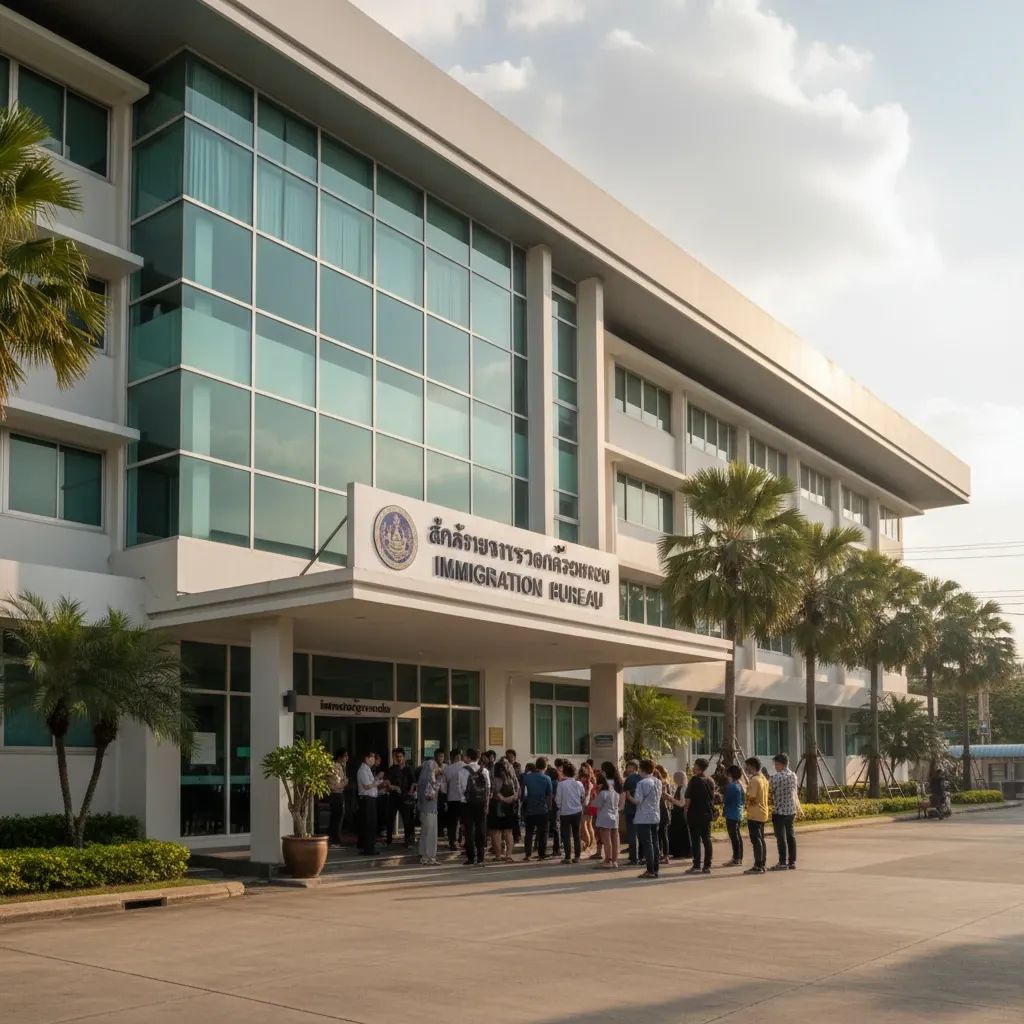
Thailand's rapid immigration response to tourist misconduct has entered a new phase. A public indecency case involving two foreign nationals on a Phuket beach illustrates how swiftly authorities now move from viral social media documentation to criminal sanctions, visa revocation, and deportation proceedings—often within hours rather than weeks. The implications extend far beyond the tourists involved: for expats, retirees, and long-term residents, the incident crystallizes an uncomfortable reality about conditional legal protection and enforcement discretion in Thailand's tourism-dependent justice system.
Why This Matters
• Immigration trumps courts: Visa revocation is an administrative process that bypasses criminal appellate review, making it a faster enforcement mechanism than prosecution alone.
• Social media as prosecutorial tool: Viral evidence eliminates investigative delays and forces police to respond visibly, creating new liability for public behavior in previously low-profile areas.
• Uniform application across visa categories: Retirement visa holders, marriage-based residents, and digital nomads all face identical penalties for public indecency violations—residency status offers no immunity.
The Incident and Operational Speed
On April 10, authorities received and documented images showing two individuals engaged in sexual activity on Layi Beach in Kamala, a quieter corner of Phuket that has increasingly become a focal point for enforcement. The Kamala Police Station, acting on digital evidence rather than in-person witness testimony, coordinated an arrest operation that same evening. By 9:00 p.m., both suspects—identified as two foreign nationals, each 24 years old—were in custody at a hotel in the nearby Kathu district.
The response was notably swift. Police officials led the investigation with support from Phuket Provincial Police senior commanders. Rather than the traditional workflow of witness statements, formal complaints, investigation files, and prosecutorial review, this case moved directly from digital evidence to detention.
Both individuals received the maximum statutory fine under Thailand's public indecency laws—the provisions criminalizing acts deemed offensive to public decency through exposure or obscene behavior in spaces open to public access.
What once required weeks of bureaucratic processing now unfolds in hours. Police commanders understand that failure to respond visibly to documented offenses generates political pressure and reputational risk. When thousands see an indecent act circulate online and authorities do nothing, the legitimacy cost accumulates.
The Broader Legal Framework: What Counts as Violation
Thailand's public decency statute intentionally employs broad language to grant prosecutors and judges significant interpretive room. Case law has clarified but not entirely eliminated ambiguity: topless sunbathing without exemptions violates the law; deliberate genital exposure violates it; sexual contact in view of the public violates it. The dividing line between culturally accepted behavior and criminal misconduct shifts with context and observer perception.
Religious sites carry compounding penalties. Tourists photographed unclothed or disrespectfully near temples face combined charges under public indecency and religious insult statutes, with aggregate sentences reaching seven years imprisonment. A seemingly isolated infraction can escalate dramatically based on location.
Other prohibitions converge. Smoking on beaches carries the identical fine as public sexual acts. E-cigarettes remain entirely illegal in Thailand—mere possession triggers enforcement regardless of use.
The overlapping regulatory landscape means minor infractions can accumulate into serious consequences. Understanding these boundaries is not optional for long-term residents; it defines the operational perimeter of legal safety.
Immigration Pathways: Deportation and Re-Entry Bans
The fine imposed represents the immediate penalty. Far more consequential is the immigration administrative track running parallel to criminal proceedings. The Thailand Immigration Bureau now faces the task of determining whether to revoke visas and impose re-entry bans. These bans range from one year to indefinite prohibitions, determined by offense severity and prior history.
The deportation process itself unfolds over days or weeks. Individuals remain in police or designated detention facilities pending travel document verification with their respective embassies. Once confirmed, they receive formal deportation notices.
They board flights arranged by immigration authorities—often departures within 48 to 72 hours of final administrative clearance. Upon arrival in their home countries, they are entered into Thailand's immigration database as banned from re-entry for the duration of the imposed prohibition.
Recent Enforcement Statistics
Statistics underscore the scale of enforcement activity. The Thailand Immigration Bureau has reported significant visa revocations for foreign nationals convicted of crimes or involvement in public disturbances. These figures encompass drug possession, sex work, overstaying, employment violations, and public indecency.
For the expelled individuals, re-entry bans create complications within Southeast Asia's interconnected visa systems. Malaysia, Cambodia, and Laos increasingly cross-reference Thai immigration alerts and interdiction records. A banned individual may face questioning at other borders about the reason for Thai expulsion, potentially triggering secondary scrutiny or denial of entry elsewhere in the region. The operational consequence is that a single indecency violation in Thailand can fragment future mobility across Southeast Asia.
What This Means for Long-Term Residents and Expats
For anyone holding a retirement visa, marriage-based residency, work permit, or education authorization, the Layi Beach case carries an implicit but unambiguous message: your legal status is conditional on lawful conduct. Unlike Thai citizens, foreign residents operate under permanent discretionary enforcement.
An immigration officer reviewing a public indecency charge can recommend visa cancellation without judicial review—a process designed to operate substantially faster than criminal appeals.
Consider the practical exposure: A retiree engaging in public conduct risks not merely fines but expulsion from Thailand. A work visa holder faces similar vulnerability. A spouse on a marriage visa has no privileged legal standing. The statute applies uniformly across all visa categories. What exemptions or legal protection categories exist for citizens do not apply to foreign nationals.
The gray zone of enforcement also matters. Definition disputes—what qualifies as "obscene behavior," how much physical contact constitutes prohibited conduct—are resolved operationally rather than through consistent precedent. Two officers at different beaches might assess identical behavior differently. However, once video evidence exists, ambiguity disappears. Shareable digital documentation removes prosecutorial discretion.
Why Low-Visibility Areas Are Now Enforcement Targets
Layi Beach occupies a geographic and social position that makes it significant. It is quieter than the neon-intensive beaches of Patong or the family-oriented Kata. Previously, its relative obscurity created an informal tolerance for boundary-testing behavior. Images shared online change this calculus entirely.
When documentation circulates on social media, the incident moves from a private indiscretion to crowd-sourced enforcement evidence. Police face institutional pressure to respond. Ignoring a publicly documented indecency that thousands have viewed creates reputational liability for commanders.
This dynamic reconfigures the risk landscape for long-term residents. Conduct that might have been overlooked in smaller towns or disconnected social circles now risks exposure and enforcement. The digital documenting and sharing of infractions has eliminated the obscurity protection that previously existed in less-trafficked areas.
Comparative Regional Enforcement
Thailand's approach to public indecency occupies the middle tier of Southeast Asia's enforcement spectrum—stricter than some jurisdictions, more lenient than others, but distinguished by operational speed and administrative efficiency.
Malaysia's enforcement varies sharply by state. In Kuala Lumpur, public displays of affection encounter mild enforcement; in Terengganu and Kelantan, where Sharia courts hold jurisdiction, kissing can trigger legal consequences. Penalties include potential caning—a deterrent mechanism Thailand's legal code does not employ.
Singapore prosecutes public indecency under the Miscellaneous Offences Act, with sentences reaching six months' imprisonment and fines to S$2,000 (approximately 50,000 baht). However, Singapore's enforcement applies equally to residents and visitors; there is no categorical immigration stream for expedited deportation.
Cambodia has charged foreign nationals for nude photographs at temples under pornography and public disorder statutes. The charge structure itself reflects a different judicial logic: charges aggregate to compound the sentence, whereas Thailand typically applies singular provisions.
What distinguishes Thailand is the seamless coordination between criminal and immigration enforcement mechanisms. A public indecency conviction does not trigger a protracted legal appeal cycle; immigration authorities can recommend visa revocation within days. This integrated efficiency reflects Thailand's institutional design for rapid response in tourist zones.
Enforcement Trends and Future Implications
The Layi Beach case is unlikely to be isolated. As social media enables rapid documentation and viral sharing of infractions, authorities will continue responding with coordinated speed. The institutional model—rapid arrest, immediate maximum fines, swift deportation initiation—has become standardized in tourist zones.
For anyone residing in or visiting Thailand, the operational reality crystallizes: the legal framework is not ambiguous, and enforcement has shifted from reactive to proactive. Thailand's tourism industry remains Southeast Asia's most valuable economic sector, but that prosperity arrives with non-negotiable conditions: cultural deference and lawful conduct are foundational requirements rather than advisory recommendations.
Understanding and respecting local norms is essential. For expats, the Layi Beach incident serves as a stark reminder that residency status remains permanently conditional on compliance with Thai law. The dual-track system—criminal proceedings and administrative immigration action—means violations escalate faster than residents might anticipate, and remedies through legal appeal are limited by institutional design. The cost of misconduct has become measurable, immediate, and largely irreversible within Thailand's enforcement framework.


