
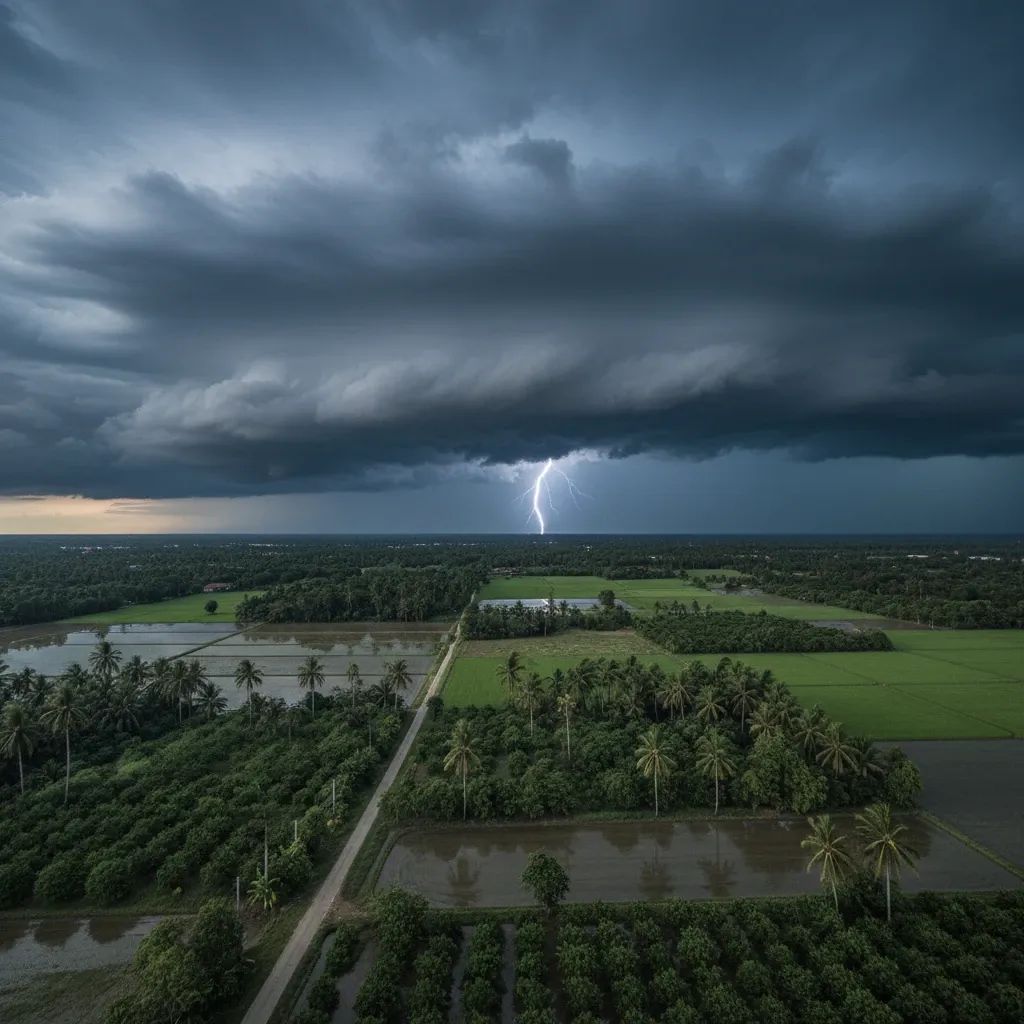
The Thailand Meteorological Department has issued its eighth seasonal thunderstorm warning just as Pattaya prepares for its biggest water festival day—a confluence of extreme weather risk and mass celebration that's forcing both residents and visitors to balance festival enthusiasm with genuine safety concerns.
Why This Matters:
• Immediate danger window: Storm activity with lightning, strong gusts, and possible hail peaks today through April 20, coinciding exactly with Wan Lai Pattaya festivities.
• Festival infrastructure at risk: Beach Road and surrounding zones will host dense crowds until midnight, with over 800 security personnel deployed but limited shelter options if weather turns severe.
• Temperature paradox: Daytime feels-like temperatures hitting 38°C before evening storm probability jumps to 60%, creating heat exhaustion and flash-flood risks in quick succession.
• Agricultural warnings issued: Farmers across eastern provinces told to brace fruit trees and secure livestock against sudden squalls.
Meteorological Mechanics Behind the Warning
A moderately strong high-pressure system originating over China has extended across the South China Sea, intensifying southerly and southeasterly winds over Thailand's northeast, eastern regions, and the upper Gulf of Thailand. This pressure gradient collides with the season's peak heat—most of the country experiencing scorching temperatures—creating textbook conditions for atmospheric instability.
Technical Forecast Details
The Thailand Royal Meteorological Department forecasts scattered thunderstorms accompanied by gusty winds, localized hail, and lightning strikes across upper Thailand. For Pattaya specifically, the forecast shows a 15% rain probability during daylight hours but escalates sharply to 60% overnight, with temperatures ranging between 28°C and 32°C but a heat index pushing toward 38°C due to approximately 65% relative humidity.
Why These Storms Matter
These aren't gentle afternoon showers. Summer storms in the tropics develop rapidly, produce dangerous wind shear, and can drop temperatures by 10 degrees in minutes—a particularly hazardous scenario when tens of thousands of people are outdoors, many consuming alcohol, with limited immediate shelter.
Wan Lai Pattaya: The Festival That Won't Stop
Despite the meteorological warning, Wan Lai Pattaya—the city's signature Songkran water celebration held annually on April 19—will proceed as the culminating event of Thailand's extended New Year festival. "Wan Lai" literally means the final day of extended Songkran celebrations, marking the conclusion of the traditional water festival period.
This is not a modest community gathering; it transforms Beach Road from Dolphin Roundabout to Wat Chai Mongkol intersection into a continuous 12-hour water battleground attracting both domestic and international visitors.
The Pattaya City Administration has organized a full road closure from 12:00 to midnight, dedicating the entire beachfront strip to pedestrian water play. Authorities expect the area to reach maximum capacity by early afternoon, with continuous water fights, music stages, and street vendors operating throughout.
For many Thailand-based expats and long-term residents, Wan Lai represents the "final release" of Songkran energy—a deliberately uninhibited celebration before the country returns to routine. Unlike the more family-oriented celebrations in Bangkok or Chiang Mai, Pattaya's version skews toward adult participants and high-intensity revelry.
What This Means for Residents and Visitors
The collision of severe weather warnings with Pattaya's busiest festival day creates specific practical challenges:
Safety personnel are stretched. Over 800 officers from Thailand Royal Police Pattaya Division, municipal staff, and emergency responders will patrol the festival zone. However, crowd density makes rapid evacuation nearly impossible. Emergency lanes have been designated through connecting soi (side streets), but these are primarily for ambulance access, not mass shelter.
Shelter options are minimal. Beach Road's commercial buildings provide some cover, but most establishments operate as open-air bars and restaurants during Wan Lai. If severe weather strikes during peak hours (typically 15:00 to 20:00), finding adequate shelter for thousands becomes logistically impossible.
Electrical infrastructure poses risk. Temporary stages, lighting rigs, and sound systems draw significant power. Lightning strikes or sudden wind gusts could create dangerous situations with exposed electrical equipment in wet conditions.
Medical concerns multiply. The Thailand Public Health Ministry routinely warns about heat exhaustion during Songkran, but the forecast creates a dual threat: extreme daytime heat followed by sudden temperature drops and potential hypothermia if storms soak participants who remain outdoors for extended periods.
Agricultural and Infrastructure Concerns Across Eastern Thailand
Beyond Pattaya's festival, the broader eastern region faces tangible economic threats. Recent storm activity on April 17 already caused damage across seven provinces, with Prachinburi bearing the brunt—at least 268 homes damaged and preliminary losses exceeding 10M baht. Seven high-voltage electrical towers collapsed along Highway 33, causing widespread blackouts that took emergency crews days to restore.
The Thailand Department of Disaster Prevention and Mitigation has specifically warned farmers to reinforce fruit tree supports and protect livestock. Eastern Thailand's agricultural economy depends heavily on durian, mangosteen, and rambutan orchards—all vulnerable to wind damage and hail during their fruiting season. A single severe storm can destroy months of income for smallholder farmers.
Provinces under heightened watch include Nakhon Nayok, Prachinburi, Sa Kaeo, Chachoengsao, Chonburi (which contains Pattaya), Rayong, Chanthaburi, and Trat. While urban festival-goers worry about getting soaked, rural communities face potential crop devastation and structural damage to aging agricultural infrastructure.
Historical Context: Songkran Safety Record
Thailand's annual Songkran period consistently ranks as the deadliest road safety week of the year, with motorcycle accidents, drunk driving, and speeding accounting for most casualties. The 20-29 age demographic suffers the highest injury and fatality rates, typically during late afternoon and evening hours.
Weather-related accidents receive less statistical attention, but slick roads from sudden downpours significantly increase collision risk, particularly for the motorcycles that dominate Pattaya's streets. In recent years, weather-related concerns have been compounded by road safety incidents. During Songkran 2025, a foreign tourist driving while allegedly intoxicated crashed into multiple vehicles on Thepprasit Road, damaging four cars and two motorcycles and injuring seven people—a reminder that impaired judgment compounds environmental hazards.
Pattaya authorities have implemented strict measures: mandatory helmet checks, alcohol breath tests at checkpoints, and enforcement of the "3 Do's and 5 Don'ts" campaign from the Thailand National Police. These emphasize asking permission before splashing strangers, securing valuables in waterproof bags, and avoiding high-pressure water guns or ice projectiles.
Practical Advisory for Today
Quick Safety Checklist:
• Monitor weather conditions actively—deterioration can happen within 15 minutes
• Identify nearest shelter before joining Beach Road festivities
• Avoid temporary stages, speaker towers, and lighting rigs if weather turns severe
• Drink clean water regularly throughout the day, not just alcohol or sugary beverages
• Reduce vehicle speed if rain begins; roads become treacherously slick during first rainfall
The Thailand Meteorological Department urges everyone in affected areas to avoid open fields, large trees, unstable structures, and billboard supports during storm activity. For those determined to participate in Wan Lai despite warnings:
Monitor conditions actively. Weather can deteriorate within 15 minutes. If you hear thunder or see lightning, storms are already dangerously close—don't wait for rain to seek shelter.
Identify shelter routes. Before joining Beach Road festivities, note the nearest solid building access points. Shopping centers like Central Festival Pattaya Beach or hotel lobbies provide the safest refuge.
Avoid electrical equipment. Stay clear of temporary stages, speaker towers, and lighting rigs if weather turns. Wet conditions and electricity create lethal combinations.
Hydration matters more than you think. With heat indices reaching 38°C, dehydration sets in rapidly even during water play. Drink clean water regularly—not just alcohol or sugary beverages—throughout the day.
Transportation caution. Public transport is recommended, but if you must drive, reduce speed significantly if rain begins. Pattaya's roads become treacherously slick during the first rain after dry periods, as accumulated oil residue rises to the surface.
The Broader Pattern: April Weather Volatility
April marks Thailand's hottest month but also the transition toward monsoon season, creating inherently unstable atmospheric conditions. The combination of record heat building throughout March and April, plus incoming moisture from intensifying maritime air masses, produces powerful convective storms.
For Pattaya and the eastern seaboard, this pattern repeats annually but varies in intensity. Some years pass with only brief afternoon showers; others see destructive wind events. The Thailand Ministry of Agriculture tracks these patterns carefully, as they directly impact the region's economically vital fruit harvest season.
This year's warning carries particular weight because the high-pressure system from China arrived earlier than typical, overlapping precisely with peak festival timing. Meteorologists cannot control when natural systems develop, and festival organizers cannot reschedule Wan Lai—it's fixed to the traditional lunar calendar calculation.
What Happens After Midnight
Assuming no major weather incidents force early closure, Wan Lai Pattaya officially ends at midnight. The Pattaya City Sanitation Department begins immediate cleanup, removing tons of accumulated trash, draining standing water, and reopening Beach Road to vehicle traffic.
For residents, this marks the true end of Songkran disruption. Banks, government offices, and most businesses resume normal operations on April 20, though some tourism-oriented establishments may extend closures through the weekend if it falls favorably.
The storm system causing current warnings should move through by April 21, with conditions stabilizing as the high-pressure influence wanes and typical hot-season weather returns—meaning relentless heat but decreased storm probability until the monsoon properly establishes in May or June.
Final Assessment
Pattaya faces a manageable but real risk today. Summer thunderstorms are not typhoons—they're brief, violent, and localized rather than sustained catastrophes. The primary danger comes from the combination of vulnerable crowds, electrical infrastructure, and limited evacuation capacity during peak festival hours.
For those living in Thailand's eastern provinces, this weather pattern represents the new normal for late April: extreme heat punctuated by sudden violent storms. Agricultural communities have learned to prepare; urban festival-goers must do the same.
The celebration will happen. Thousands will play, drink, and enjoy Wan Lai regardless of meteorological warnings—this is fundamentally part of Thai festival culture. But both residents and visitors should approach today with heightened awareness, clear exit strategies, and willingness to take shelter when conditions warrant.
Storm warnings during festivals are inconvenient but not catastrophic if people respond intelligently. The Thailand Disaster Prevention system functions effectively when citizens heed official guidance. Today tests whether celebration enthusiasm can coexist with prudent caution—a balance Thailand manages annually, but never without tension.


