
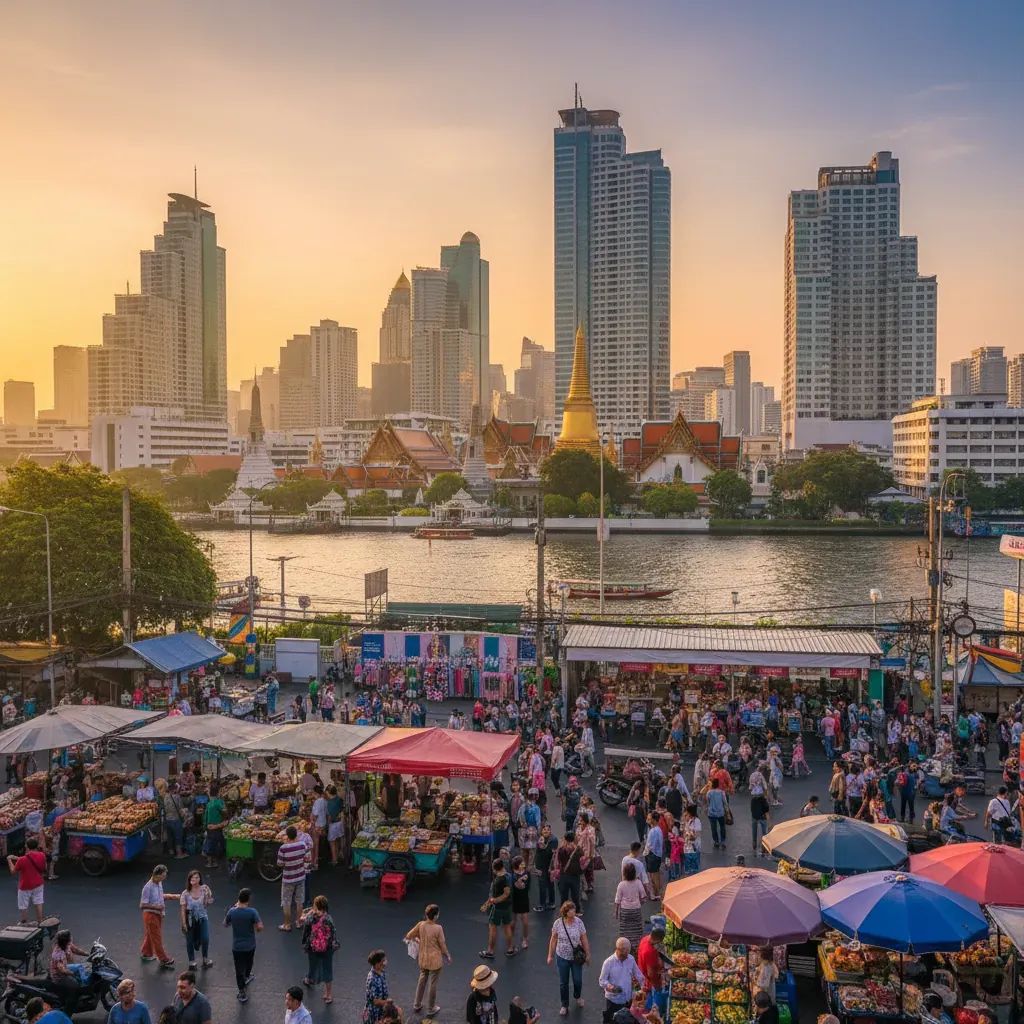
High-speed rail construction, new hospital openings, and a surge in tech sector jobs are reshaping daily life in Pattaya as the city executes an ambitious plan to become more than a beach resort. Behind the scenes, the Pattaya municipal government is fundamentally restructuring its economy—cutting the city's reliance on tourism from over 70% of total revenue to 60% by the end of 2025—and pivoting instead toward high-tech industries, logistics, and premium services within Thailand's Eastern Economic Corridor (EEC). The shift, outlined by Mayor Poramet Ngampichet at the annual Chonburi Real Estate Association summit on April 9, signals a long-term transition from beach resort to regional business capital.
Why This Matters for Residents
The transformation brings tangible changes to daily life in Pattaya:
• Economic diversification: The city is actively reducing tourism dependency and courting investments in healthcare, digital economy, and MICE (Meetings, Incentives, Conferences, Exhibitions) sectors—creating job opportunities across multiple industries.
• Infrastructure surge: The high-speed rail link connecting Bangkok airports to U-Tapao (with a Pattaya stop), Laem Chabang Port expansion, and the Pattaya monorail are all advancing, reshaping land values, rental yields, and commute patterns.
• Job creation: The broader EEC is projected to generate 500,000 new jobs by 2030, with Pattaya positioned as a primary beneficiary. However, job accessibility for foreign residents varies—most tech and logistics positions require Thai language proficiency or specific professional credentials, while MICE, healthcare, and service sectors offer more opportunities for English-speaking expats.
• Quality-of-life improvements: Better flood control, upgraded utilities, expanded healthcare, 5G coverage, and improved public transportation are directly addressing long-standing resident concerns about livability.
From Beach Town to Business Hub
Speaking at the Dusit Hotel event—attended by Chonburi Governor Naris Niramaiwong and private-sector leaders—Mayor Ngampichet emphasized that Pattaya must evolve into a "living economic city," where urban systems, infrastructure, and commerce function in an integrated way to serve residents, investors, and visitors alike. The mayor's messaging was direct: the city cannot remain dependent on fluctuating tourist arrivals. Instead, it must anchor itself to the EEC's industrial and logistical backbone, which spans Chachoengsao, Chonburi, and Rayong provinces.
The EEC initiative, aligned with Thailand 4.0 policy, targets a transition from traditional manufacturing to advanced technology and sustainable development. Pattaya's geographic advantage—nestled between the Laem Chabang deep-sea port (Thailand's largest) and the expanding U-Tapao International Airport—positions it as a natural gateway for cargo, talent, and capital flowing through the eastern seaboard.
What the Numbers Say
The ambition is backed by significant capital. A THB 700 billion ($22.56 billion) casino-free tourism and entertainment complex is moving forward within the EEC, designed to draw 40 million visitors annually. U-Tapao Airport's Phase 1 expansion, which officially kicked off in June 2025, aims for a 60 million passenger capacity by 2029, transforming nearby districts like Na Jomtien and Bang Saray into investment hotspots.
Meanwhile, the Laem Chabang Port Phase 3 expansion—set for completion between 2029 and 2031—will boost annual container capacity to 18.1 million TEUs and vehicle handling to 3 million units. As of March 2026, marine infrastructure construction was 91% complete. The port is integrating a rail hub to increase rail freight from 7% to 30% of total cargo, easing road congestion and cutting logistics costs.
The 220-km high-speed rail line linking Don Mueang, Suvarnabhumi, and U-Tapao airports (with a Pattaya stop) is expected to slash travel time between Bangkok and the EEC to under an hour. Construction began in late 2025, with completion targeted for 2029–2030. This rail link is already influencing property values along the corridor, especially in East Pattaya and Huay Yai, where the EEC Capital City (EECiti) is taking shape. Infrastructure tenders for EECiti opened in 2026, and the development will feature government offices, financial centers, medical facilities, and international schools.
The Monorail: Daily Life Game-Changer
The Pattaya monorail (Purple Line)—an 11-km mass transit system connecting Jomtien, Central Pattaya, and East Pattaya—represents one of the most significant infrastructure changes for residents' daily life. Scheduled for construction in 2027, the monorail is designed to address chronic traffic congestion by linking three key districts that currently rely heavily on motorcycles, taxis, and personal vehicles.
The proposed route includes stations in Jomtien Beach, Pattaya Second Road, Pattaya Third Road, South Pattaya, and East Pattaya near the EEC Medical City. Expected fare structure is comparable to Bangkok's BTS system (estimated 15–45 baht per journey), though final pricing hasn't been officially announced. The monorail is expected to reduce commute times significantly—for example, a current 30-40 minute drive from Jomtien to East Pattaya could be reduced to 15–20 minutes by rail. Completion is targeted for 2029–2030, though residents should anticipate construction disruptions and traffic diversions along the corridor during the build period.
Shifting Property and Labor Markets
The transformation is reshaping Pattaya's real estate landscape. Developers are pivoting from short-term holiday condos to long-term housing—townhouses, detached homes, and family-oriented projects—driven by an influx of skilled workers attached to EEC industries. New developments like ECO Home in Bang Saray and ASCENT BY BAAN PATTAYA in Huay Yai cater to this demographic, offering villas with private pools and proximity to new transport links.
Condominium projects in Wongamat and Central Pattaya are also multiplying, with several slated for completion in 2026 and beyond. Rental yields remain competitive, bolstered by foreign buyer demand, improved infrastructure, and the city's evolving reputation as a place to live and work, not just vacation.
Healthcare Expansion: What's Available Now and Coming
Healthcare infrastructure is undergoing significant expansion. Thammasat University Hospital Pattaya, a 300-bed digital hospital in the EEC Medical City area near East Pattaya, is now operational with plans to scale to 600 beds. The facility features modern diagnostic equipment, international-standard surgical suites, and English-speaking staff, catering to both residents and international patients.
For expat residents, the hospital accepts major international health insurance policies (Allianz, AXA, Bangkok International Insurance) and cash payments. Consultation fees for specialists range from 800–1,500 baht, comparable to or lower than Bangkok private hospitals. Emergency services are available 24/7. Current operational services include orthopedics, cardiology, gastroenterology, oncology, and maternity care. Planned expansions (2027–2030) include a dedicated medical imaging center and rehabilitation facility.
Compared to Bangkok's Bumrungrad or Samitivej hospitals, Thammasat Pattaya offers shorter wait times and lower costs, though some highly specialized treatments still require Bangkok referrals. For retirees and remote workers on fixed incomes, this facility represents a practical healthcare option without Bangkok travel.
The broader healthcare push also includes a Medical City initiative with plans for clinics, diagnostic centers, and long-term care facilities specifically targeting medical tourism and expat healthcare needs. However, detailed timelines and facility specifics are still being finalized.
What This Means If You Live in Pattaya Now
For Expat Residents and Remote Workers:The economic shift creates mixed opportunities. Tech and digital economy jobs are expanding, but most require Thai language proficiency or advanced certifications. However, MICE sector roles (event management, hospitality, translation services) and education positions (international schools, corporate training) offer more accessible entry points for English speakers. Property appreciation may benefit homeowners but could strain renters—anticipate rental cost increases of 10–15% annually in key areas like East Pattaya and Huay Yai through 2030.
For Retirees:Quality-of-life improvements (healthcare expansion, 5G infrastructure, traffic management) directly enhance daily living. However, the influx of working-age professionals could change neighborhood character—historically quiet areas like Huay Yai may see increased commercial activity and density. Healthcare access has significantly improved with Thammasat Hospital operational and more facilities planned. Cost of living may gradually increase but remains lower than Bangkok.
Construction Timeline and Daily Life Impact:
• 2026–2027: Monorail design finalization and corridor preparation; expect traffic diversions on Pattaya roads connecting Central to East Pattaya
• 2027–2029: Peak construction phase for monorail, high-speed rail, and port facilities; noise and traffic disruptions likely in coastal areas and East Pattaya
• 2029–2030: Major infrastructure completions; significant traffic relief and improved connectivity
• Most affected areas: East Pattaya (hospital, EECiti development), Huay Yai (EEC Capital City), Ba Saray (airport expansion), Jomtien (monorail corridor)
Small Business and Local Vendor Implications:While new commercial opportunities are emerging, traditional street vendors and small businesses in Central Pattaya face pressure from modernization projects. The city has committed to relocating affected vendors to dedicated commercial zones, but implementation details and compensation timelines remain unclear.
The Cost Question: Affordability in a Growing City
Rapid infrastructure and economic development typically drives property appreciation—a trend already visible in Pattaya. Rental prices in East Pattaya have increased 8–12% annually since 2023, and this pace is expected to accelerate as EEC developments gain momentum.
Current Market Data (March 2026):
• East Pattaya condos: 12,000–18,000 baht/month for 1BR (up from 10,000–15,000 in 2024)
• Huay Yai townhouses: 18,000–25,000 baht/month (up from 15,000–20,000 in 2024)
• Central Pattaya: 10,000–15,000 baht/month for older units (stable)
• Purchase prices: 1.5–2.2 million baht per square wah in East Pattaya (up from 1.2–1.8 million in 2024)
Affordable Housing Initiatives:The city government has allocated housing quotas in new developments for lower-income Thai nationals, but programs for foreign residents or remote workers remain limited. The EECiti development will include mixed-income residential zones, though pricing details are not yet public. Mayor Ngampichet has committed to preventing gentrification from displacing long-term residents, but specific affordability safeguards and rent control measures are still under discussion.
What Residents Should Anticipate:
• Continued rent increases of 10–15% annually through 2029 in high-growth areas
• Property values likely to appreciate 15–25% over five years for well-located assets
• Affordability pressure on current renters; locking in long-term leases now may be advantageous
• Potential for new affordable housing stock, but timelines and eligibility remain uncertain
Key Dates for Residents
• 2026: Completion of sidewalk improvements (May); Road Chao 81 project launch; EECiti infrastructure tender phase
• 2027: Monorail construction begins; Bali Hai Pier upgrade project starts (pending Cabinet approval)
• 2027–2029: Peak construction phase; expect traffic and noise disruptions in East Pattaya, Huay Yai, and coastal zones
• 2029–2030: High-speed rail completion; monorail operational; U-Tapao Phase 1 expansion targets 60 million passenger capacity
• 2029–2031: Laem Chabang Port Phase 3 expansion completion
• 2030: Bali Hai cruise terminal targeting operations
• 2037: Extended EEC development roadmap endpoint
Balancing Growth with Livability
Mayor Ngampichet acknowledged the challenges inherent in this transformation: balancing tourism with quality of life, managing uneven economic development, navigating construction disruptions, and ensuring equitable access to new opportunities. The city's goal, he said, is not just to remain a global travel destination but to become a place where people want to build careers and raise families.
The emphasis on "quality over quantity" in tourism is central to this vision. Rather than chasing sheer visitor numbers, Pattaya is targeting higher-spending segments—MICE, medical tourism, premium leisure—and coupling that with a digital economy ecosystem. The Eastern Economic Corridor of Innovation (EECi) serves as a research and technology hub, focusing on sustainability, agriculture value creation, industrial transformation, and future industries. Five Special Targeted Industry Clusters are prioritized: Medical and Healthcare; Digital and Electronics; Automotive and Next-Generation Mobility; Bio-Circular-Green (BCG) Economy; and High-Value Service Industries.
However, comparable transitions in other Thai cities present cautionary lessons. Rayong and Laem Chabang experienced rapid industrialization but faced issues with infrastructure strain, environmental concerns, and inflated housing costs that outpaced local wage growth. Pattaya's leadership is aware of these precedents and has emphasized public-private coordination to avoid repeating these mistakes—though execution will ultimately determine success.
Investment Climate and Incentives
The EEC framework offers tangible incentives for investors: corporate income tax exemptions and reductions, land ownership rights for foreign entities, and special visa and work permit schemes for international professionals. The government is targeting 3% GDP growth in 2026, with infrastructure and tourism as key drivers. For Pattaya, the influx of capital and talent is expected to ripple through hospitality, real estate, education, and health services.
The transformation timeline is aggressive. The second phase of the EEC Action Plan (2024–2027) involves 48 programs, including dual-track and high-speed rail systems, industrial estate expansions, and smart city infrastructure. The broader EEC development roadmap extends through 2037, with continuous rollouts of ports, logistics hubs, and innovation zones.
Public works are also visible on street level. Sidewalk improvements along Pattaya Second and Third Roads were over 70% complete in March 2026, with a finish date set for May 2026. The Eastern National Sports Stadium received over 20 million baht for grandstand roof upgrades, and the city launched the survey and design phase for Road Chao 81 in March 2026, scheduled for completion by January 2027. This project integrates road networks, drainage, electricity, water supply, and environmental management for sustainable urban growth.
Meanwhile, the Bali Hai Pier upgrade and cruise terminal, pending Cabinet review, may begin construction in 2026, with operations by 2030, targeting large international cruise liners.
The Road Ahead
Pattaya's transition is not without risk. The city must manage construction-related disruptions, ensure equitable access to new economic opportunities, prevent rapid gentrification from displacing long-term residents, and avoid repeating infrastructure bottlenecks seen in other EEC cities. The balance between growth, equity, and livability—emphasized repeatedly by Mayor Ngampichet—will ultimately determine whether the city becomes a genuine "living economic city" or simply replaces one form of economic dependency with another.
For residents, the takeaway is clear: Pattaya is no longer content to be a tourist playground. The infrastructure, investment, and policy momentum are all pointing toward a future where the city functions as a regional business and logistics hub, deeply integrated into Thailand's Eastern Economic Corridor. Whether that vision materializes as promised will depend on execution quality, governance accountability, and the city's demonstrated ability to absorb rapid change while preserving the livability qualities that attracted residents in the first place.
The next three to four years will be transformative—and challenging. Residents should prepare for construction disruptions, cost pressures, and neighborhood change, while positioning themselves to benefit from new job opportunities, improved services, and infrastructure that genuinely enhances daily life.


