
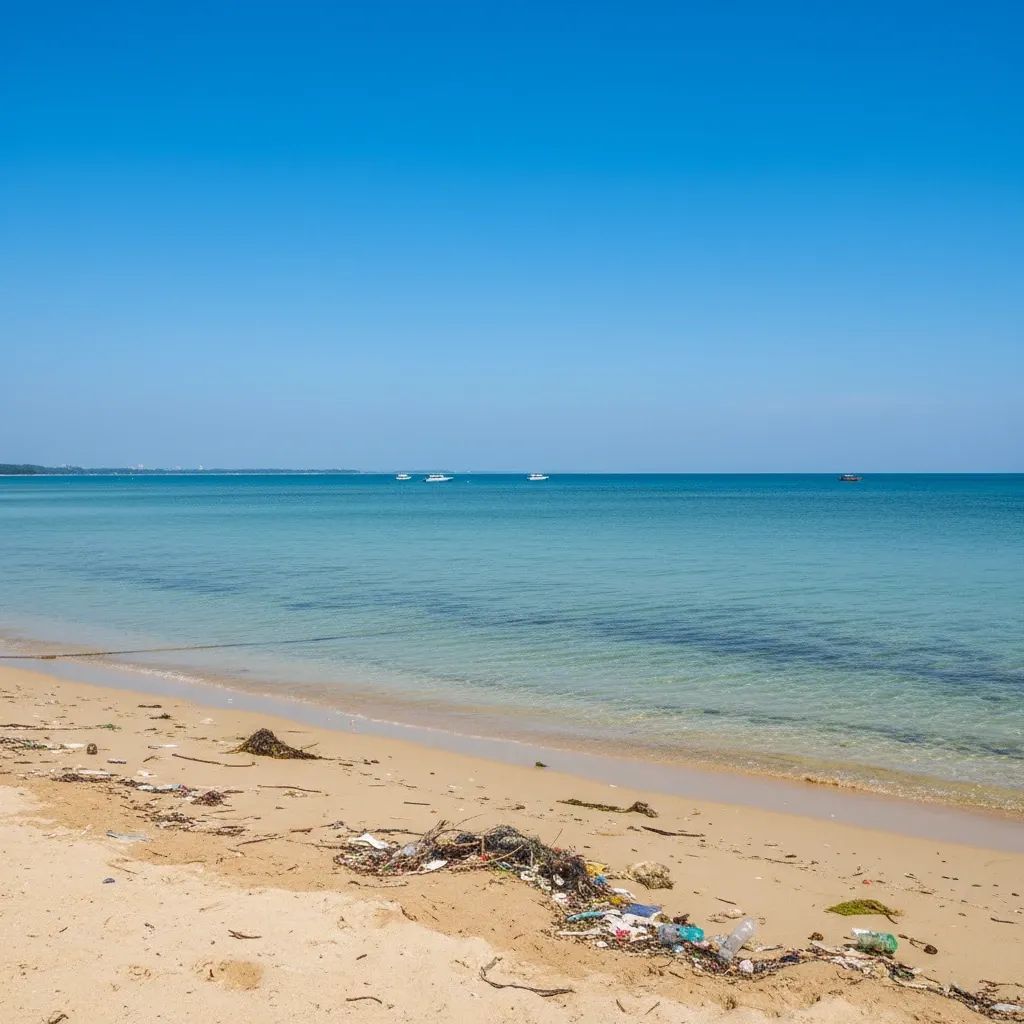
Pattaya's beaches are losing their appeal—not to competitors or shifting tastes, but to piles of trash left behind by visitors who have access to bins but choose not to use them. The situation has triggered sharp criticism across Thai social media, with locals and business owners now openly questioning whether enforcement mechanisms actually exist or remain purely symbolic.
Why This Matters
• Volume is accelerating: Pattaya expects 9.2M foreign tourists in 2026, a jump from 7.8M in 2025, meaning waste infrastructure faces mounting pressure during already-stretched peak periods.
• Marine debris compounds the problem: Between February and April 2026, monsoon currents deposited debris across several kilometres of Jomtien Beach, including nails and broken glass that created actual safety hazards and closed swimming areas.
• Enforcement gaps undermine deterrence: Current fines reach ฿2,000 ($60) for littering, but spotty application has made violators essentially invisible—creating zero behavioral incentive to comply.
• Economic stakes are concrete: Pattaya's ฿40B tourism economy depends on pristine beaches. Each viral social media image of garbage-strewn sand reduces bookings and competitive positioning against cleaner regional rivals.
The Waste Crisis Takes Shape
The Wan Lai Pattaya festival in April drew over 200,000 visitors within days. When the crowds dispersed, they left behind the expected litter—food containers, beer bottles, single-use plastics—despite municipal waste bins positioned every 50 metres along Beach Road. The Thailand Tourism Authority projects this pattern will intensify throughout 2026, with the Eastern Seaboard handling 20M annual visitors across greater Chonburi Province.
What distinguishes Pattaya's current crisis from past cycles is the compounding effect. Visitor-generated litter combines with marine debris swept in by seasonal currents. Cleanup crews must now address both sources simultaneously, a workload that municipal budgets struggle to absorb. Post-festival operations typically require three-day intensive cleanup campaigns that strain sanitation worker capacity and local resources.
Geographic concentration worsens the pressure. A 3-kilometre stretch of beachfront absorbs tens of thousands of daily visitors during peak season. Unlike sprawling inland cities that can distribute waste impact across multiple zones, coastal resorts face concentrated demand on finite natural assets.
Why Existing Laws Remain Toothless
Thailand's Cleanliness and Order Act of 2017 provides statutory authority for fines up to ฿2,000 for public space littering, ฿10,000 for waterway dumping, and ฿5,000 for hazardous waste abandonment. The Public Health Act of 1992 adds jail terms up to 1 month for serious violations. On paper, the framework is comprehensive.
In practice, enforcement remains inconsistent and often invisible. The Pattaya Deputy Mayor's office has installed CCTV cameras at known dumping sites and deployed inspection teams during peak activity hours, yet observers note these efforts concentrate on fixed locations rather than mobile beach areas where transient visitor populations complicate prosecution. A tourist who discards a beer bottle during a 30-minute beach visit faces minimal practical risk of identification or penalty.
Online commenters frequently reference international enforcement models. Singapore applies immediate spot fines with zero negotiation. Barcelona reduced beach litter by 80% through deposit systems and smoking restrictions. Mumbai's sustained cleanup initiative removed nearly 10M kilograms through community mobilization backed by consistent legal authority. Thailand's gap between statutory penalties and practical application has created what waste management analysts describe as an "expectation vacuum"—visitors perceive negligible enforcement risk, eliminating deterrent effect entirely.
This enforcement gap particularly disadvantages sanitation workers, who often migrate from Northeast Thailand and earn modest wages. Municipal negligence essentially transfers the burden to these workers, who face multi-day post-festival cleanup operations in heat and humidity that most affluent residents and tourists never experience.
What This Means for Long-Term Residents and Investors
For expatriates and established residents, the deteriorating beach environment directly affects quality of life and property value trajectory. Morning walks now require navigating debris fields. Beachfront condominium values face downward pressure as environmental degradation becomes visible and persistent through social media documentation.
Hospitality operators face more immediate economic pressure. Hotels and restaurants along Beach Road invest in private cleanup efforts to maintain their immediate frontage—essentially subsidizing municipal services that should handle coastal maintenance. The Pattaya Business and Tourism Association has quietly advocated for stricter enforcement, recognizing that viral images of trash-strewn beaches directly correlate with booking declines.
International tour operators increasingly factor environmental standards into destination recommendations. As sustainability consciousness shapes travel decisions among European and North American markets, Pattaya risks repositioning as an overtourism cautionary tale rather than a model tropical resort. Competing destinations in Vietnam, Malaysia, and the Philippines now actively market environmental credentials as differentiators.
Local business dynamics have shifted. Some resort operators now budget explicitly for environmental remediation as a line item, viewing it as necessary competitive insurance rather than optional expenditure. This cost externalization—private sectors absorbing public infrastructure failure—creates resentment and questions about fair burden-sharing.
Proven Solutions Exist Elsewhere; Thailand Hasn't Adopted Them
Thai-language social media discussions reveal sophisticated awareness of solutions implemented internationally. Deposit-return schemes, now standard across Scandinavia and parts of Europe, create financial incentive for proper disposal. Consumers pay small surcharges refunded upon container return—a mechanism that fundamentally changes cost-benefit calculations for abandonment.
Designated consumption zones represent another widely-discussed model used successfully in Japan and coastal Australia. This approach restricts food and beverage consumption to specific beach areas with enhanced collection infrastructure, allowing authorities to concentrate enforcement resources while maintaining general beach access.
Technology offers additional pathways. The Netherlands deploys AI-powered smart bins for automatic waste sorting. Baltimore's harbour uses solar-powered collection systems to intercept debris before reaching open water. Thailand's Department of Marine and Coastal Resources experimented with floating boom systems in Bangkok's Chao Phraya River, with expansion to coastal areas pending budget approval.
Alcohol restrictions generate ongoing debate. Some advocates push glass container bans citing safety hazards when bottles break on sand. Others argue this addresses symptoms rather than root causes, noting that responsible consumption coexists with beach cleanliness in many international destinations. The distinction matters: it separates behavioural factors from structural ones.
The Pattaya Environmental Office currently promotes a 6-category waste separation system using transparent bags for easier inspection, with free bulk item collection via municipal hotline (1337). Yet these programmes remain voluntary and poorly advertised to the tourist population most responsible for beachfront accumulation.
The Economic Calculus: Cost of Inaction Versus Investment
Tourism generates approximately ฿40B annually for Pattaya's economy, supporting 150,000 direct and indirect jobs. Environmental degradation threatens this revenue stream as social media amplifies negative perceptions faster than official cleanup efforts can respond. A single viral image of trash-covered sand can deter thousands of potential visitors whose booking algorithms increasingly filter for environmental consciousness.
The Thailand Office of Tourism Development acknowledges competitive pressure. While Pattaya improved compared to previous years—particularly during major holidays—the margin for error narrows as regional alternatives intensify marketing around pristine beaches and sustainable practices. Vietnam, Malaysia, and the Philippines actively capture market share from established Thai resorts using environmental differentiation.
Remediation costs compound the fiscal challenge. The Pattaya Municipal Budget allocates ฿120M annually for waste management, a figure that must cover residential collection, illegal dumping site remediation, and marine debris removal simultaneously. As tourist volumes grow, this budget line faces increasing pressure without commensurate revenue increases from national tourism taxes—a structural mismatch that guarantees deterioration absent policy intervention.
Infrastructure scaling cannot proceed through traditional municipal budgeting alone. Private sector partnership becomes necessary. Yet current arrangements pit hospitality operators against city administration over responsibility demarcation, creating friction that delays solutions.
Behavioural Dimensions Complicate One-Size-Fits-All Approaches
Long-term observers note that litter behaviour splits along complex lines not easily reduced to nationality or income. Younger Thai tourists often demonstrate strong environmental awareness from school programmes. Certain international visitor segments—particularly budget tour groups—exhibit less concern for cleanup. Northern European visitors typically show high compliance; some Asian markets lack equivalent social conditioning.
The "tragedy of the commons" dynamic operates visibly: when surrounded by existing litter, individuals feel less compunction about adding to the mess. Early-morning cleanup crews report that pristine beaches remain cleaner throughout the day, suggesting that visible maintenance creates social pressure for compliance. This observation offers practical insight: initial investment in cleanup may yield compounding behavioral benefits as social norms gradually shift.
Alcohol consumption intersects with the problem imperfectly. Sober picnickers abandon food waste; intoxicated revellers sometimes clean up meticulously. The correlation exists but remains weak, suggesting that targeted interventions must address broader patterns rather than single factors.
The Strategic Divergence: Reactive Versus Preventive Approaches
The Pattaya City Council faces a choice between maintaining current reactive cleanup patterns—essentially accepting permanent litter management—versus implementing proactive systems that prevent generation at source. The latter requires political will to enforce existing laws consistently, potentially generating friction with tourism operators concerned about visitor experience friction.
International best practices suggest multi-layered strategy: strict enforcement creating deterrence; infrastructure improvements making proper disposal convenient; education campaigns shifting social norms; and technological solutions automating collection and sorting. No single intervention suffices. Successful beach destinations combine all four approaches simultaneously while maintaining political commitment across electoral cycles.
The question transcends Pattaya. Coastal provinces from Krabi to Koh Samui face identical challenges as tourism volumes recover and grow. Solutions pioneered in Pattaya will establish precedents affecting Thailand's entire coastal tourism infrastructure for the coming decade.
The online outcry reflects genuine concern among residents and regular visitors who recognize potential squandered. Pattaya possesses natural advantages and decades of hospitality expertise. Whether it can match that foundation with environmental stewardship remains the central question for local authorities as peak season approaches and municipal budgets face renewal discussions. The answer will shape not just Pattaya's competitive position but Thailand's broader coastal tourism trajectory.


