
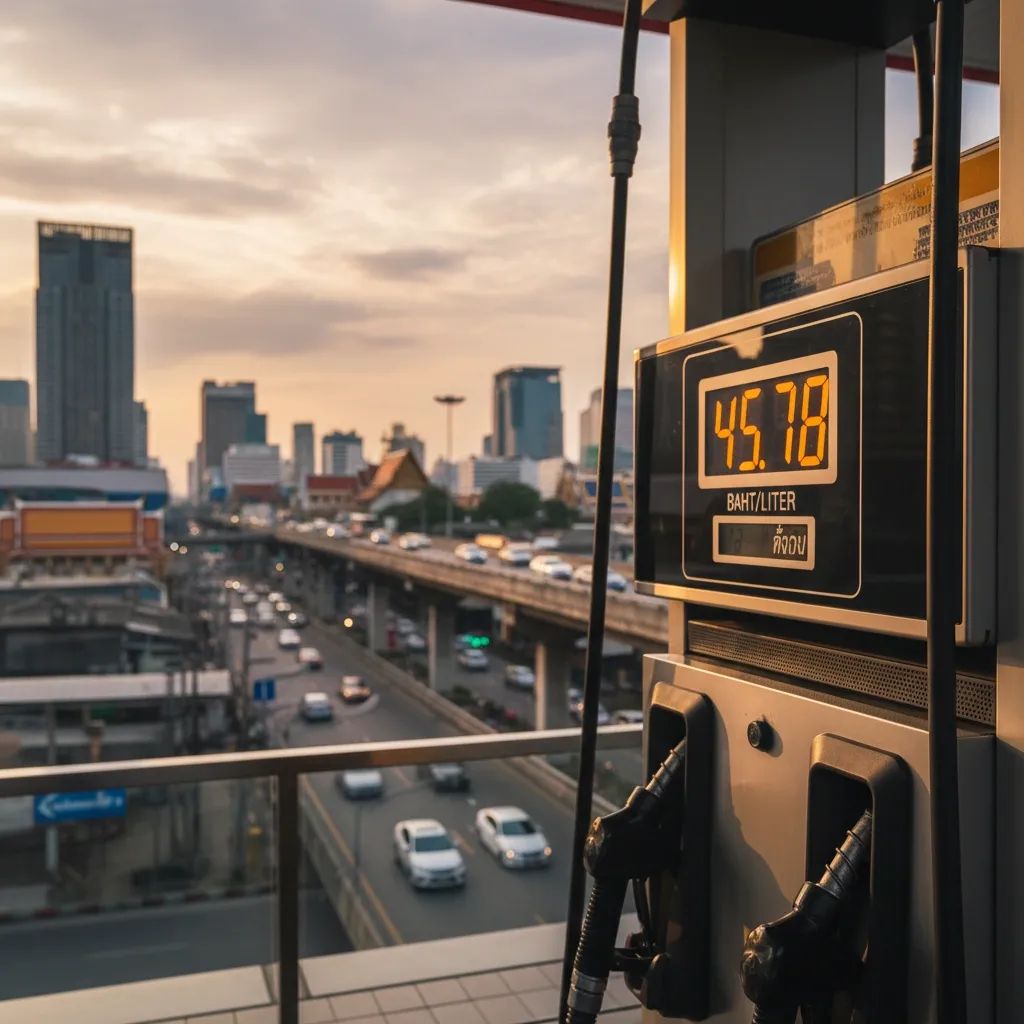
The Strait of Hormuz blockade has triggered an oil crisis so acute that global petroleum inventories are approaching depletion within weeks—and when they do, energy markets face a potential supply shock comparable to the 1970s energy embargo. Neil Chapman, Senior Vice-President of ExxonMobil, warned May 29 that if current inventory depletion rates persist, Dated Brent crude could surge to $150–$160 per barrel, a jump that would ripple immediately through fuel costs, inflation, and business operations across Thailand and the wider region.
Why This Matters
• Timeline is compressed: Global crude reserves are falling at 8.7 million barrels daily—the fastest recorded pace. Depletion to minimum operational levels could occur within 2–3 weeks, not months.
• Thailand's exposure: The Kingdom imports roughly 80% of its oil consumption and historically relied on supplies passing through the now-blockaded Strait of Hormuz. Price shock hits directly at pumps, transportation, and manufacturing.
• Supply cushion is expiring: Strategic reserves released by the IEA in March (400 million barrels globally) can sustain only 66 days of the current supply deficit before depletion. That window closes in early June 2026.
• Knock-on inflation risk: Sustained oil prices above $120 per barrel could add 0.8% to global inflation, delaying interest rate cuts and extending the period of elevated borrowing costs for Thai households and businesses.
The Crisis Sequence: From Blockade to Inventory Collapse
The disruption did not emerge from market dysfunction or speculation. On February 28, 2026, Iran's Revolutionary Guard Corps blockaded the Strait of Hormuz following U.S. and Israeli military operations, deploying sea mines and attacking merchant vessels. Within days, commercial shipping—which normally carries 20–21 million barrels daily through the waterway—collapsed by 70%, leaving over 150 tankers anchored outside the strait unable to move.
By early April, the U.S. Navy established its own counter-blockade on Iranian ports, creating a dual-blockade scenario that halted more than 11 million barrels per day of Persian Gulf oil and condensate production. A ceasefire was negotiated in early April, but the underlying dispute persists: Iran established a "Persian Gulf Strait Authority" demanding transit fees and sovereignty over the waterway—a claim rejected by the United States and Gulf states. Negotiations remain deadlocked.
The practical effect: approximately 10 million barrels daily of supply that normally flows through the Strait is now rerouted via the longer Cape of Good Hope route or regional bypass pipelines. These alternatives can manage a maximum of 10 million barrels per day combined—exactly matching the displaced volume on paper, but with months-long transit delays that have drained inventories accumulated over prior decades. The result is a structural supply deficit that is not bridged by alternative routes; it is deferred and then accelerated.
The International Energy Agency documented this acceleration: Global visible petroleum stocks experienced a draw of 157 million barrels in March alone—an all-time record daily pace of 5.1 million barrels. By May, Goldman Sachs calculated that global crude reserves had fallen from roughly 101 days of consumption to 98 days, with ongoing daily draws accelerating to 8.7 million barrels by late May. The U.S. Energy Information Administration confirmed that U.S. crude oil inventories alone declined 3.33 million barrels during the final week of May, alongside notable drops in gasoline and distillate stockpiles.
These are not projections or modeling exercises. They are recorded physical barrels exiting storage and entering the market faster than they are being replenished.
Asia's Structural Disadvantage in a Tight Oil Market
Historically, 80–85% of crude oil and condensate flowing through the Strait of Hormuz were destined for Asian markets, with China, India, Japan, and South Korea as the dominant importers. Thailand sits within this same regional supply architecture, drawing approximately 80% of its oil consumption from overseas sources. For a country with limited spare refining capacity and heavy import dependence, a supply tightness affecting Asian procurement is not an abstraction—it is a direct operational constraint.
Asia is already experiencing acute shortages as of May 2026, according to energy analysts surveying current conditions. Other global regions are projected to reach minimum operational inventory levels by July if depletion trends persist unchanged. The region cannot respond by simply shifting supply sources; alternative suppliers outside the Middle East lack the spare production capacity to absorb Asian demand.
The Thailand Energy Ministry has not announced independent strategic reserve releases beyond the Kingdom's participation in the IEA's historic March release of 400 million barrels globally. That intervention, while unprecedented in scale, is proving structurally inadequate. The U.S. Strategic Petroleum Reserve, which holds the world's largest commercial stockpile, can sustain a maximum drawdown rate of only 1.0–1.2 million barrels daily—equivalent to roughly one-tenth of the current supply deficit. Energy analysts have characterized the measure frankly as a temporary palliative, not a structural solution. When those released reserves are exhausted—a threshold approaching in early June—the market will confront the full magnitude of the supply loss without any official cushion.
Darren Woods, ExxonMobil's Chief Executive, acknowledged this transition during the company's Q1 2026 earnings call on May 2. He noted that oil in transit, strategic reserve releases, and commercial inventory drawdowns had mitigated impacts through March and April, but explicitly flagged: "as inventories approach minimum working levels," ExxonMobil anticipated significant upward price pressure if the Strait remained closed. That scenario has now materialized, positioning May through early June 2026 as the critical depletion window.
What a Price Spike Looks Like for Thailand's Economy
Current Brent crude is trading near $105 per barrel, already substantially elevated above the $60–$80 range typical of 2024–2025. Chapman's projection of $150–$160 per barrel represents a 43–52% increase from current levels—a magnitude that does not remain confined to global commodity exchanges.
Diesel prices at Thai pumps would rise proportionally within days. Diesel fuel the nation's transport, logistics, and agricultural sectors, so price increases cascade immediately into food distribution costs, manufacturing inputs, and service delivery across the economy. A food supplier faces higher distribution costs; a construction company faces elevated fuel surcharges; a taxi operator absorbs tighter margins. These are not theoretical losses—they are direct compressive pressures on business profitability and household purchasing power.
Inflation persistence complicates monetary policy decisions. The Bank of Thailand has maintained elevated interest rates to combat inflation driven partly by energy costs. Sustained crude prices above $120 per barrel would make interest rate cuts economically and politically difficult to justify, extending the period during which Thai borrowers face higher mortgage rates, auto loan costs, and credit card interest. For households already strained by existing rate levels, delayed relief is economically meaningful—it represents deferred recovery in real purchasing power.
Manufacturing and petrochemical sectors face dual pressures. Thailand's substantial plastics and chemicals industries depend on hydrocarbon feedstocks transiting the Strait—materials now subject to both availability constraints and cost volatility. Companies managing these inputs confront two simultaneous challenges: securing sufficient supply in a tightened market and absorbing or passing through higher costs to downstream customers. Some will choose to reduce capacity or defer expansion projects, with employment implications.
Export-oriented sectors face demand contraction risk. The International Energy Agency has warned that a prolonged energy shock could trigger a shallow global recession in the second half of 2026, with global oil demand expected to contract by 420,000 barrels per day. For an economy as dependent on external trade as Thailand's, any global contraction directly impacts export competitiveness and domestic employment that depends on external demand. Tourism, manufacturing, and agriculture all face potential headwinds if global growth decelerates.
Wood Mackenzie, an energy research firm, has modeled three scenarios. A "Quick Peace" scenario, with the Strait reopening by June, would allow global recovery by year-end 2026. A "Summer Settlement" extending closure to September points to persistent shortages and shallow recession in the second half of 2026—manageable but lasting. The most severe "Extended Disruption" scenario, with the Strait closed through December, would trigger deeper recession and what the firm describes as "economic scarring"—lasting productivity and employment damage.
The Response: Limited Tools, Temporary Effectiveness
Governments and the energy industry have deployed countermeasures, but their limits are evident. The IEA's March release of 400 million barrels was historically unprecedented and politically significant—a demonstration that member countries could act in concert during crisis. But the physics of the measure are constraining.
The U.S. Strategic Petroleum Reserve can theoretically extract 4.4 million barrels daily at maximum, but sustained realistic extraction runs at 1.0–1.2 million barrels daily given aging infrastructure and prior drawdowns in 2022. If all 400 million barrels from the coordinated IEA release were deployed at maximum capacity, they would last approximately 66 days against the current 10+ million barrel daily supply deficit. That math is unforgiving: the cushion exhausts by early June 2026, leaving markets to confront the unmitigated supply loss.
Logistical delays compound the problem. The U.S. Department of Energy requires approximately 13 days for bidding and contract award before oil moves from reserve to market. Additional time is required for transportation to refineries. The theoretical release date in March therefore translated to actual market availability by late March at the earliest—a lag that has already compressed the effective buffer window.
Private industry responses have been muted. Refinery throughput increases face constraints; existing refineries are already operating near capacity across Asia. New refining infrastructure cannot be constructed in weeks. Energy companies have increased production where operationally feasible—ExxonMobil reported record production from its Guyana operations in Q1 2026—but these increases, while meaningful, operate at the margin relative to the 10+ million barrel daily supply loss. They do not close the structural gap.
The Market Paradox: Why Demand Destruction Takes Time
Chapman's projection assumes that once prices reach $150–$160 per barrel, demand destruction will eventually rebalance the market. In straightforward terms: at extreme prices, some consumers reduce consumption or shift behavior, demand declines, and prices stabilize at a higher equilibrium. This is how markets theoretically self-correct. But there is a transition period between price shock and demand response during which people still require fuel, electricity, and transported goods at prices well above historical norms. That interim period is the inflationary shock period—the painful adjustment window.
Additionally, once the geopolitical impasse ends and the Strait reopens, nations and energy companies will compete fiercely to replenish strategic reserves that have been drawn down. This simultaneous restocking across multiple countries creates a secondary demand spike, potentially sustaining elevated prices for months beyond the initial disruption. The time lag between supply restoration and price normalization could extend well into late 2026 or early 2027.
The structural backdrop adds risk. The global oil industry has underinvested in new production capacity over the past five years as capital shifted toward renewable energy and energy transition assets. Even if the Strait reopens tomorrow, the ability to rapidly ramp Persian Gulf production back to normal levels is constrained by maintenance backlogs, equipment delays, and investment gaps accumulated during the underinvestment period. Some energy analysts project that structurally higher oil prices could persist for years independent of the current geopolitical disruption—simply because new production capacity cannot be built or brought online quickly enough to satisfy demand.
The Window Closing: June 2026 as the Inflection Point
Chapman's warning rests on data, not speculation. Global inventories are depleting at record pace. The mechanisms that have cushioned against price shocks—accumulated reserves and strategic petroleum releases—are finite and approaching exhaustion. The timeline is weeks, not months.
ExxonMobil, Barclays, UBS, and the U.S. Energy Information Administration are not predicting high prices in isolation or by accident. The directional consensus is clear: if the Strait remains closed and inventories continue depleting at current rates, oil prices face significant upward pressure. Whether Chapman's specific $150–$160 projection materializes or prices peak at $130–$140 is less important than the underlying reality: the buffer system supporting current prices is expiring on a definable timeline.
For residents and businesses in Thailand, the practical implication is unambiguous: fuel costs will likely rise materially in June or July 2026, translating through to food prices, transportation costs, manufacturing expenses, and utility bills. Whether price increases occur at the high end of forecasts or moderate somewhat, the direction is certain. The countdown is real. The adjustment will be felt broadly across household and business budgets within six weeks. And swift diplomatic resolution to the Strait of Hormuz impasse is now the difference between sustained manageable inflation and a sharper, more disruptive energy shock that constrains growth and raises borrowing costs simultaneously.


