
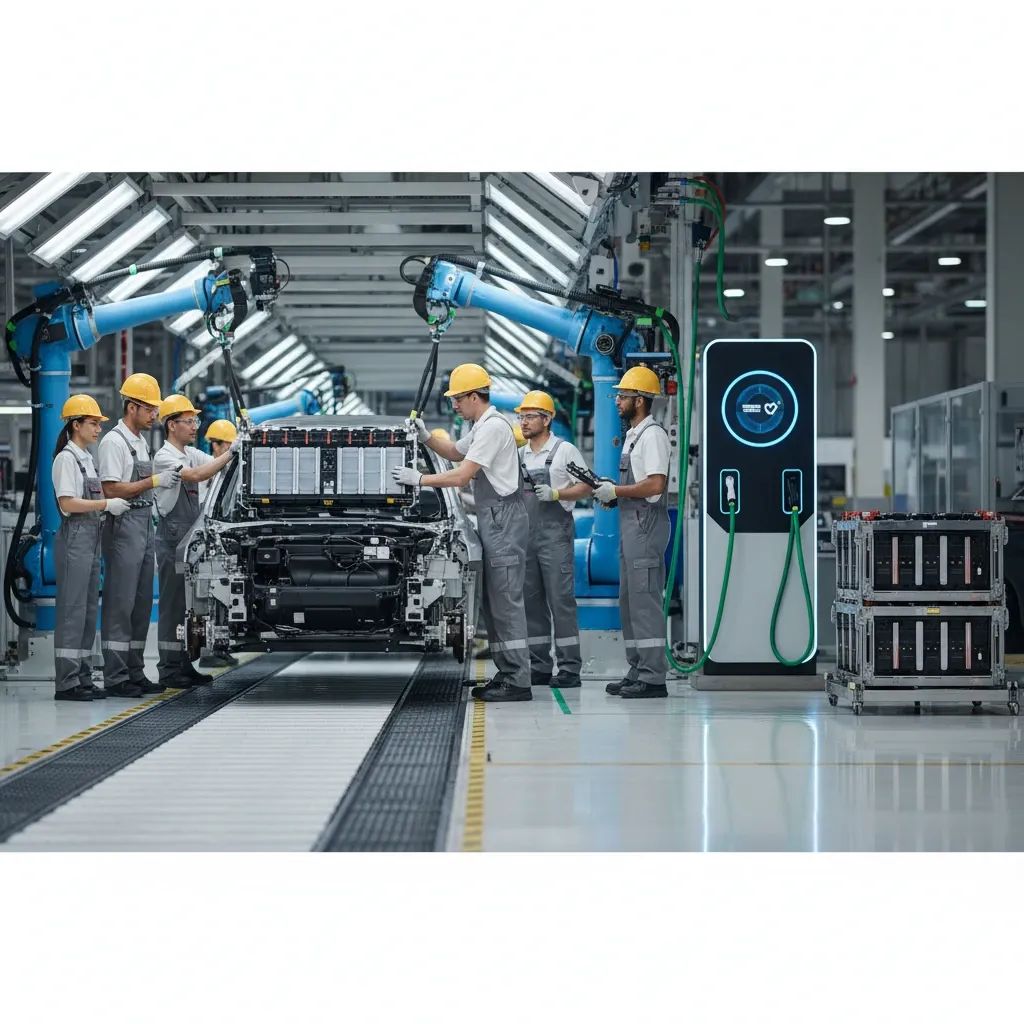
Thailand's electric vehicle manufacturing base faces a pivotal test as the country's flagship EV3.5 incentive program winds down at the end of 2027, raising fundamental questions about whether automakers will continue building cars locally or shift to importing cheaper models from China.
Why This Matters:
• Subsidies worth up to 100,000 THB per vehicle and tax breaks that slashed excise duty from 8% to 2% will disappear, potentially raising EV prices
• Chinese imports could flood the market under 0% ASEAN-China FTA tariffs, undercutting locally-made vehicles
• The Federation of Thai Industries warns of a potential production collapse if new support measures aren't ready by 2028
• Your next EV purchase may cost more or come with fewer locally-made options starting in 2028
The Subsidy Cliff Looming Over Thailand's Auto Sector
The Thailand Board of Investment's EV3.5 scheme, launched in 2024 with a four-year lifespan, has reshaped the country's automotive landscape. The program delivered generous cash subsidies between 20,000-100,000 THB depending on vehicle price and battery capacity, reduced excise taxes to just 2% for models under 7M THB, and temporarily cut import duties on completely built-up units by up to 40% through 2025.
But those incentives came with strings attached. Manufacturers enjoying the import breaks must produce two vehicles domestically for every one imported by 2026, escalating to a three-to-one ratio in 2027. The government simultaneously tightened battery localization rules, capping imported battery cells at 10% of factory price from January 2026 and eliminating their contribution to local content requirements after June 2026.
The strategy worked—at least initially. Thailand attracted over $4.1B in EV supply chain investments across 198 projects, with battery electric vehicle production capacity climbing toward 370,000 units annually. Major players including Mercedes-Benz, BYD, Great Wall Motor, SAIC, Aion, Changan, and Hyundai established assembly operations between 2022 and 2026. Changan alone is targeting 200,000 units yearly at its Rayong facility and pledged to reach 70% local sourcing of EV components by 2027.
Sales figures tell the success story clearly. Electric vehicle registrations tripled year-on-year in January 2026, surpassing 44,000 units and achieving a remarkable 48% market penetration rate. Chinese manufacturers captured 46.8% of the market that month, selling 42,251 units. For full-year 2025, electrified vehicles represented over 40% of new registrations, with pure battery-electrics accounting for 19.6% and hybrids another 21.8%.
What This Means for Manufacturers and Buyers
The program's expiration creates a stark inflection point. Without the subsidy cushion and tax advantages, automakers face significantly higher operating costs in Thailand. The Federation of Thai Industries has sounded alarms that manufacturers may simply pivot to importing finished vehicles from China, where production costs remain lower and the ASEAN-China Free Trade Agreement guarantees zero-tariff entry into Thailand's market.
This scenario poses an existential threat to the domestic parts supply chain and assembly workforce. Local component manufacturers, who invested heavily expecting continued production volume, already report declining orders. A shift toward imports would leave these suppliers stranded with excess capacity and mounting losses.
For consumers, the immediate impact translates to potentially higher sticker prices starting in 2028. The loss of 50,000-100,000 THB subsidies—equivalent to several months' salary for middle-income Thai buyers—combined with excise tax increases from 2% back to 8% could push many popular EV models out of reach for first-time electric buyers. This threatens to stall adoption momentum just as Thailand pursues its ambitious 30% zero-emission vehicle target by 2030 (725,000 cars and 675,000 motorcycles).
Yet not everyone sees crisis ahead. Thai-made electric vehicles already increased their domestic market share from 5% in 2024 to 20% in 2025, demonstrating that local production can compete when supported by scale and supply chain maturity. The question is whether that progress can survive without policy scaffolding.
Industry Pushes for "EV 4.0" Framework
Recognizing the looming gap, ten Thai automotive associations have jointly proposed a comprehensive post-2027 strategy to government ministries. Their recommendations center on maintaining competitive advantages for local production without simply extending blanket subsidies.
The excise tax reform proposal would create a larger differential between imported and domestically-manufactured EVs, essentially penalizing finished imports while keeping local assembly attractive. This approach mirrors strategies used in Indonesia and Vietnam to protect nascent EV industries from Chinese competition.
More controversially, the associations advocate for stricter local content requirements, proposing a minimum 80% threshold for vehicle production—though the Thailand Ministry of Industry has not yet responded to this specific figure. They also suggest linking future import quota allocations to concrete domestic investments in assembly plants, charging infrastructure, R&D centers, and battery recycling facilities. Under this framework, companies wanting to import EVs at preferential tax rates would need to demonstrate equivalent commitments to Thailand's manufacturing ecosystem.
The industry coalition has floated an "EV 4.0" incentive package specifically targeting affordable, entry-level models priced below 800,000 THB. This reflects growing political sensitivity about EV subsidies disproportionately benefiting wealthier buyers who can afford premium Chinese models, while lower-income Thais remain priced out of electric mobility. Focusing future support on the sub-800K segment could broaden adoption while addressing equity concerns.
Interestingly, hybrid electric vehicles are experiencing renewed policy attention. The Thailand government now emphasizes clearer guidelines for HEV manufacturers, with technical requirements for components and batteries that favor local content. This pivot acknowledges market realities—hybrids captured 21.8% of 2025 sales—and provides a hedge if pure battery-electric adoption slows due to higher prices or charging infrastructure limitations.
Regional Hub Strategy Faces Reality Check
Thailand's broader ambition to serve as ASEAN's EV manufacturing hub depends heavily on resolving the post-2027 policy framework. The government has promoted Thailand as a regional export platform, with each exported EV counting as 1.5 units toward manufacturers' domestic production obligations through June following the model year.
But this export-oriented strategy assumes Thailand can maintain cost competitiveness against China's massive scale and Vietnam's lower labor costs. Thailand's total automotive production target for 2026 sits at 1.5M units (950K export, 550K domestic), but achieving the 2030 zero-emission vehicle goal requires sustained investment in battery cell manufacturing and electric motor production—segments where China currently dominates global capacity.
The registration deadline for EV3.5-qualified vehicles has been extended from December 2027 to January 2028, giving manufacturers a brief buffer. Yet automotive executives privately acknowledge this merely postpones the reckoning rather than resolving underlying policy uncertainty.
Some analysts suggest Thailand may need to accept that not all EV models can or should be built locally. A tiered approach—domestic assembly for high-volume mainstream models, strategic imports for niche premium and budget segments—might optimize the country's competitive advantages in mid-market production while allowing consumer choice across price points.
What Comes Next
The Thailand Cabinet faces pressure to announce successor policies well before 2027 ends, as automakers make 2028 production and investment decisions throughout the coming 18 months. Delay creates paralysis, potentially causing manufacturers to hedge by reducing Thailand commitments and preserving flexibility to import.
The outcome will shape whether Thailand emerges as a genuine regional EV powerhouse or remains primarily an assembly market dependent on imported technology and components. For residents, the practical question is simpler: will your next electric vehicle cost more, and will it say "Made in Thailand" on the door jamb.


