
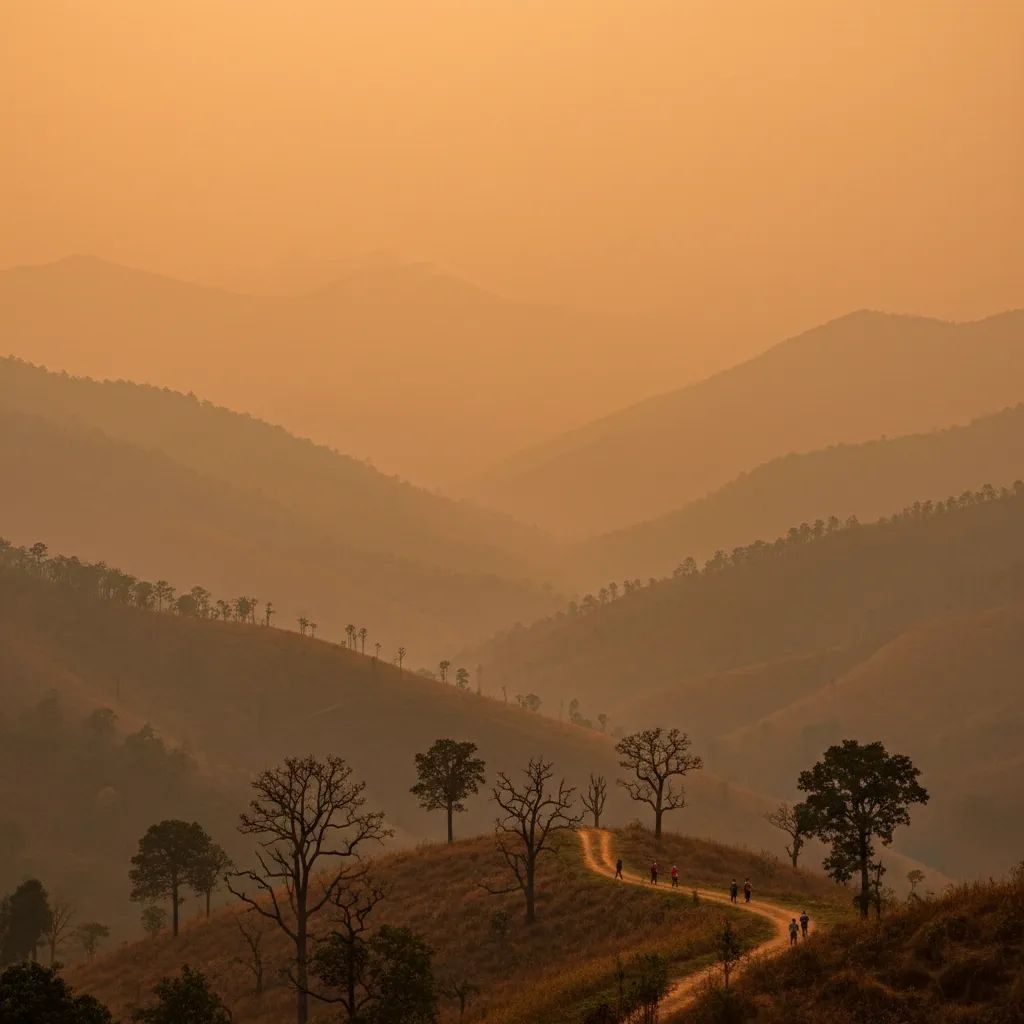
The Thailand Ministry of Natural Resources and Environment has confirmed that forest fires across the northern region remain at crisis levels despite intensified government intervention, with satellite detection systems logging over 1,500 hotspots in a single day across 17 provinces during late April. The situation has now persisted into early May, straining public health systems and threatening economic stability in tourism-dependent provinces.
Why This Matters
• Health emergency: Chiang Mai recorded 4,240 respiratory cases in the first week of April alone, part of 147,107 cumulative cases this burning season — a year-on-year increase since 2022.
• Economic hemorrhage: Tourism cancellations and health costs are estimated to inflict 5,000–10,000M baht in opportunity losses, according to Kasikorn Research Center projections.
• Legal enforcement: Four provinces — Nan, Phrae, Sukhothai, and Tak — imposed forest entry bans throughout April, with violators facing up to 20 years imprisonment and 200,000 baht fines.
• Persistent threat: As of May 2, Chiang Mai has accumulated 10,872 hotspots since January 1, a 139% surge compared to the same period in 2025.
The Scale of the Crisis
Satellite imagery from the Suomi NPP system captured the severity on April 20, when Thailand's Northern Fire Operations Center detected 1,518 active hotspots scattered across protected forest zones. Conservation forests bore the brunt, accounting for 1,013 of those ignition points. Tak Province led with 238 detections, followed closely by Chiang Mai with 237.
By early May, the situation showed minimal improvement. On May 2, Lampang Province experienced renewed outbreaks in multiple protected forest reserves immediately after the open-burning prohibition expired on April 30. Volunteer fire crews were forced to retreat from several zones as erratic wind patterns and intense flame fronts made containment impossible.
The geography of northern Thailand — a basin ringed by steep mountain ranges — creates a natural trap for smoke and particulate matter. Combined with delayed monsoon rains and temperatures reaching 38°C in some areas, the region has become what environmental monitors describe as a "combustion chamber."
Root Causes: Drought, Heat, and Human Activity
The Thailand Meteorological Department attributes the ferocity of this year's burning season to a confluence of climate factors. The transition from La Niña conditions back to neutral in early 2026 suppressed rainfall, creating accumulated dryness in forest undergrowth. Peak fire risk occurs daily between 2:00 PM and 4:00 PM, when temperatures peak and humidity drops.
But climate alone doesn't explain the crisis. Government investigators confirm that nearly 100% of ignitions trace back to human actions: slash-and-burn agriculture to clear cornfields, illegal hunting expeditions that use fire to flush game, and deliberate arson to harvest forest products like mushrooms.
Cross-border pollution compounds the domestic problem. Neighboring Myanmar and Laos generate thousands of additional hotspots during the dry season, with prevailing winds carrying PM2.5 particulate clouds directly into Thailand's northern provinces. The Geo-Informatics and Space Technology Development Agency (GISTDA) has been tracking these transboundary flows as part of the government's monitoring infrastructure.
Government Response: Ambitious Policies, Mixed Results
The Thailand Cabinet elevated the wildfire and haze crisis to national agenda status earlier this year, approving a comprehensive five-pillar strategy covering agricultural zones, forest areas, urban centers, cross-border pollution, and centralized coordination.
Key measures include:
Agricultural Controls: Registration systems for farmers requiring controlled burns, with sugar mills prohibited from accepting more than 15% fire-scorched cane in their intake. Residue management programs aim to redirect crop waste away from open burning.
Forest Management: The "Zero Burn" policy has been coupled with a cluster-based approach covering 14 major forest groups nationwide. Provincial governors received full executive authority over firefighting operations in their jurisdictions. Helicopter water-bombing missions were deployed to Nakhon Sawan and Mae Hong Son provinces.
Access Restrictions: The month-long ban on entering protected forests in four provinces represented the most stringent enforcement measure. While exemptions were granted for registered residents with legitimate needs, enforcement teams struggled with vast, mountainous terrain that makes surveillance difficult.
Technology Integration: The Digital Economy and Society Ministry announced plans for a unified "One Map" platform that will consolidate national data systems to enable real-time wildfire tracking and cross-agency coordination.
Cross-Border Diplomacy: New import controls target corn feed originating from burn zones, attempting to economically disincentivize slash-and-burn practices in neighboring countries. Ministerial-level discussions within the Mekong Subregion and ASEAN frameworks are ongoing.
Early results showed promise. In February, the cluster-forest management model — piloted in 2025 — achieved a 69% reduction in hotspots compared to the previous year's baseline. Chiang Mai itself posted a 76% drop in hotspots and 36% reduction in burned area during 2025, demonstrating that coordinated planning and rapid response can work.
Yet April and early May revealed the limitations of these interventions. Despite all enforcement efforts, accumulated hotspots in Chiang Mai surged 139% year-over-year through early May. The government's target of reducing forest burning by 10% and agricultural burning by 15% nationwide appears increasingly ambitious as the season drags on.
What This Means for Residents
For anyone living in or visiting northern Thailand, the immediate reality is hazardous air quality that persists for weeks at a stretch. PM2.5 concentrations regularly exceed safe thresholds, triggering respiratory distress, eye irritation, and systemic inflammation. Research conducted in Chiang Mai found that every 10 μg/m³ increase in PM2.5 correlates with a 1.8% rise in daily mortality rates, with cardiovascular and acute respiratory events driving the increase.
Vulnerable populations — children, pregnant women, the elderly, and those with chronic conditions — face compounded risks. The Thailand Ministry of Public Health has distributed N95 masks and established "clean air rooms" in affected provinces, but access remains limited in rural areas.
Economic impacts ripple through daily life. Tourism operators report waves of booking cancellations as international air quality rankings repeatedly place Chiang Mai among the world's most polluted cities. Small business owners face reduced foot traffic, while factory managers grapple with production slowdowns on high-pollution days.
For agricultural workers and outdoor laborers, the dilemma is acute: continue working in hazardous conditions or forfeit daily income. Healthcare costs mount as clinics fill with respiratory cases, adding financial strain to households already managing the expense of air purifiers and protective equipment.
The Enforcement Challenge
Legal tools exist — Thailand's forest protection statutes carry severe penalties — but enforcement remains patchy. The steep, remote terrain of conservation forests makes monitoring nearly impossible without significant aerial surveillance resources. Some researchers argue that overly strict burning prohibitions may be counterproductive, driving subsistence farmers to ignite fires deeper in forest zones where detection and response are even more difficult.
Academic observers have called for a dedicated local-level wildfire authority with cross-agency coordination powers and enhanced legal enforcement capacity. Current fragmentation among the Ministry of Natural Resources and Environment, provincial administrations, and local governments creates coordination gaps that fires exploit.
Looking Ahead
As Thailand moves deeper into May, the critical question is when monsoon rains will arrive in force. Meteorological forecasts remain uncertain, with some models suggesting potential El Niño conditions could further delay precipitation.
The Thailand National Environment Committee continues to refine its response protocols, with emergency budget allocations flowing to frontline firefighting operations. The Cell Broadcast and SMS alert systems now provide real-time warnings to mobile phone users in affected areas, improving public awareness.
But structural solutions require more than seasonal crisis management. Academics and environmental advocates argue that sustainable resolution demands fundamental changes in agricultural practices, stronger regional cooperation to address transboundary pollution, and long-term forest fuel management strategies that reduce combustible undergrowth through controlled measures during safer periods.
For residents navigating daily life amid the haze, the immediate priorities are clear: monitor air quality indices, limit outdoor exposure during peak pollution hours, use proper respiratory protection, and stay informed through official channels. The smoke will eventually clear when rains arrive — but without deeper systemic reforms, northern Thailand faces the prospect of repeating this crisis annually.


