
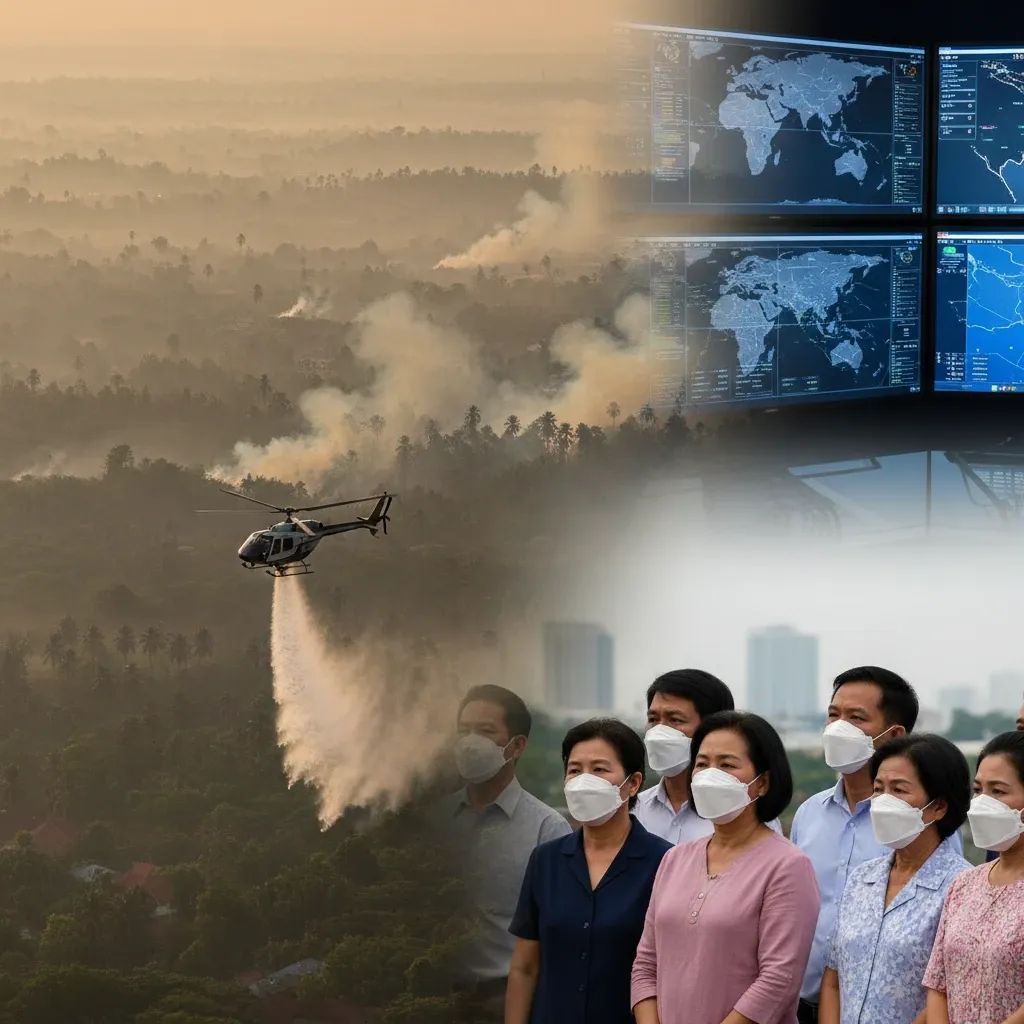
Thailand's Emergency Forest Closure: Emergency Access Ban Aims to Stop Human-Caused Fires
The Thailand Natural Resources and Environment Ministry has imposed a sweeping nationwide closure on all reserved and protected forest areas deemed at high risk, a move announced on April 14 that cuts off public access entirely. The directive—issued under Prime Minister Anutin Charnvirakul's explicit orders—responds to what officials describe as an uncontrolled fire season: as of mid-April 2026, 42 provinces are experiencing hazardous PM2.5 concentrations, with northern regions peaking at 211.6 micrograms per cubic meter, far exceeding the World Health Organization's safe threshold.
Why This Matters
• Access terminated indefinitely: All entry to protected forests in designated zones is prohibited with immediate legal prosecution for violators—there are no exemptions or appeals.
• Air crisis spreading: More than two-fifths of Thailand's provinces now record unsafe air quality, forcing school closures, workplace disruptions, and respiratory health advisories across the country.
• Massive detection network online: On April 13 alone, satellite systems identified 4,579 heat signatures nationally, with 78% concentrated within forest boundaries, signaling the crisis remains near its seasonal peak.
• Cross-border smoke complicating response: Haze originating in Myanmar and Laos continuously drifts into Thai airspace, undermining domestic mitigation efforts despite regional coordination frameworks.
The Human Factor Behind Forest Blazes
A critical truth frames this year's intervention: nearly every significant forest fire in Thailand originates from deliberate human activity. Officials conducting field research throughout 2025 documented that 62.2% of detected ignitions trace to foraging operations—individuals deliberately setting fires to clear undergrowth, stimulate mushroom emergence, extract honeycomb, or illuminate forest pathways at night.
Agricultural land preparation accounts for additional fires, where farmers torch field stubble to ready soil for planting. Rural hunting practices rely on fire to drive game toward waiting weapons. Pastoral communities use controlled burns to regenerate grass for livestock feed. Even routine forest camping occasionally produces uncontrolled blazes from carelessly abandoned cooking fires or disregarded cigarette ends.
Natural ignition sources—lightning strikes, spontaneous combustion—register as statistically negligible. The crisis is behavioral, concentrated during Thailand's dry season (December through May), when dry vegetation becomes highly flammable and temperatures spike. This ecological window creates a predictable, though devastating, annual cycle that enforcement alone has historically failed to interrupt.
The closure decision gained urgency following a catastrophic fire at Kaeng Krachan National Park in Phetchaburi Province weeks ago, where fire burned through more than 1,700 rai (approximately 272 hectares or 672 acres) of protected watershed forest. Investigation teams are now pursuing individuals suspected of illegal encroachment and deliberate arson—a case that symbolizes the enforcement priority underpinning the access ban.
Layered Detection and Suppression Infrastructure
Natural Resources Minister Suchart Chomklin framed the government's approach not as fire suppression but as systematic prevention through technological advantage and operational agility. The ministry has activated multiple layers of detection and response capability across the country.
Thailand's Geo-Informatics and Space Technology Development Agency (GISTDA) operates a satellite-fed hotspot monitoring system scanning the nation 10 times daily using data feeds from MODIS, VIIRS, NOAA-20, and NOAA-21 satellites. This constant surveillance allows real-time identification of emerging fires, narrowing search zones dramatically and reducing the physical wear on ground crews deployed to verify satellite detections and coordinate suppression efforts.
At the tactical level, water-dropping helicopters equipped with Bambi bucket systems—specialized containers capable of holding thousands of liters—can extract water from shallow sources in under 45 seconds and deliver focused spray onto active fire fronts. This aerial capacity proves invaluable in steep, roadless terrain where vehicle access is impossible. Historical operations, including the Khao Yai National Park fire response, documented helicopter sorties totaling over 90,000 liters deployed in coordinated attacks against major blazes.
Rapid-response ground units are pre-positioned in vulnerable districts stocked with modern equipment and immediate-action protocols. The Interior Ministry granted all provincial governors emergency decision-making authority, allowing them to mobilize resources without layer-by-layer bureaucratic approval—a streamlining designed to collapse response times.
Grassroots Surveillance and Community Networks
The operational strategy extends beyond centralized command centers to harness local knowledge and infrastructure. Village kamnan (subdistrict officials), headmen, volunteer rescue teams, and tambon-level civil defense organizations have been tasked with monitoring conditions and distributing real-time alerts through village loudspeaker systems—a communication method proven effective in rural areas with limited cellular coverage or digital literacy.
These ground-level actors frequently detect fires before satellite systems register heat signatures. In mountainous provinces where telecommunications infrastructure is sparse, their early warning function is irreplaceable. The government committed resources for their support: equipment provisioning, shift-rotation schedules to combat fatigue-induced accidents, and pre-arranged evacuation protocols for injured personnel.
Dr. Raweewan Bhuridej, permanent secretary of the Natural Resources Ministry, was assigned direct oversight of field-worker welfare, including regular checks on officer physical readiness, equipment serviceability, vehicle maintenance schedules, and medical preparedness for remote-area injuries. This welfare emphasis signals acknowledgment that firefighting in rugged terrain exacts a substantial human toll.
Regional Complications and Cross-Border Realities
Why Cross-Border Smoke Undermines Domestic Efforts
• Uncontrolled smoke sources: Myanmar and Laos experience comparable fire seasons, but without coordinated enforcement, their smoke continuously crosses into Thailand regardless of domestic closures.
• Legal limitations: Thailand lacks transnational prosecution mechanisms for cross-border haze, leaving residents exposed to pollution from fires beyond national control.
• Regional coordination gaps: The Clear Sky Strategy 2024-2030 framework exists but has generated minimal measurable relief, leaving air quality dependent on geography rather than policy effectiveness.
• Ranking impact: Thailand's global air quality rank fell to position 48 in 2025, with annual PM2.5 averaging 17.8 micrograms per cubic meter, reflecting both local and imported pollution.
Without reciprocal enforcement mechanisms among neighboring countries, Thailand's unilateral forest closure cannot fully insulate residents from regional haze. This structural reality means that even perfect domestic enforcement will leave air quality partially dependent on conditions in Myanmar and Laos.
What Residents Should Know
Checking Real-Time Air Quality
Residents can monitor current air conditions through multiple platforms:
• Thailand's Pollution Control Department website (www.pcd.go.th) - Official government data updated hourly
• AirVisual app (available iOS/Android) - Shows real-time AQI and forecasts for your location
• Google Maps - AQI layer available in air quality information
• Thailand Air Quality Index (Thai AQI) - Specific Thai standard classifications ranging from Good to Hazardous
Prohibited Activities and Penalties
The forest closure now bans:
• All entry to designated protected forest zones without written government authorization
• Hiking, camping, and forest tourism in closed areas
• Foraging, gathering of mushrooms, honey, or other forest products
• Any activity involving fire in forest areas, including camping cookfires
Penalties for violation include fines of 4,000-40,000 baht and potential imprisonment of up to 4 years under Thailand's forest protection statutes. There is no prosecutorial discretion—violations are treated as criminal offenses.
Health Protection Beyond Masks
• N95 masks: Use properly fitted masks (N95 or equivalent) during outdoor activity; cloth masks provide minimal PM2.5 protection
• Indoor air quality: Seal windows and doors; use HEPA air purifiers in homes and offices if possible
• Activity modification: Reduce outdoor exertion during peak haze hours (typically 6-10 AM and 5-9 PM when air quality is worst)
• Health monitoring: Residents with respiratory conditions, children, and elderly individuals should remain indoors during Hazardous air quality alerts
• Hydration: Increase water intake to support respiratory system function
• Veterinary care: Pet owners should limit outdoor time for animals, especially during peak haze periods
Expected Duration of Restrictions
Restrictions typically remain in force until late May or early June when monsoon rains increase humidity and reduce fire risk. Based on 2025 patterns, the peak burning window will likely extend through May. Current projections suggest restrictions may begin easing by early June if El Niño conditions do not intensify and precipitation increases as historically expected.
Comparative International Approaches
Other nations offer contrasting strategies worth examining for Thai policy relevance. Australia deploys large-capacity aerial tankers—the Erikson S64 Skycrane holds over 10,000 liters—and conducts prescribed burns during cooler, wetter seasons to preemptively reduce fuel accumulation. Thailand's rigid prohibition on controlled burning has eliminated this preventive pathway, forcing reliance on reactive suppression alone.
Singapore enacted the Transboundary Haze Pollution Act, enabling prosecution of entities whose activities generate smoke damaging air quality beyond borders—even when fire locations lie in foreign territory. Thailand has pursued no analogous legal mechanism, limiting its recourse against cross-border smoke sources. Google's FireSat project, launching globally this year, promises detection of fires as small as 5x5 meters with updates every 20 minutes, providing free data to resource-constrained nations. Thailand is positioned to access this tool, potentially supplementing GISTDA's existing satellite infrastructure.
The FAO's Integrated Fire Management framework emphasizes community participation as central, recognizing that locals are often first responders and hold invaluable terrain knowledge. Thailand's enforcement model, while administratively robust, risks alienating rural communities whose cooperation remains essential for sustained prevention. Alternative framing—positioning communities as partners rather than subjects of prosecution—has achieved measurable results in Southeast Asian contexts.
Structural Challenges Persist Beyond Technology
The forest closure and enhanced detection capability address symptoms but not underlying drivers. For smallholder farmers, burning remains economically rational when machinery is inaccessible or unaffordable. For upland communities, fire-dependent foraging practices remain embedded in seasonal livelihood cycles. For regional neighbors, agricultural and forest management practices continue unchanged regardless of Thailand's domestic restrictions.
Statistical trend data reveals the depth of the challenge. In 2025, Thailand recorded 213,372 rai (approximately 34,139 hectares or 84,365 acres) of burned forest—a reduction from some prior years but still considerable. Early 2026 indicators suggest potential reversal as El Niño conditions strengthen, creating conditions that historical data correlate with elevated fire incidence. The April 13 detection of 4,579 hotspots suggests the peak burning window remains far from conclusion, potentially extending pressure through late May when monsoon rains typically arrive.
The Temporal Reality
The government has committed to maintaining emergency operations until atmospheric conditions stabilize—customarily late May or early June when monsoon precipitation increases moisture and reduces fire risk. Until that threshold, the forest closure persists, satellite surveillance runs continuously, and rapid-response teams remain deployed.
For residents, the calculus simplifies: air quality will remain compromised until both human-set fires cease and natural precipitation arrives. Technology accelerates detection and attack capacity but cannot substitute for behavioral change or climatic intervention. Whether the closure—supported by explicit prosecution warnings—shifts entrenched practices remains the core policy test facing Thailand this season.
As weeks progress, the trajectory of detection frequency, burned area, and air quality measurements will reveal whether enforcement intensity and technological capability have meaningfully altered annual fire patterns or merely suppressed them until conditions favor renewed ignition next dry season.


