
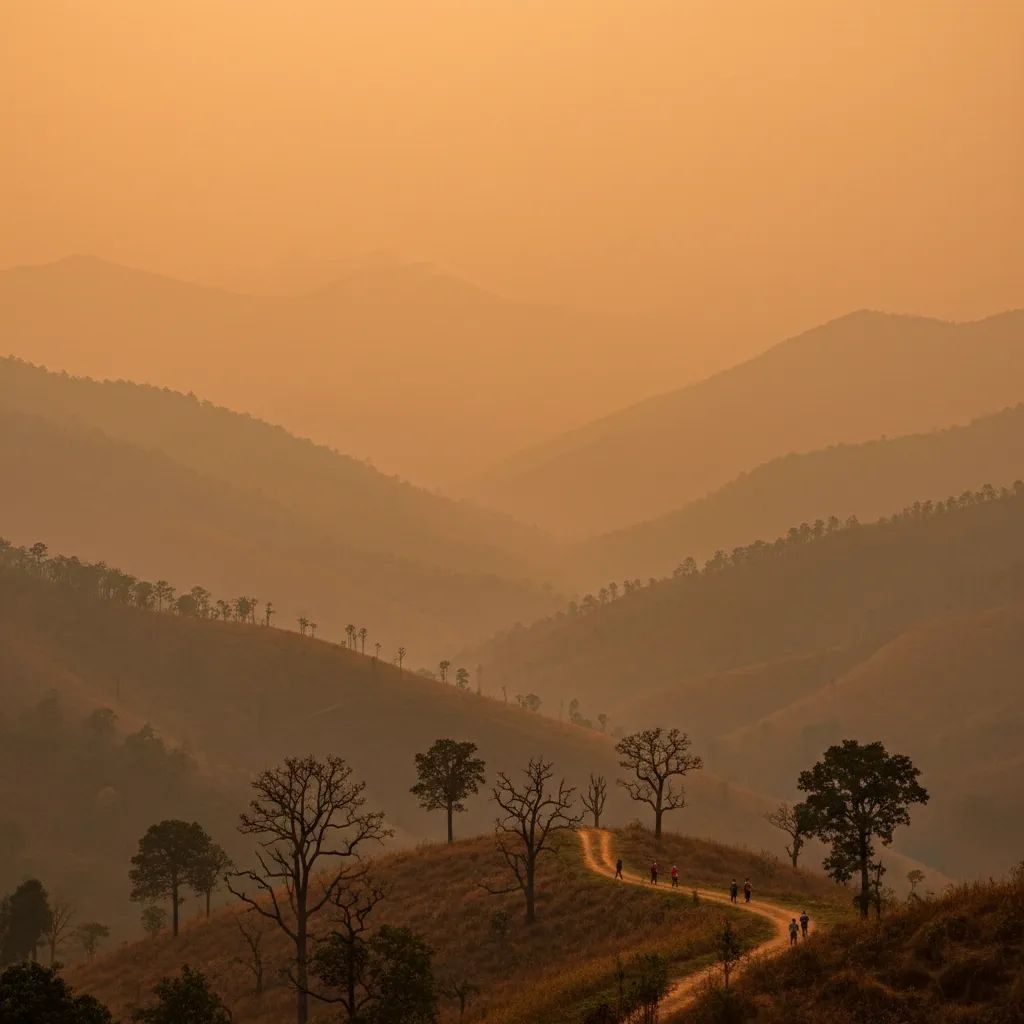
Thailand's Geo-Informatics and Space Technology Development Agency (Gistda) has confirmed 5,277 active fire hotspots across the country—a record high that signals the worst burning season in recent memory and compounds an already dire air quality crisis affecting millions of residents, particularly in the northern provinces.
Why This Matters
• Health emergency underway: PM2.5 pollution has reached red-level severity in 14 northern provinces, with some areas recording readings 60 times higher than WHO guidelines.
• Disaster zones declared: Provincial governors in Chiang Mai, Lamphun, and Phayao gained access to emergency funds on April 4 to combat fires and pollution.
• Regional crisis: Neighboring Laos recorded 9,313 hotspots, the highest in Southeast Asia, creating transboundary haze that drifts directly into Thailand.
• Legal consequences escalating: Violators now face up to 20 years imprisonment and 2M baht fines for illegal forest burning.
Where the Fires Are Burning
Satellite data from the US National Oceanic and Atmospheric Administration's (NOAA) Suomi NPP system reveals a troubling geographic concentration. The northern and northeastern regions account for the overwhelming majority of fire activity, with 3,117 hotspots detected in conservation forests alone—representing nearly 60% of the national total.
National reserved forests hold another 1,310 active fires, while agricultural zones contribute 392 hotspots despite government restrictions on field burning. Communities and residential areas recorded 227 fires, with an additional 203 in Sor Por Kor land reform areas and 28 along major highways, creating visibility hazards for motorists.
This distribution underscores a critical reality: over 80% of Thailand's fire crisis originates in forested areas, not farmland, challenging the common perception that agricultural burning is the primary culprit.
The Escalation Timeline
The current spike did not emerge overnight. Thailand recorded just 334 hotspots on February 11, a figure that climbed to 931 by mid-February. The burning season accelerated dramatically in late March, with 1,488 hotspots on March 23 and a then-record 4,750 on March 30. After briefly declining to 1,971 on April 1, the count surged again to 2,927 on April 5 before reaching the current high of 5,277.
This pattern reflects the typical burning season cycle in Southeast Asia, which peaks from late February through April. What makes 2026 exceptional is the sustained intensity—previous years saw sporadic spikes, but this year's figures have remained persistently elevated for weeks.
What This Means for Residents
The immediate consequence is catastrophic air quality across northern Thailand. Chiang Mai has repeatedly topped global pollution rankings, with PM2.5 concentrations reaching 188 micrograms per cubic meter—more than 12 times the WHO's 24-hour exposure limit. The mountain town of Pai recorded readings exceeding 900 micrograms per cubic meter, forcing residents indoors and overwhelming local hospitals.
Medical facilities report surges in respiratory cases: coughing, throat inflammation, nosebleeds, and eye irritation dominate emergency room visits. Children, elderly residents, pregnant women, and those with chronic conditions face the highest risk. Historical data from 2023 shows that nearly 2 million Thais required hospitalization for pollution-related respiratory illness during a similar crisis.
The economic toll extends beyond healthcare. Tourism operators in Chiang Mai and surrounding provinces face cancellations as international travelers avoid the region. Outdoor workers—construction crews, street vendors, delivery drivers—must choose between income loss and health risks. Schools in affected areas have suspended outdoor activities, and some government offices have implemented work-from-home protocols.
The Transboundary Dimension
Thailand cannot solve this crisis in isolation. Laos recorded 9,313 hotspots during the same monitoring period, while Myanmar registered 1,548, Vietnam 886, Cambodia 657, and Malaysia 20. Prevailing winds carry smoke and particulate matter across borders, meaning fires burning in Laotian forests deposit pollutants in Thai lungs.
The mountainous topography of northern Thailand creates a basin effect that traps incoming haze. Cities like Chiang Mai sit in natural bowls surrounded by peaks, with temperature inversions during the dry season preventing pollutants from dispersing upward. This geographic vulnerability transforms transboundary fires into a locally acute health emergency.
Thailand has activated diplomatic channels with Myanmar and Laos, including a direct WhatsApp hotline for real-time hotspot coordination. A joint action plan running through 2027 focuses on satellite-based mapping, coordinated air quality reporting, and long-term strategies to reduce slash-and-burn agriculture across the Mekong region.
Government Response and Enforcement
Provincial governors in three northern provinces gained emergency fund access when disaster zones were declared on April 4. These resources finance helicopter water drops, rapid-response firefighting teams, and fuel management operations to create firebreaks in high-risk forests.
The Thailand Ministry of Natural Resources and Environment has implemented 24-hour surveillance using real-time satellite feeds and high-altitude observation posts. A "Single Command" coordination system enables faster deployment of resources to emerging hotspots.
Agricultural burning controls have tightened significantly. Farmers must now register unavoidable burns and receive prior approval—a system designed to prevent the uncoordinated field clearing that creates regional smoke events. Violators face disqualification from government support programs, delays in land document processing, or even revocation of land ownership rights.
The legal penalties for forest arson have escalated to 20 years imprisonment and fines reaching 2M baht, reflecting the government's determination to deter illegal burning in protected areas. High-risk conservation forests have been closed to public access entirely during peak fire season.
The Root Causes
Three primary factors drive Thailand's hotspot crisis. Seasonal agricultural burning remains persistent despite restrictions, as farmers clear rice, sugarcane, and maize fields for the next planting cycle. Traditional practices die hard, and alternative methods—plowing stubble, composting, or transitioning to high-value crops—require upfront investment many smallholders cannot afford.
Forest fires constitute the majority of hotspots, both from natural ignition in tinder-dry conditions and human causes: illegal burning for hunting access, uncontrolled fires set by foragers gathering forest products, and insufficient fuel management in protected areas. The prolonged dry spell this year, combined with high temperatures and minimal rainfall, has created conditions where a single spark can ignite massive blazes.
Finally, accumulated dry vegetation from previous years provides abundant fuel. Paradoxically, years with fewer fires can set the stage for worse conflagrations later, as unburned material builds up in forests and grasslands.
Path Forward
The Thailand government has set ambitious targets: a 10% reduction in forest burning, a 10-15% cut in agricultural fires, and an overall decrease of 20-30% in burned areas compared to last year. Achieving these goals requires sustained enforcement, farmer education, and continued regional cooperation.
Over 250M baht has been allocated for initiatives promoting non-burning agriculture, including subsidies for equipment that processes crop residue into organic fertilizer or biomass fuel. An incentive program rewards sugarcane farmers who deliver fresh, unburned cane to mills, creating a financial motive to abandon field burning.
Research suggests that eliminating fire emissions across Southeast Asia could prevent 59,000 premature deaths annually—a figure that underscores the human stakes behind these satellite statistics. For Thailand's residents, particularly those in the northern provinces, the path from 5,277 hotspots to breathable air depends on coordinated action across borders, enforcement of existing laws, and long-term agricultural transformation.
The immediate priority remains clear: extinguish active fires, mitigate health impacts through public advisories and medical support, and prevent new ignitions through vigilant monitoring and rapid response. Whether 2026 becomes a turning point or another chapter in recurring seasonal crises will depend on sustained commitment from governments, farmers, and communities across the region.


