
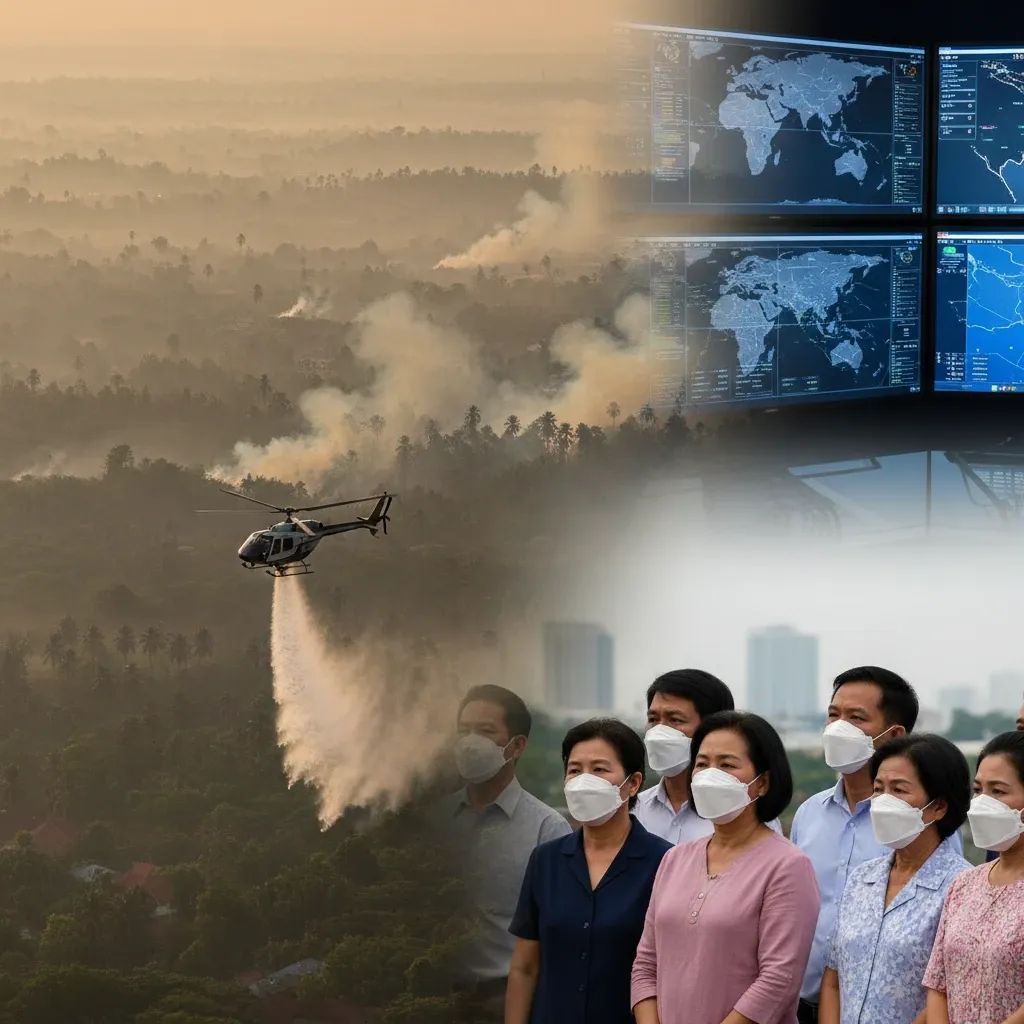
Thailand's Ministry of Natural Resources and Environment has deployed personnel and helicopter support to battle a wildfire that has already consumed over 3,000 rai (approximately 480 hectares) of protected forest in Kaeng Krachan National Park, part of a UNESCO World Heritage site in Phetchaburi and Ratchaburi provinces. The blaze, which authorities now suspect was deliberately set for agricultural encroachment, marks the latest in a series of environmental emergencies threatening one of Southeast Asia's most biodiverse wilderness areas.
Why This Matters
• Protected wilderness at risk: More than 3,000 rai of Class 1A watershed forest has burned since April 10.
• Criminal investigation underway: Evidence points to intentional arson linked to illegal land clearing, poaching, and wild honey collection.
• Air quality concerns: Satellite data registered over 40 active fire hotspots by April 17, with smoke potentially affecting regional air quality during the dry season.
• Heritage site threatened: Kaeng Krachan is part of Thailand's Kaeng Krachan Forest Complex, inscribed as a UNESCO World Heritage site in 2021.
Ground and Air Operations Mobilized
The Thailand Department of National Parks, Wildlife and Plant Conservation launched containment operations on April 15 after satellite monitoring detected thermal anomalies near Bang Kloi village in Kaeng Krachan District on April 10. An initial advance team of rangers entered the rugged terrain to cut firebreaks—cleared strips designed to halt the blaze's spread along mountain ridges.
By mid-week, the response had scaled up to include park rangers, firefighting units, civilian volunteers, and representatives from non-governmental organizations, all working on the ground. Helicopters have been deployed for aerial reconnaissance and water-bombing runs, a critical asset given the steep, nearly inaccessible topography of the upper Kaeng Krachan zone.
Ministry officials ordered the reinforcement, emphasizing zero tolerance for those who damage protected watersheds.
Rapid Escalation and Satellite Evidence
What began as isolated hotspots on April 10 exploded into a 1,700-rai burn zone by April 13, then doubled to an estimated 3,000 rai by April 17. The fire is advancing northward toward Ratchaburi Province, with satellite imagery showing abnormal fire-jumping behavior across ridgelines—a pattern that officials say is inconsistent with natural ignition and strongly suggests deliberate fire-setting.
More than 40 distinct fire clusters were active as of the afternoon of April 17, forming new pockets of flame as the blaze leapfrogs natural barriers. This behavior has alarmed ecologists, who note that such patterns typically result from multiple ignition points set by humans rather than a single lightning strike or accidental campfire.
Suspected Arson for Agricultural Encroachment
Investigators from the Thailand Ministry of Natural Resources and Environment are gathering evidence pointing toward intentional arson motivated by several illegal activities:
• Land clearing for farming: Encroachers routinely burn forest to prepare plots for cash crops, believing the ash enriches soil and accelerates plant growth—a practice that violates national park protection statutes.
• Poaching facilitation: Fires are sometimes set to flush out wildlife, making it easier to hunt protected species.
• Wild product harvesting: Locals have been known to ignite undergrowth to encourage the sprouting of edible forest vegetables (phak wan) and mushrooms (phaeng pa), which fetch high prices in regional markets. The same tactic is used to drive away elephants and other large animals that obstruct access to wild beehives.
Legal proceedings are being prepared against suspects, and the ministry has appealed to the public for tips. Offenders face imprisonment and substantial fines for illegal burning or encroachment within protected zones under Thailand's national park and forest protection laws.
What This Means for Residents
For anyone living in or near Phetchaburi and Ratchaburi provinces, the immediate concern is air quality. Wildfire smoke carries particulate matter (PM2.5) that can exacerbate respiratory conditions, particularly during the hot, dry season when atmospheric dispersion is poor. Residents with asthma or cardiovascular issues should monitor local air quality indices and limit outdoor activities if haze becomes visible.
Beyond the health dimension, the fire underscores the fragility of Thailand's watershed forests, which regulate water flow to downstream agricultural and urban areas. The upper Kaeng Krachan zone is classified as Class 1A watershed—the highest protection tier—because it feeds river systems essential for irrigation and municipal supply. Soil erosion and sedimentation from burned slopes could degrade water quality for months, affecting farming communities and hydroelectric operations.
For the tourism sector, Kaeng Krachan's reputation as a premier birdwatching and wildlife destination hinges on its ecological integrity. Repeated fires not only kill mature trees and displace fauna but also invite invasive species that thrive in disturbed habitats, potentially altering the forest's character for decades.
Long-Term Ecological Damage
Kaeng Krachan National Park is the largest protected area in Thailand, spanning more than 2,900 square kilometers of montane and lowland forest. Its inclusion in the Kaeng Krachan Forest Complex UNESCO World Heritage Site in 2021 recognized its exceptional biodiversity and ecological importance.
Wildfires at this scale inflict multiple layers of harm:
• Biodiversity loss: Intense heat kills canopy-dwelling species and destroys nesting sites. Studies show that repeated burns reduce forest species richness and inhibit seedling regeneration, effectively stalling forest recovery.
• Soil degradation: High-temperature fires reduce organic matter and weaken the substrate for years. This makes it harder for native vegetation to re-establish, opening the door for fast-growing invasive grasses.
• Wildlife displacement: Animals flee ahead of the flames, often into marginal habitat or human-dominated landscapes, increasing the risk of human-wildlife conflict.
• Water cycle disruption: Burned watersheds experience faster runoff and higher erosion rates, leading to flash floods during the rainy season and reduced dry-season stream flow.
The Thailand Department of National Parks has warned that if fires recur annually in the same zones, the forest may undergo irreversible conversion to shrubland or grassland, displacing ecologically valuable broadleaf evergreens.
Prevention Strategies and Community Engagement
Recognizing that enforcement alone cannot halt illegal burning, the Thailand Ministry of Natural Resources has adopted a "grouped forest" management model covering critical forest complexes nationwide. Under this framework, national parks, reserved forests, and adjacent agricultural zones are managed collaboratively by the Department of National Parks, Royal Forest Department, local governments, and district administration, closing jurisdictional gaps that once allowed fires to spread unchecked.
Key tactics include:
• Early-warning networks staffed by local residents, creating both employment and enhanced fire detection capabilities.
• Door-to-door campaigns urging farmers to adopt alternatives to burning, such as composting agricultural residues or selling them as biomass fuel.
• Firebreaks and green belts: Crews clear combustible material along strategic corridors and plant moisture-rich, fire-resistant vegetation to slow flame advance.
• Controlled burns (prescribed fire): In carefully monitored conditions, rangers ignite low-intensity fires to remove accumulated leaf litter, reducing the fuel load that feeds catastrophic blazes.
• Drone and AI surveillance: Unmanned aerial vehicles equipped with thermal cameras scan remote valleys for nascent hotspots, enabling rapid helicopter deployment before fires grow unmanageable.
The ministry has also emphasized cross-border cooperation with neighboring countries through ASEAN mechanisms, coordinating alerts during peak fire season to address transboundary haze.
Legal Consequences and Public Appeals
Anyone found guilty of igniting fires within Kaeng Krachan National Park faces serious penalties under Thailand's national park and forest protection laws. Investigators are focusing on identifying responsible parties and have urged community members to report suspicious activity, emphasizing that protecting watersheds safeguards their own water and livelihood security.
Broader Context: Thailand's Annual Fire Crisis
The Kaeng Krachan blaze unfolds against the backdrop of Thailand's perennial dry-season fire crisis, which peaks between February and April each year. While some fires originate from lightning or accidental sparks, research consistently identifies human activity—especially agricultural burning and land speculation—as the primary driver. In 2026, authorities have tracked thousands of hotspots nationwide, contributing to air quality concerns in several provinces.
The government's strategy balances proactive fire prevention, rapid suppression, and strict enforcement, recognizing that sustainable forest management requires shifting community behavior as much as deploying firefighting resources. The outcome at Kaeng Krachan will serve as a test case for whether Thailand can protect its UNESCO-designated heritage while addressing the socioeconomic pressures that drive illegal burning.


