
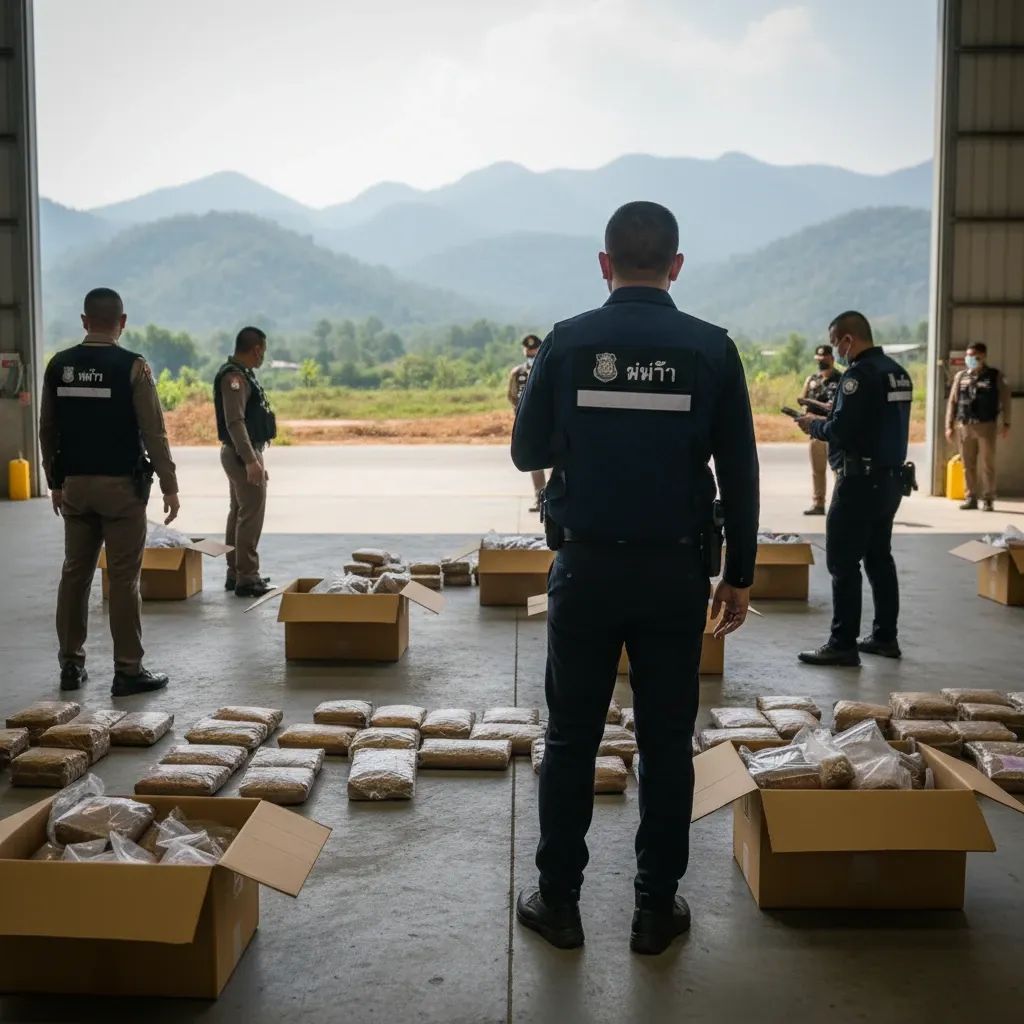
The Thailand Royal Police's Regional Bureau 5 has dismantled a major cross-border drug trafficking network operating between Chiang Rai and Chiang Mai, seizing nearly 14 million methamphetamine pills and arresting 7 suspects caught mid-operation inside a rented warehouse. The bust, executed on March 15, represents one of the largest single seizures in the northern region this quarter and underscores the persistent flow of industrial-scale narcotics from Myanmar's Shan State into Thailand's interior markets.
Why This Matters
• Volume: 13,990,000 meth pills intercepted—enough supply to flood central Thailand's distribution networks for weeks
• Financial impact: Authorities confiscated assets worth ฿30M, including 11 vehicles, 2 motorcycles, ฿3.95M cash, and 2 properties across multiple Chiang Mai districts
• Network reach: The operation exposed a sophisticated smuggling corridor that masks narcotics inside agricultural shipments bound for Bangkok and surrounding provinces
• Enforcement signal: Part of a 4-case sweep netting over 17M pills and 600 kg of crystal meth in northern Thailand within 48 hours
The Warehouse Operation
Thailand Provincial Police Region 5, in coordination with the Office of Narcotics Control Board (ONCB) Region 5, Third Army Area Command, and local administrative units, raided the facility in San Pong subdistrict, Mae Rim district, approximately 20 kilometers north of Chiang Mai city. Intelligence had tracked a massive shipment moving south from Chiang Rai's porous border zones—areas abutting Myanmar's Shan State, where methamphetamine production has surged despite international pressure.
Officers arrived to find all 7 suspects actively repackaging pills from burlap sacks into cardboard boxes designed to blend with produce shipments. Six suspects hail from Samoeng district, one from Chiang Dao district—both mountainous areas west and north of Chiang Mai known for their proximity to smuggling trails. The Thailand Attorney General's office charged the group with unlawful possession of Category 1 narcotics (methamphetamine) with intent to distribute, carrying sentences of life imprisonment under Thailand's stringent 1979 Narcotics Act.
The Thailand Governor of Chiang Mai joined the March 16 press briefing, framing the seizure as evidence that northern provinces remain both conduit and temporary depot for narcotics destined for the densely populated central plains. Investigators believe the warehouse served as a "safe house" where bulk shipments pause for rebranding before onward transport via private courier services or concealed vehicle compartments.
The Golden Triangle Pipeline
Chiang Rai's 54 documented border crossings along 5 zones provide traffickers with natural corridors through jungle and mountainous terrain. Criminal syndicates exploit these gaps, often employing local villagers familiar with the topography and occasionally using armed escorts to deter interdiction. The Mekong River and smaller waterways like the Ruak River offer additional routes, particularly during the dry season when shallow channels facilitate foot and small-boat crossings.
From Chiang Rai, narcotics flow through Phayao, Lampang, and Tak provinces into central Thailand—primarily Ayutthaya, Pathum Thani, and greater Bangkok—where demand remains robust despite ongoing crackdowns. A portion of the supply continues onward to international markets in Japan, Australia, and New Zealand via transnational crime networks with sophisticated logistics.
Production in Myanmar's Shan State has intensified amid internal conflict, with ethnic armed groups reportedly funding operations through drug revenue. The United Nations Office on Drugs and Crime (UNODC) identifies the Golden Triangle as one of the world's largest sources of synthetic narcotics, and Thailand's position as a transit hub makes interdiction efforts critical but challenging.
What This Means for Residents
For those living in Thailand's northern provinces, the relentless drug trade translates into persistent security concerns, corruption risks, and the threat of violence spilling over from cross-border trafficking disputes. Communities near the Myanmar frontier face recruitment pressure from smuggling networks seeking porters and lookouts, often targeting economically vulnerable residents with cash incentives.
In central Thailand, the influx of cheap methamphetamine continues to fuel addiction rates, particularly among young adults and labor workers. Public health officials estimate hundreds of thousands require treatment, yet the Thailand Ministry of Public Health struggles with insufficient psychiatric specialists trained in addiction medicine. The government's fiscal year 2025 (October 2024–September 2025) saw seizures exceed 1 billion pills nationwide, yet street availability remains high, and prices have fluctuated downward on online platforms, making pills more accessible.
For expatriates and long-term residents, the visible law enforcement presence—checkpoints, roadblocks, and frequent police operations—reflects Thailand's aggressive posture but also the scale of the underlying problem. Travelers in northern regions should remain aware that certain roads and districts experience heightened police activity, and anyone inadvertently associated with narcotics faces severe legal consequences under Thailand's zero-tolerance prosecution standards.
Escalating Enforcement and Uneven Outcomes
Between October 2025 and January 2026, Thailand's Royal Police logged 89,076 drug cases, arresting 88,421 suspects and seizing over 330M pills, 11 tons of crystal meth, and assets worth ฿3.4 billion. The March 2026 northern sweep alone accounted for 17M pills and nearly 600 kg of ice across 4 major busts, with the Mae Rim warehouse representing the single largest haul.
Despite these headline numbers, enforcement officials privately acknowledge that seizures represent only a fraction of total throughput. The Thailand Border Patrol Police and specialized interdiction units stationed along the Chiang Rai frontier report near-continuous engagement with smuggling attempts, yet production capacity in Shan State far outstrips Thailand's interdiction capacity. Some analysts argue that the strategy of high-profile busts and asset seizures, while politically popular, fails to disrupt the economic fundamentals driving the trade.
Increasingly, traffickers have pivoted to online sales via Facebook, Line, Instagram, TikTok, and encrypted platforms, using emoji codes and decentralized drop-shipping to evade detection. The Thailand Office of Narcotics Control Board has allocated resources to cyber-surveillance, but the digital marketplace evolves faster than regulatory frameworks, particularly given Thailand's privacy protections and jurisdictional constraints on platform operators.
Asset Seizures and the Financial War
The March 16 announcement by Regional Police 5 highlighted the confiscation of 11 cars, 2 motorcycles, ฿3.95M in cash, and 2 residential properties linked to the Mae Rim suspects—collectively valued at approximately ฿30M. This represents a growing emphasis on financial warfare against trafficking organizations, targeting not only drugs but the accumulated wealth that fuels reinvestment and corruption.
Under Thailand's Asset Forfeiture Act, authorities can freeze and ultimately transfer assets tied to narcotics offenses into state coffers, theoretically depleting criminal capital. However, implementation remains uneven: legal challenges, opaque ownership structures, and under-resourced forensic accounting units mean many assets slip through. Critics contend that without more aggressive international cooperation—particularly with Myanmar, Laos, and China—traffickers will continue to launder proceeds across borders, rendering domestic seizures symbolic rather than strategic.
The Broader Context: Production, Policy, and Pragmatism
Thailand's methamphetamine crisis is not an isolated law enforcement failure but a symptom of regional instability and market dynamics. The Shan State conflict has displaced governance structures, creating power vacuums that criminal enterprises exploit. The scale of production—billions of pills annually—far exceeds Thailand's consumption, positioning the kingdom as a logistics corridor for regional and international distribution.
Policy debates within Thailand's National Security Council and academic circles increasingly question whether pure interdiction can succeed. Some voices advocate for harm reduction models—needle exchanges, supervised consumption sites, and decriminalization of possession for personal use—arguing that the current approach criminalizes addiction without reducing supply. Others counter that Thailand's conservative political culture and treaty obligations under the 1988 UN Convention Against Illicit Traffic in Narcotic Drugs and Psychotropic Substances constrain reform options.
The Thailand Prime Minister's Office has signaled support for enhanced technology, inter-agency coordination, and legal reforms, but concrete shifts remain incremental. Meanwhile, the 2026 action plan from the Office of Narcotics Control Board prioritizes demand reduction and prevention, aiming to shrink the user base through education campaigns and community resilience programs—a tacit acknowledgment that supply-side tactics alone cannot stem the tide.
What Comes Next
Investigators are expanding the probe to identify upstream suppliers and downstream distributors connected to the Mae Rim network. The Thailand Attorney General has indicated that additional charges may follow as forensic analysis of seized phones and financial records progresses. Residents in Chiang Mai's Samoeng and Chiang Dao districts should expect increased police presence and possible asset freezes as authorities pursue accomplices.
For those living in or traveling through northern Thailand, the March 2026 busts serve as a reminder that the region remains a frontline in Southeast Asia's narcotics war. While large-scale seizures disrupt logistics temporarily, the underlying supply chain adapts quickly, and the human costs—addiction, incarceration, and community destabilization—continue to mount. Whether Thailand can pivot from reactive enforcement to systemic disruption will determine whether the current wave of arrests marks genuine progress or simply another turn in a decades-long cycle.


