
Northern Border's Hidden Cost: How Uniform and Corruption Became Drug Trafficking Partners
The Thailand Office of the Narcotics Control Board dismantled a slice of the country's most entrenched synthetic drug operation when it arrested two serving military officers on March 2 as part of Operation Cut Off the Malignancy, exposing what amounts to a quiet institutional crisis: the uniform itself has become a smuggling tool. The arrests reveal not just personal criminal misconduct, but structural vulnerability—the very security apparatus meant to defend Thailand's northern frontier is being weaponized by narcotics networks to move product deeper into the country and eventually across international waters.
Why This Matters:
• Institutional Penetration: Military personnel with operational authority over border checkpoints now face charges for actively transporting drugs and laundering trafficking proceeds through family nominees—essentially weaponizing their position and credentials.
• Massive Wealth Seizure: Authorities froze ฿122M in assets (roughly equivalent to a luxury apartment portfolio across Bangkok and northern provinces), signaling the scale of profit these networks generate.
• Kingpin Structure Partially Dismantled: While the alleged mastermind remains free, the arrest of his money launderers and transport facilitators has disrupted daily operations, though the network's underlying supply chain remains intact.
The Investigation: From Interstate Seizure to Internal Betrayal
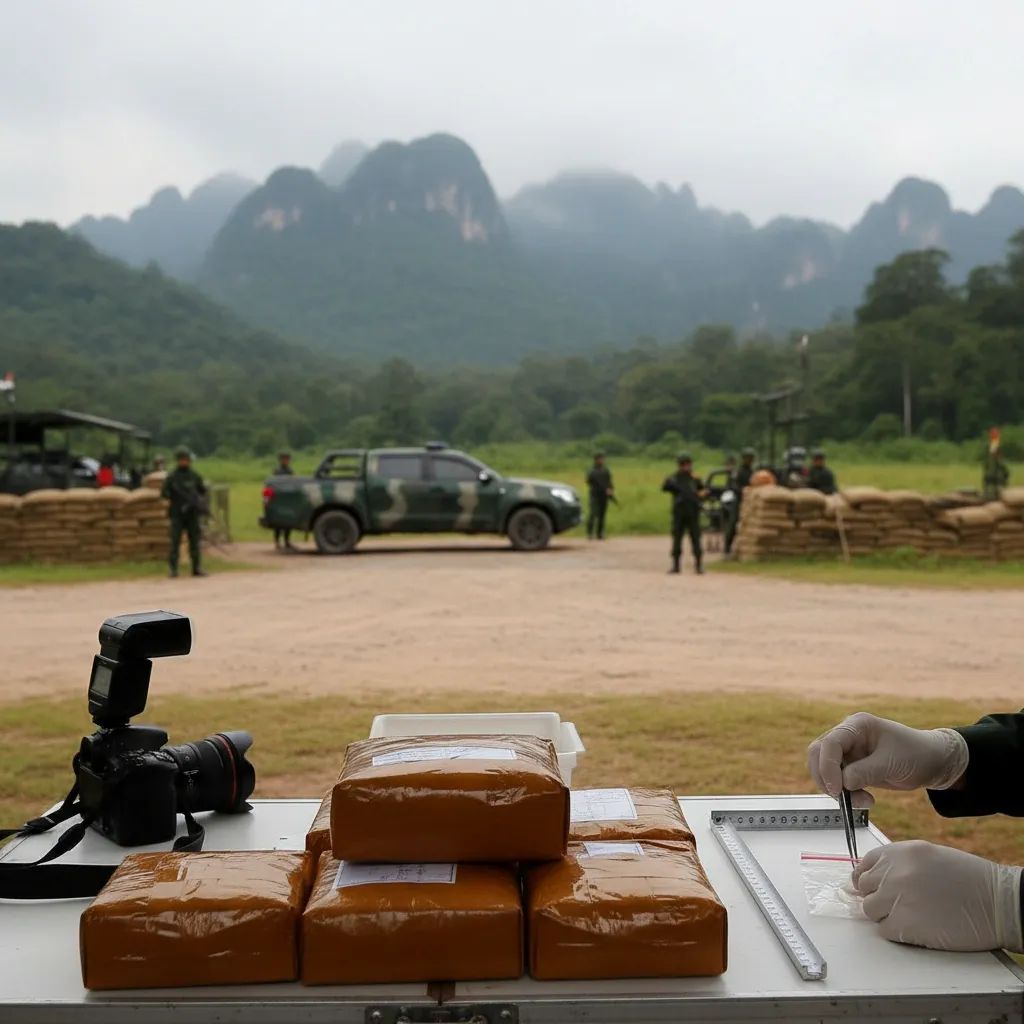
The case originated not with interrogations but with roadside interdictions that spoke in the language of tonnage. On December 26, 2024, soldiers stationed in Mae Fah Luang District, Chiang Rai Province, intercepted a pickup truck carrying 1,418 kilograms of crystal methamphetamine—roughly equivalent to the annual consumption rate of a mid-sized city. The driver abandoned the vehicle, but his mobile phone remained behind. When forensic teams decoded the encrypted communications, they discovered something far more damaging than a single trafficking operation: evidence of systematic coordination at the command level.
The conversations identified a network controller using the alias "Sia Jiw," alleged to be Chutithan, a man with a documented heroin conviction from 2006 who had essentially reinvented himself as a logistics mastermind. The phone data revealed names, vehicle registrations, safe house locations, and payment schemes—essentially a digital ledger of the operation's entire structure. What followed was months of financial forensics and surveillance that eventually led investigators to two individuals in uniform.
A lieutenant colonel attached to the Office of the Permanent Secretary for Defence emerged as a central node in the money laundering apparatus. Financial investigators traced suspicious bank transfers, property acquisitions in Chiang Mai, Nonthaburi, and Bangkok, and a pattern of wealth accumulation inconsistent with military salary. Critically, the properties were held not in his name directly but through family relatives—a textbook nominee arrangement used by organized crime to obscure beneficial ownership. His in-laws, it turned out, had no legitimate income to justify their asset holdings, but they held title to multiple parcels of land and residential units worth tens of millions of baht.
A second officer, a special forces lieutenant, faced separate charges: using military credentials and checkpoint access to physically escort drug shipments across interdiction zones. Border control points in northern Thailand typically conduct vehicle inspections, but a soldier in uniform driving a military vehicle with military plates operates under different scrutiny protocols. The lieutenant allegedly exploited this advantage repeatedly, transforming his tactical credentials into a delivery service.
The Sia Jiw Architecture: From Production Hub to Distribution
Understanding how Sia Jiw's network functioned requires understanding the geography of supply. The Golden Triangle—the Myanmar-Laos-Thailand junction—has evolved from a heroin production zone into an industrial methamphetamine manufacturing complex. Myanmar's Shan State, destabilized by ongoing civil conflict, hosts numerous clandestine laboratories run by armed groups and criminal syndicates. Production capacity far exceeds local demand; the entire enterprise exists to export.
Shipments destined for Thailand move through Mae Fah Luang District, one of several porous crossing points where dense jungle terrain and limited military presence create natural smuggling corridors. Once drugs crossed into Thai territory, Sia Jiw's network took over: consolidation, repackaging, and redistribution southward through provinces with less intensive border security.
On March 8, 2025—two months into the investigation—authorities moved on another suspected shipment. In Doi Mae Salong Nok, also in Chiang Rai, they intercepted a six-wheel truck displaying military-style license plates and containing 1,400 kilograms of crystal meth. The encounter escalated into gunfire. When officers secured the vehicle, they found seven suspects inside, three of them identified as former military personnel. The military plates were counterfeit—another indication of how thoroughly the network had infiltrated institutional logistics.
These two seizures alone totaled approximately 2,800 kilograms—enough to supply an entire region's street-level market for months or to command a wholesale price exceeding ฿450M at border rates.
What This Means for the Northern Security Apparatus
The arrests place the Ministry of Defence in an awkward position. It announced an internal review of personnel stationed in border units, but the damage to institutional credibility is already concrete. Thai checkpoint staff now operate under implicit suspicion; any officer could theoretically be working with traffickers. Border communities in Chiang Rai and Mae Fah Luang report that people are avoiding certain routes due to uncertainty about whether checkpoints are genuinely enforcing law or facilitating passage.
For residents and business operators moving goods across provincial lines—legitimate commerce in agricultural products, textiles, and construction materials—the environment has become more friction-laden. Checkpoints intensified random inspections post-arrest, slowing routine supply chains. Merchants report delays of two to four hours that weren't standard practice six months ago.
The broader implication extends to Thailand's ability to control its northern frontier during a period of unprecedented methamphetamine pressure. The Royal Thai Army designated 25 districts across six provinces as urgent interdiction zones and deployed advanced detection equipment—handheld X-rays, drones, night-vision cameras. Yet technology cannot compensate for compromised personnel. A lieutenant colonel with access to interdiction planning can provide real-time route intelligence to traffickers, rendering the technical advantages obsolete. An officer controlling a checkpoint becomes a checkpoint circumvented.
The Financial Underground: Following the Money Trail
The ฿122M in frozen assets provides the clearest picture of the network's operational scale. The ONCB collaborated with the Anti-Money Laundering Office to trace the flow: narcotics revenue entered bank accounts held by the lieutenant colonel's extended family, moved through a series of transfers designed to obscure the source, and emerged as down payments on residential property and luxury vehicles.
Investigators documented the real estate portfolio in granular detail. Properties in Chiang Mai near commercial zones. Condominiums in Nonthaburi convenient to Bangkok's financial district. A villa in a Bangkok suburb with security features consistent with storage or safe-house use. Land purchases in rural Chiang Rai with road access suitable for vehicle staging. This wasn't random wealth accumulation; it was geographic positioning for logistics.
Gold ornaments, firearms, and cash reserves discovered during raids suggested contingency planning—portable wealth that could move quickly if the operation faced sudden pressure. The firearms inventory included weapons not standard-issue military equipment, indicating either black-market acquisition or diversion from state arsenals.
For Thailand's financial sector, the case compounds existing compliance challenges. Banks flagged the suspicious transactions retrospectively, but the velocity and scale of transfers had already occurred. Property developers in border provinces face intensified due-diligence requirements, though enforcement remains inconsistent. The Anti-Money Laundering Office issued new guidance in March requiring enhanced verification of buyer identity in provincial real estate markets, but industry observers describe the directive as under-resourced and difficult to implement uniformly across regional branches.
The Regional Pattern: Thailand's Problem Is Southeast Asia's Problem
Thailand's situation sits within a broader crisis affecting the entire region. East and Southeast Asia recorded 236 tonnes of methamphetamine seizures in 2024—a 24% increase from 2023. Thailand accounted for the largest share, including confiscation of one billion methamphetamine tablets in pill form alone. Myanmar's internal instability directly fuels this production. Armed groups controlling territory in Shan State operate clandestine laboratories with near-total impunity, generating annual revenues in the billions of baht that fund their military operations and reinforce their political power.
The supply pipeline has diversified beyond traditional land routes. Maritime corridors now connect to Malaysia, Indonesia, and the Philippines. The expanding network means that disrupting one smuggling organization simply redistributes market share to competitors. When the ONCB dismantled Sia Jiw's financial structure, rival syndicates were already positioning themselves to capture his trading relationships and distribution channels.
Thai and Lao military forces began joint Mekong River patrols in May 2026 to intercept water-based smuggling, but these operations typically net small quantities relative to total traffic. The real chokepoint—institutional corruption—remains the hardest problem to solve through enforcement alone.
Where the Investigation Stands
The alleged kingpin "Sia Jiw" remains at large, reportedly moving between safe houses in Myanmar, Laos, and Cambodia while his operational infrastructure crumbles. The ONCB is coordinating with Interpol and regional law enforcement to track his movements, but international cooperation in Southeast Asia remains fragmented. Cambodia and Laos lack the institutional capacity or political motivation to pursue certain fugitives aggressively.
Investigators continue vetting additional military and police personnel suspected of providing logistical support. The March 2 arrests represent the second phase of expanded enforcement, suggesting that the network's penetration into state institutions ran deeper than initially apparent. Each arrest revealed new accomplices, new financial pathways, new vehicles that had passed through checkpoints.
For residents of northern provinces and businesses dependent on border trade, the message is mixed: authorities are serious about rooting out corruption, but the underlying conditions—porous frontiers, production capacity in neighboring countries, global demand—remain largely immutable. The arrest of two uniformed officers is significant progress, but the vacuum they leave will likely fill with replacement operatives or entirely new organizations. The only measure of genuine success would be interdiction at the source, an outcome that requires stability in Myanmar—a condition unlikely in the immediate term.


