
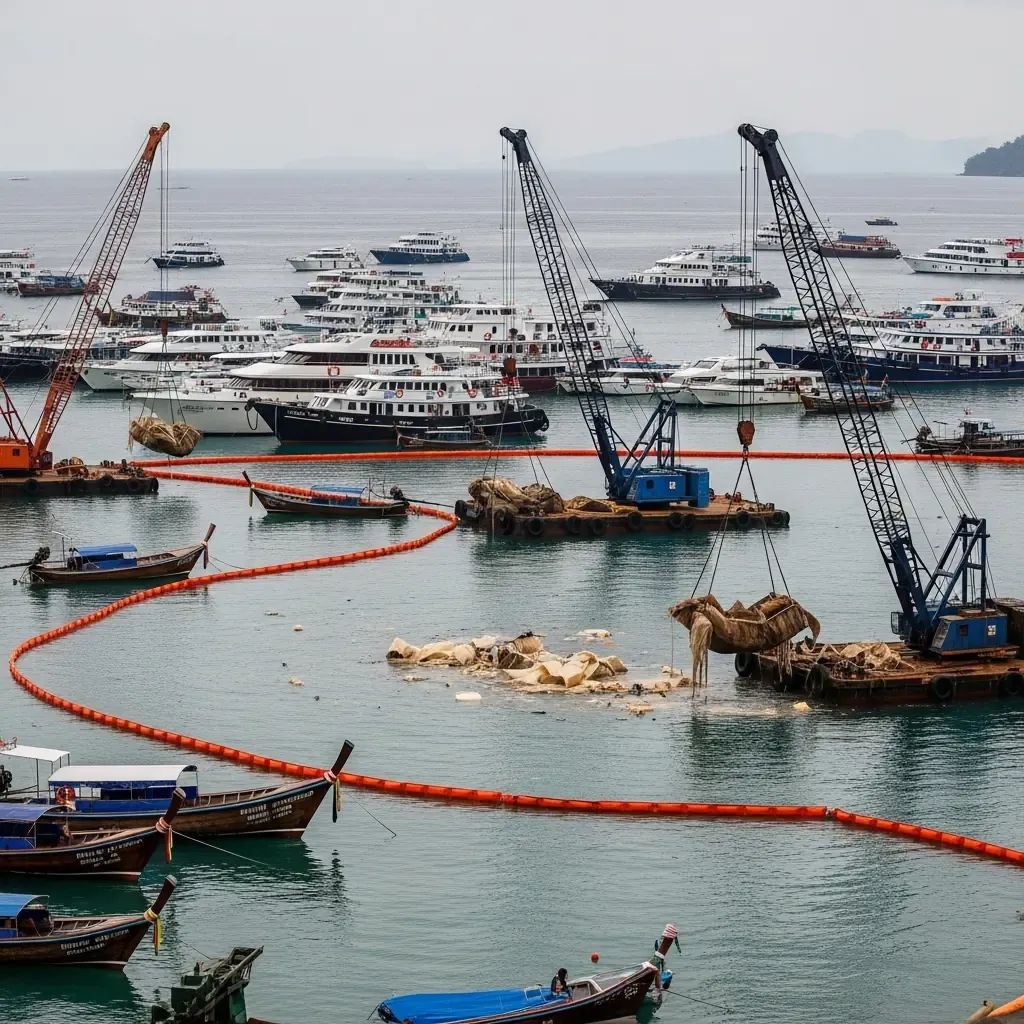
The Royal Thai Police in Pattaya have rolled out mandatory alcohol screening for boat operators and baht-bus drivers serving Koh Larn island, a move designed to protect the surge of tourists expected during the Wan Lai Pattaya festival on April 19. Wan Lai is Pattaya's delayed version of Songkran held a week later than the nationwide celebration, and it draws tens of thousands of domestic and international visitors to the city's beaches, creating intense pressure on the island's ferry transport system. The crackdown — conducted at key transit hubs including Na Baan Pier and Tawaen Beach Pier — represents one of the most comprehensive safety pushes in recent memory, with more than 800 officers deployed across Koh Larn and surrounding island areas.
Why This Matters
• Zero-tolerance enforcement: Boat captains and songthaew drivers face up to 6 months imprisonment and fines between 1,000–10,000 baht if caught operating under the influence.
• Critical travel window: Beach Road will be fully closed from 12:00 to midnight on April 19, forcing visitors to rely on public boats and local transport to reach the island festivities.
• Legal blood-alcohol limit: Thailand law caps drivers at 50 milligrams percent (0.05% BAC) blood alcohol — roughly equivalent to a single drink for most adults — with marine operators held to the same standard.
• Checkpoint coverage: Nine inspection stations now operate across Koh Larn's main transit points, with marine police stationed at Bali Hai Pier on the mainland screening all outbound passenger ferries.
The Enforcement Reality on Koh Larn
Officers from Pattaya Police Station, led by Police Colonel Anek Srathongyu and Deputy Colonel Siriwat Khatchamat, fanned out across the island on April 16 to conduct surprise breathalyzer checks on drivers of songthaews — the open-bed pickup trucks that function as Koh Larn's primary taxi service — and motorcycle taxi operators. The operation, coordinated with Thailand Tourist Police, regional marine authorities, and community oversight committees, focused on the two main ferry landing zones where visitor foot traffic peaks during holiday periods.
The timing is deliberate. Songkran's "Seven Dangerous Days" enforcement period ran from April 10–16, but Wan Lai—scheduled for April 19—falls just outside this nationwide crackdown window. Because the festival will draw fresh crowds to the island, authorities have extended enhanced screening specifically for Koh Larn's transport sector to prevent a lapse in enforcement during this secondary peak period.
Marine law in Thailand explicitly prohibits boat captains and crew from consuming any detectable alcohol while on duty. This marine-specific regulation, enforced by the Marine Department under the Ministry of Transport, is stricter than the 50 mg% limit applied to motor vehicle drivers. The rationale is straightforward: maritime environments present unique hazards—shifting weather, strong currents, congested boat traffic—that demand absolute clarity of judgment. Violations can result in license suspension for up to 2 years, in addition to criminal penalties.
Clear Penalty Breakdown for Different Violations
For Boat Operators (Marine Transport):
• Operating with detectable alcohol: License suspension up to 2 years + criminal penalties up to 6 months imprisonment and 1,000–10,000 baht fine
For Motor Vehicle Drivers (Songthaews/Taxis):
• Operating with blood alcohol above 50 mg%: Up to 6 months imprisonment and 1,000–10,000 baht fine
For Passengers Drinking Aboard Vessels or in Public Transport:
• Consuming alcohol on a moving public vehicle or ferry: Up to 10,000 baht and/or imprisonment
What This Means for Residents and Visitors
For expats and long-term residents accustomed to flexible enforcement, the stepped-up patrols represent a noticeable shift. Koh Larn-specific checkpoints will remain active through April 19, with officers instructed to prioritize drunk driving, speeding, and failure to wear helmets — the three violations that account for the majority of Songkran-related fatalities nationwide.
If you're planning to visit Koh Larn during the festival window, expect delays at both Bali Hai Pier on the mainland and the island's two main docks. Marine police are conducting visual inspections and random breathalyzer tests on captains before departure, a process that can add 10–15 minutes to boarding times. On the island itself, songthaew drivers — who typically negotiate fares directly with passengers — report that officers are conducting mid-route stops, particularly along the coastal road connecting Tawaen Beach to Samae Beach.
Ferry Information for Festival-Goers:
• Normal schedule: Ferries depart every 30 minutes during standard hours; every 15–20 minutes during festival peak hours (noon–18:00)
• Main routes: Bali Hai Pier (mainland) to Tawaen Beach Pier and Na Baan Pier (island)
• Approximate costs: 30–40 baht per person one-way for standard ferries; 200–300 baht for private speedboat services
• Note: Private speedboat services also face alcohol screening for operators, though passenger boarding is typically faster
The broader enforcement push extends beyond Koh Larn. Chonburi Province authorities deployed 23 primary checkpoints across all 11 districts during the Seven Dangerous Days (April 10–16), supplemented by 47 community-level checkpoints on secondary roads. For Wan Lai specifically, the focus has narrowed to transport corridors serving Koh Larn and Beach Road.
Traffic Disruptions and Alternative Routes
The complete closure of Beach Road on April 19, from the Dolphin Roundabout south to the Wat Chai intersection, will force all vehicle traffic onto Second Road and Sukhumvit. Soi 1 through Soi 13/4 — the narrow connecting streets between Beach and Second Road — will be reserved exclusively for ambulances and emergency responders, with parking prohibited. Violators can expect their vehicles to be towed immediately.
Public transport users should note that standard baht-bus routes along Beach Road will be suspended from noon onward. The city has not announced supplementary shuttle services, meaning anyone traveling north-south through central Pattaya will need to navigate Second Road or book a private ride-hailing service. Motorcycle taxis will operate, but expect surge pricing and longer wait times as demand spikes.
For those heading to Naklua for the April 18 "mini" Wan Lai celebration, authorities have imposed one-way traffic on Suwang Fa Road and restricted heavy trucks (six wheels or more) from entering certain residential zones. The left lane of Sukhumvit will be cordoned off for water-play activities on both April 18 and 19, leaving only two lanes for general traffic and emergency vehicles.
Festival Details and Legal Boundaries
The main event on April 19 begins with a traditional water-blessing ceremony at Wat Chaimongkol Royal Monastery from 08:00 to 12:00, followed by live concerts and entertainment along the beach promenade until 23:00. Unlike the informal water fights that erupt spontaneously across the city, the official celebration zone is confined to the 3-kilometer Beach Road corridor, with the heaviest activity concentrated between Central Pattaya and South Pattaya.
Prohibited behaviors during the festival include:
• Use of high-pressure water guns (violators face confiscation and fines)
• Public alcohol consumption on Beach Road or in vehicles
• Indecent or overly revealing attire
• Aggressive water-throwing that targets individuals who clearly wish to avoid participation
Chonburi Province officials have activated a three-tier security perimeter dubbed the "egg yolk" model, dividing the festival area into 15 sub-zones, each staffed by dedicated patrol units. The approach mirrors strategies used at major public events in Bangkok and Chiang Mai, with the innermost zone — the stretch of sand and promenade directly fronting the beach — receiving the highest concentration of uniformed officers.
Impact on Island Businesses and Service Standards
For Koh Larn's transport operators, the heightened scrutiny introduces a new layer of operational friction. The island's economy revolves almost entirely around day-trippers, many of whom arrive expecting seamless access to beaches, restaurants, and snorkeling sites. Delays caused by alcohol checks — particularly if a driver or boat captain fails screening and must be replaced — can cascade through the day's schedule, leaving visitors frustrated and businesses short-staffed during peak earning hours.
However, preliminary data from this year's Songkran period suggests the measures are achieving their intended effect. Nationwide statistics for the Seven Dangerous Days (April 10–16) show a decline in accidents, injuries, and fatalities compared to 2025, according to the Royal Thai Police. Chonburi Province, which encompasses Pattaya and the surrounding coastal districts, reported no major security incidents during the April 16 operation on Koh Larn, with all tested drivers clearing the 50 mg% threshold.
Expats who've lived through multiple Wan Lai festivals note that the real test comes late in the evening, when alcohol consumption peaks and enforcement typically thins. This year, authorities have pledged to maintain checkpoint staffing through midnight, with plainclothes officers embedded in the crowd to identify intoxicated individuals attempting to board ferries back to the mainland.
Legal Context and Penalties
Thailand's alcohol control laws apply uniformly across land and sea transport. For motor vehicle drivers, the legal limit of 50 milligrams percent (0.05% BAC) translates to roughly 0.05% blood alcohol concentration — stricter than the 0.08% threshold common in many Western countries. A standard beer (330 ml, 5% alcohol) consumed on an empty stomach by a person of average weight can push blood alcohol above the legal limit for 1–2 hours.
Boat operators face the additional constraint of Marine Department regulations, which prohibit any detectable alcohol consumption while on duty, regardless of blood concentration. For passengers, drinking aboard a moving vehicle or vessel on a public route carries a penalty of up to 10,000 baht and/or imprisonment. The law is rarely enforced against tourists consuming discreetly, but during high-profile crackdowns like Wan Lai, officers have been known to issue on-the-spot fines, particularly to groups drawing attention through loud or disorderly behavior.
Historical Lessons and Future Adjustments
Pattaya officials have learned from past missteps. In last year's Wan Lai festival, public elevators in several beachfront buildings flooded due to water damage, leaving disabled and elderly residents stranded for days. City engineers have since installed waterproof barriers around vulnerable infrastructure, though residents in older buildings remain skeptical about enforcement.
The alcohol checkpoints themselves reflect a shift toward preventive policing rather than reactive cleanup. In previous years, officers focused primarily on post-accident response and crowd control, with drunk-driving enforcement limited to late-night stops on major highways. The current approach — screening operators before they begin work — aims to eliminate impaired driving before it occurs, a strategy that aligns with broader public health campaigns targeting Thailand's high rate of traffic fatalities.
Whether the heightened enforcement persists beyond festival periods remains an open question. Budget constraints, officer fatigue, and political pressure from transport unions — who argue that excessive checks discourage legitimate business — have historically led to enforcement lapses once the media spotlight fades. For now, residents and visitors alike should assume that any interaction with public transport, particularly boats and songthaews, will involve a potential alcohol screening.
Practical Advice for Festival-Goers
If you're heading to Koh Larn or participating in Wan Lai activities on April 19, plan for:
• Extended transit times: Allow an extra 30–45 minutes for ferry boarding and docking procedures.
• Cash on hand: While digital payment has expanded, many songthaew drivers and street vendors still prefer cash, especially during festivals when network connectivity falters.
• Hydration and sun protection: April temperatures routinely exceed 35°C, and the combination of alcohol, sun exposure, and crowded conditions has sent dozens to hospital in past years.
• Secure belongings: Pickpocketing spikes during water festivals, with thieves targeting distracted tourists fumbling with waterproof phone cases.
For residents planning to avoid the chaos entirely, consider stocking up on essentials before April 18, as grocery stores and pharmacies in central Pattaya often see empty shelves and long lines during the festival window. Roads typically return to normal by mid-morning on April 20, though cleanup crews may block certain lanes while clearing debris.


