
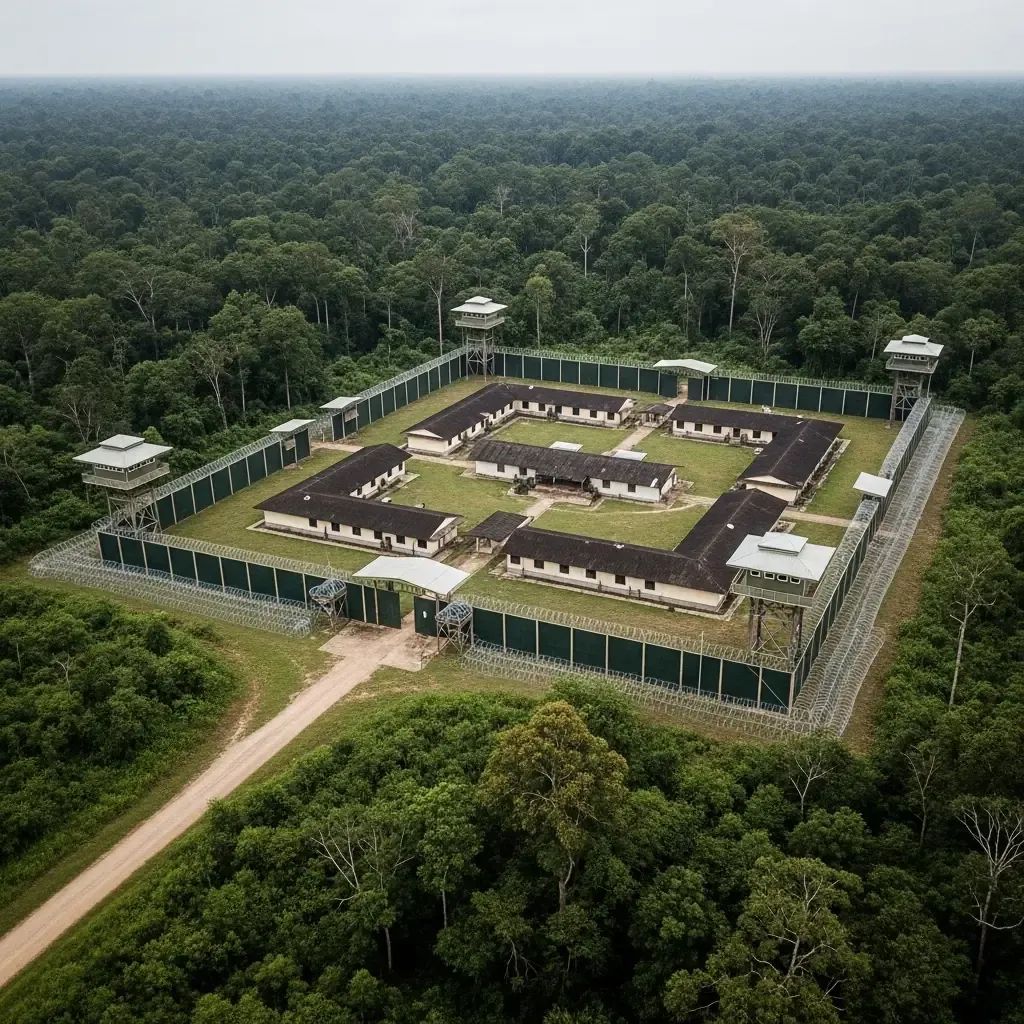
The Thailand Royal Police detained 7 Chinese nationals at a Kanchanaburi resort in April 2026 on illegal entry charges. Several claimed they were lured by false employment promises—a pattern that has become increasingly common across the country. But the real story here is not just about border enforcement; it reveals how Thailand has become both a transit corridor and recruitment ground for transnational scam syndicates that operate from compounds across the Myanmar border.
Why This Matters
• Severe legal consequences: Illegal entry and unauthorized employment can result in up to 5 years imprisonment and fines reaching ฿100,000—roughly equivalent to 2 months of median Bangkok rent
• Thailand's western border is a key trafficking route: The Kanchanaburi-Myanmar crossing corridor has become a primary route for moving Chinese nationals toward forced labor compounds
• More than just this arrest: Over 300 Thai citizens were rescued from border scam centers during a multinational crackdown that concluded on March 12, 2026
Understanding the Trafficking Pipeline
The distinction here matters: these Chinese nationals weren't simply overstaying visas to work ordinary jobs. Most were destined for what law enforcement calls "pig butchering" operations—systematic online fraud schemes housed in guarded compounds near Thailand's borders. The schemes involve romance fraud, fake cryptocurrency investments, and extortion that extract money from victims worldwide, including Thailand.
Criminal syndicates, many with roots in organized crime networks, advertise fabricated positions on social media and job sites with promises of salaries significantly higher than typical domestic wages. The bait includes flights and housing. Victims arrive on valid tourist visas, their guard down. Once in Bangkok or Kanchanaburi, they're transported overland toward Myanmar, Laos, or Cambodia. Passports are confiscated upon arrival at the compound. Then coercion begins.
Victims face physical punishment if daily fraud quotas aren't met. Families receive threats. Some workers are sold between compounds. The psychological toll is compounded by the fact that many fear reporting—they've been forced into criminal activity, and arrest seems as likely as rescue.
A Pattern Playing Out Across Thailand
The Kanchanaburi bust is not isolated. In early March 2026, Thailand authorities arrested 14 Chinese nationals in Nonthaburi after they entered illegally, many reportedly escaping crackdown-related closures of scam operations in Cambodia. The month before, 17 Chinese nationals were detained at a Bangkok hotel, again linked to fleeing Cambodia. In Chanthaburi, 12 more faced charges for illegal entry, suspected of being part of a broader network.
What's notable is the consistent nature of these arrests. They suggest that as enforcement actions close operations in one country, the networks relocate—moving staff, recruiting fresh victims, and establishing new compounds in areas where government reach is weakest.
The Sai Yok checkpoint operation on March 1, 2026 offers detail on how movement occurs. Thailand Immigration Bureau officers stopped a vehicle carrying 3 Chinese nationals without proper documents. The driver, caught at the scene, admitted to accepting ฿5,000 to drive them toward the Three Pagodas Pass in Sangkhlaburi District—a crossing into Myanmar. The booking had started as a ride-hailing app transaction before converting to a cash arrangement. Investigators believe a handler was waiting on the other side to consolidate the passengers into the compound system.
That same checkpoint also intercepted 42 Myanmar nationals attempting illegal entry for work. They had each paid between ฿15,000 and ฿30,000 to smugglers—bidirectional flows that illustrate how border criminality is transnational.
The New Reality of Enforcement
Thailand has begun to recognize that traditional anti-smuggling tactics alone won't address this issue. The government launched the Anti-Online Scam Operation Center specifically to target the digital infrastructure sustaining these networks. Military and police have deepened coordination. New laws are being drafted to close legal gaps around forced digital labor—a crime category that existing statutes don't adequately address.
The Thailand Ministry of Justice is establishing a dedicated cyber fraud agency and implementing tracking systems for illicit financial flows. Why? Because these compounds generate profit through real criminal activity affecting real people across borders. A romance scam targeting someone in Thailand moves money out of the victim's account into cryptocurrency, which then feeds the operational costs of holding workers captive in Myanmar.
The March 12 Operation: A Turning Point
A coordinated action involving the Thailand Royal Police, the FBI, the U.S. Department of Justice, and Meta concluded on March 12, 2026. The operation deactivated over 150,000 suspicious accounts used to conduct fraud and recruit victims. More significantly, authorities rescued over 300 Thai nationals who had been trafficked into forced labor at scam centers near Thailand's borders.
The operation underscores a shift in strategy. Rather than merely arresting individual border violators, enforcement is now targeting the digital infrastructure that sustains these networks. Social media platforms, cryptocurrency exchanges, and messaging apps are being used to suppress recruitment and track proceeds. By attacking the infrastructure rather than just the individuals, the operation aims to reduce the economic viability of these schemes.
What Residents Should Know: Protecting Yourself
If you or someone you know is considering employment abroad—particularly through unsolicited job offers—be aware that recruitment for scam compounds uses sophisticated methods and deliberate deception. Warning signs of fraudulent job offers include:
• Unsolicited contact on social media or messaging apps
• Salaries dramatically higher than market rates
• Promises of housing, visa, and flights covered by the employer
• Requests to travel quickly with minimal notice
• Pressure to avoid discussing the job with family or friends
If you suspect trafficking or recruitment fraud, contact:
• Thailand's Human Trafficking Hotline: 1191 (24/7 Thai-language support)
• Thai National Police Tourist Police: +66 2-355-3001 (English available)
• Thailand Department of Special Investigation (DSI): +66 2-206-9000
• Online report form: Thai Department of Social Development website
If you've received suspicious romantic or investment offers online:
• Verify identity independently through official channels
• Never share financial information or send money
• Take screenshots and report to the relevant platform
• Contact local authorities if money has been transferred
For residents of Thailand who believe they are being recruited into or suspect trafficking operations, seeking assistance immediately significantly improves outcomes. Law enforcement agencies have established protocols to protect victims and prosecute traffickers.
International Partnerships Deepening
Thailand is not treating this as a domestic problem alone. In March 2025, Thailand and Hong Kong established a joint working group to track human trafficking networks, specifically after Thailand played a central role in rescuing 48 Hong Kong nationals lured into Myanmar scam compounds.
Cooperation with the United States has intensified. Intelligence is being shared, and coordinated operations are occurring. The U.S. has sanctioned entities in Cambodia and Myanmar involved in scams and trafficking, complementing Thailand's domestic crackdown.
The Structural Challenge Ahead
Despite these efforts, vulnerabilities remain embedded in the system. Border controls in remote areas are inconsistent. Corruption among officials continues. The compounds themselves often operate in areas where government authority is limited or contested, particularly in Myanmar's border regions.
These criminal networks adapt to enforcement pressure. Close one crossing, another opens. Shut down a compound, the leadership relocates with fresh victims. The profitability of the enterprise—fraud targeting thousands globally, generating millions in proceeds—ensures continued investment in refining methods and evading detection.
The Kanchanaburi arrests, while tactically important, represent ongoing competition between enforcement capacity and criminal adaptation. Thailand is building new tools and partnerships, but the challenge is substantial. For people living here, the implications—economic, personal, and institutional—will shape policy and daily reality for years to come.


