
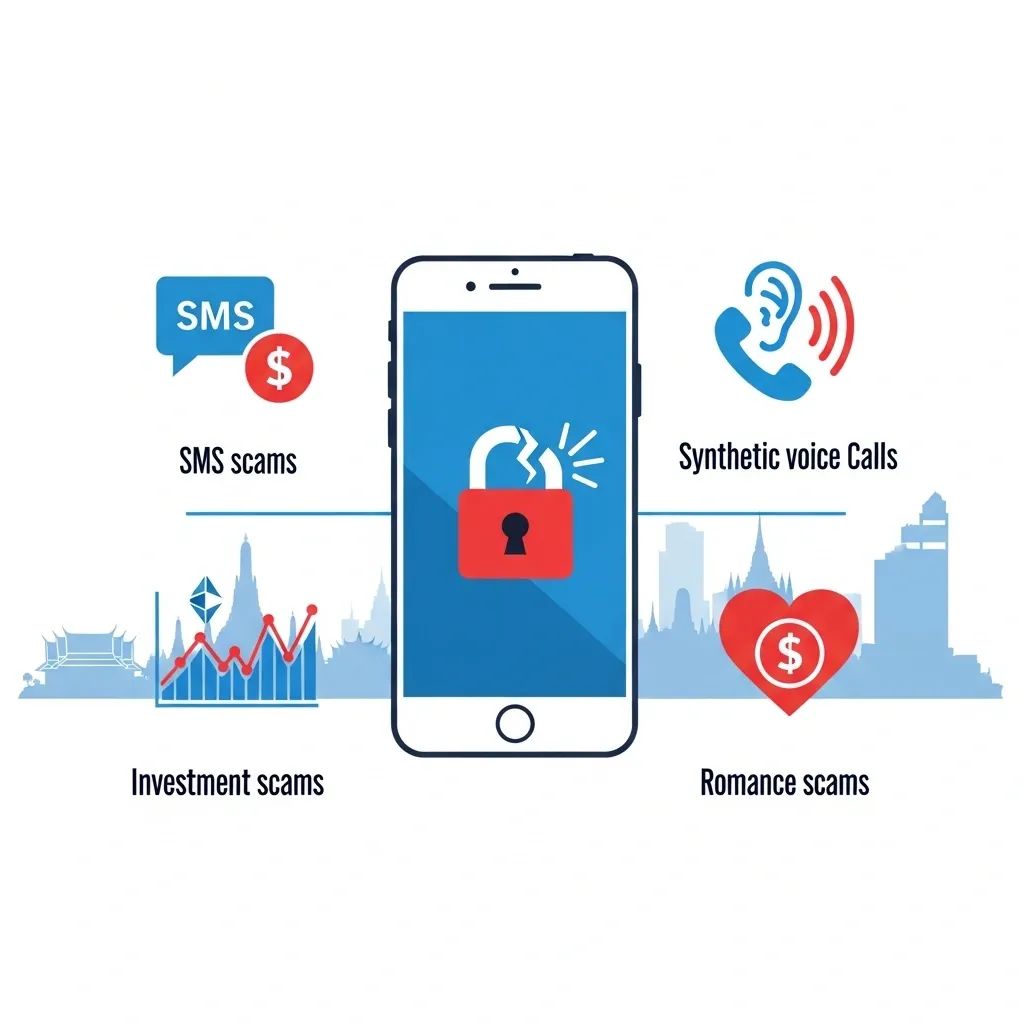
Thailand’s cyber-crime watchers are bracing for a busier, trickier, and more expensive year as online fraudsters sharpen their tools for 2026. From AI-generated voices that sound just like Mum to bogus investment dashboards that vanish overnight, the Digital Economy Ministry says scam crews are planning a fresh wave of attacks. Below is what Thai residents need to know now, before that first Monday in January.
Rapid Snapshot
• Younger and middle-aged Thais (20-49) remain the prime targets, but fraud rings are expanding toward retirees.
• Four core tactics – poisoned links, deepfake intimidation, fake crypto deals, and romance-flavoured social scams – are expected to dominate.
• Facebook still hosts the most incidents, yet call-centre losses rival any social network.
• New rules allow accounts tied to crime to be frozen within 1 hour, and telcos must cut suspicious numbers on demand.
• The classic “4 Don’ts” – don’t click, don’t believe, don’t rush, don’t transfer – now come with extra layers such as multi-factor log-ins and AI scam detectors.
Why the alarm bells are ringing now
A year of hard policing has nudged case numbers down, but officials note that average daily losses still hover around 65 M baht. The Ministry’s data portal shows almost 1 M cumulative complaints since 2022, with barely 11 % of stolen funds clawed back. What worries analysts is the democratisation of shady tech – so-called “Scam-as-a-Service” kits that bundle fake websites, SMS blasters, and voice-cloning apps for rent. That low entry cost, coupled with leaked Thai personal data on the dark web, sets the stage for smarter cons in 2026.
The four fraud blueprints to expect in 2026
Fake utility SMS – Messages that cite unpaid water or power bills come with a one-tap link. The link quietly installs a data-siphoning APK that empties mobile banking apps.
Synthetic voices & faces – AI can recreate a cousin’s voice in real time or animate a police officer’s face on video. Victims are hectored to prove innocence by wiring money to a so-called “safe” account.
Digital-asset mirages – Fraudsters flaunt charts and influencers promising 20 % weekly returns on “digital stocks.” Early pay-outs are real to hook users before the rug pull.
Romance, retail & resort clones – Copy-paste profiles lure hearts or holidaymakers. Payments for handbags or hotel rooms slide into “mule” accounts and disappear.
Where people are being ambushed
Ministry figures suggest four channels dominate: Facebook (126 k incidents / ฿2.8 B lost), call centres (32 k / ฿2.7 B), rogue websites (10 k / ฿1.7 B) and TikTok (8.7 k / ฿534 M). Facebook hosts two-thirds of investment scam pages, while call-centre cons still hurt Gen X and Boomers the most. TikTok’s short-form videos, observers say, increasingly blend “get-rich-quick hacks” and shopping deals that redirect users to Line or Telegram, where the real extortion begins.
Policy & tech counter-offensive
The government has moved from posters to hard-coded protocols. Key steps include:
• Expansion of AOC 1441 into a 100-line hotline able to freeze suspect bank accounts within an hour.
• A revised Tech-Crime Decree that forces banks and telcos to share data and shoulder partial liability if they ignore red flags.
• Roll-out of the WebD AI crawler, credited with a 70 % surge in illegal-site takedowns during 2025.
• Mandatory SIM shutdowns for numbers flagged as “mule” phones, plus cross-border signal jamming along call-centre hot zones.
• Adoption of the “ETDA DPS Notified” badge that tells shoppers a marketplace meets new safety standards.
What you can do in under 60 seconds
Cyber-security advisers still swear by the “4 Don’ts,” but they now bolt on extra moves:
• Think MFA first – enable biometrics or OTPs on every banking and e-commerce app.
• Use a password manager to avoid recycling credentials across Line, Shopee and Gov ID portals.
• Patch phones monthly, even if the update screen feels annoying; exploits target older firmware.
• Skip public Wi-Fi for transfers; a cheap VPN beats an expensive mistake.
• Screenshot suspicious requests and relay them to AOC 1441 or the 1111 hotline before cash is gone for good.
Looking ahead: can the curve be bent?
Officials insist the goal is to cut tech-crime damage by 70 % before 2028. Experts caution that victory hinges on public vigilance more than police raids. One analyst likens the fight to a marathon: “Every new law buys time, but only widespread digital literacy chips away at demand.” For now, the best defence remains ordinary citizens pausing for that split-second check – because in 2026, a single tap could be all the invitation a scam bot needs.


