
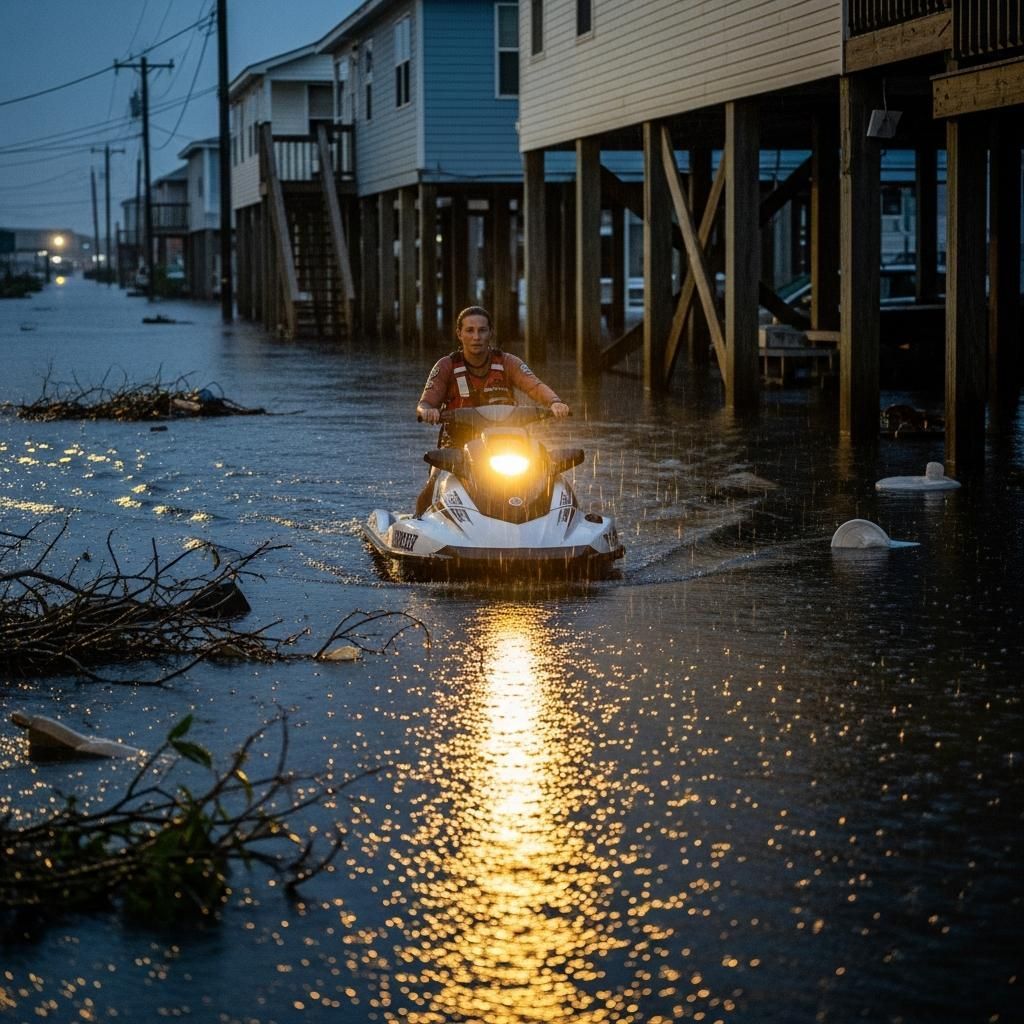
When your rental jet ski dies in the Gulf of Thailand with your children aboard, luck becomes your only insurance. The France-based family stranded off Koh Samui from August 13 to 14, 2026 learned this visceral lesson during what should have been a routine 30-minute outing—and what became a 13-hour ordeal that exposed fundamental gaps in how Thailand manages water-sport safety.
Why This Matters
• GPS tracking on rental jet skis remains voluntary, despite being proposed as mandatory after this incident. The technology exists; deployment doesn't. If your craft fails, rescue teams currently rely on search patterns and luck rather than real-time location data.
• Thailand's jet-ski industry operates under fragmented oversight—the Marine Department, Transport Ministry, local district offices, and Royal Police each play partial roles but nobody commands ultimate accountability when equipment malfunctions or operators cut corners.
• Life jackets were the difference between rescue and drowning for this family. They floated visible throughout the night. One missing vest changes the August 14 headline from "rescued" to something far darker.
The Incident: Mechanical Failure in Rough Water
A 50-year-old man and his sons, aged 12 and 9, collected a green-and-white Sea-Doo jet ski from Chaweng Beach on August 13 at 5:20 PM. All three wore life jackets—a choice that proved critical. They intended a half-hour ride. By 6:00 PM, when they failed to return, the rental operator triggered alarms. Within hours, Bor Phut Police, Koh Samui district office, rescue teams, and local jet-ski operators mobilized a coordinated search. District Chief Amorn Chumchuay took command of the operation.
The sea that night was unforgiving. Waves surged 3-4 meters high; wind intensity made daylight search impossible. Teams stood down after dark on the 13th. When dawn broke on August 14, they resumed. Around 11:00 AM, rescuers spotted the family floating approximately 13 kilometers east of Koh Mat Lang. The youngest boy perched on the partially submerged jet-ski hull. His father clung to its side. His older brother floated nearby. All were conscious but exhausted. Bangkok Hospital Samui checked them for injuries. Their mother, who had spent the night on the beach, reunited with them within hours.
Initial investigation pointed to engine malfunction—the most common cause of small-watercraft incidents. The disabled ski had drifted, pushed seaward by waves and currents. In optimal conditions, a modern jet ski floats and remains visible; this one did both. Three people without life jackets in 3-4 meter waves present a drastically different calculation.
The Regulatory Maze Thailand Hasn't Solved
On paper, Thailand's Maritime Rules are comprehensive. Since 2016, the Ministry of Transport mandates that jet-ski operators obtain special coastal vessel licenses, carry liability insurance, and restrict operations to daylight hours and designated zones. Speed limits apply in shallow water. Violations carry fines and potential imprisonment.
Implementation is another matter. The Marine Department issues licenses; the Transport Ministry writes rules; district chiefs hold local authority; the Royal Police investigate accidents; municipal bodies manage beach access. This fragmentation creates predictable breakdowns. When a tourist files a damage-fraud complaint—operators routinely claim pre-existing damage was caused by renters—responsibility diffuses across agencies. A complaint flows from local police to the Marine Department to tourism authorities, cycling through channels while the visitor's flight departure approaches.
The result: safety depends less on law than on operator ethics and individual traveler vigilance.
Jet-ski fraud remains endemic. Operators photograph skis with minor existing damage, then invoice renters for "new" damage after return. The standard protection—photographing the equipment before departure and filming its condition—relies entirely on the renter remembering to document. Fewer than half do. Giving a rental operator your actual passport as a "deposit" is practiced by many tourists and exploited by some operators. Thai consumer protection law offers limited recourse for foreigners in rental disputes; pursuing legal remedies often costs more time and money than the deposit itself.
Mechanical maintenance escapes scrutiny almost entirely. There is no mandated inspection schedule for rental equipment. There is no public registry of mechanically-failed skis. There is no requirement that operators report breakdowns. If a jet ski malfunctions and the users survive, nothing enters the formal record. The machine may return to rental rotation with unrepaired problems.
What This Means for Residents and Long-Term Visitors
This August 2026 incident represents the only documented jet-ski emergency on Koh Samui this year according to current data. That statistic invites two interpretations: genuine safety improvements, or simply underreporting in an industry with financial incentives to resolve crises quietly before authorities arrive.
For anyone renting watercraft in Thailand, certain practical steps matter more than regulatory frameworks:
Document the jet ski meticulously. Photograph the fuel level, any visible damage, wear marks, and the condition of safety equipment before departure. Record a brief video walking around the craft. If the engine shows visible rust or corrosion, refuse the unit and demand a replacement. Operators providing a pristine backup within minutes are likely running a professional operation; those resisting are showing you something.
Never surrender your real passport. Offer a photocopy or a cash deposit instead. Thai law does not require hostage-taking of travel documents. Operators who insist are testing your knowledge of your own rights.
Verify insurance coverage. Ask the operator for proof of liability insurance before renting. Many policies exclude jet-skis or impose strict conditions (age limits, skill requirements, geographic restrictions). Your own travel insurance likely excludes motorized watercraft. Read the fine print. If you suffer injury or damage, Thai insurance claims for tourists move at glacial speed and often deny responsibility entirely.
Check the weather. The Thai Meteorological Department publishes marine forecasts. Small-craft advisories typically appear when wave forecasts exceed 2 meters. Ignoring these warnings is not bravery; it's calculating risk without information.
Book through verifiable operators. Resort concierges and hotel staff vet rental partners more carefully than beach vendors do. The price premium is real. The reduced fraud risk is larger.
Life jackets matter enormously. They were the critical difference here. The family remained afloat, visible, and conscious because flotation equipment supported them through the night. Insist on USCG-approved or equivalent life vests. Cheap inflatable knockoffs fail in rough water.
The Tracking Device Question
District Chief Amorn has proposed equipping Koh Samui's approximately 200-300 rental jet skis with GPS tracking devices. Real-time location monitoring would enable rapid identification of craft straying beyond safe zones or ceasing to transmit position data. A lost machine could be located rather than searched for blindly.
Operators have already signaled resistance. Equipment costs translate directly to margin reduction. Phuket experimented with mandatory tracking for longtail boats following several drownings. Implementation remains inconsistent, enforcement patchy. Technology solves some problems—locating a disabled craft—but not others. Tracking devices do nothing to prevent mechanical neglect, operator fraud, or the fundamental fact that a broken engine still leaves you drifting.
The Thailand Marine Police operate with limited patrol capacity. Coordination between the Marine Department, district offices, and municipal bodies remains vague. These institutional gaps—the spaces where accountability evaporates—are where operators exploit ambiguity.
The Environmental Layer Nobody Discusses
Beyond tourist safety, jet-skis create ecological friction that Thai regulators have approached half-heartedly. The craft generate noise disturbing marine mammals, including dugongs and migrating whales that traverse Gulf of Thailand waters. Engine emissions and fuel leaks contribute to coastal pollution in areas where coral reefs and seagrass beds support local fishing stocks.
The Thailand Department of National Parks, Wildlife and Plant Conservation has restricted or banned jet-skis in designated marine protected areas. Outside those boundaries, enforcement is minimal. Daily, operators push machines into shallow water, damaging seafloor ecosystems. Inexperienced riders venture into swimming zones, creating collision hazards for snorkelers and divers. This collision between tourism revenue and environmental stewardship continues unexamined in most policy discussions.
The Enforcement Window, Then Fade
This rescue has already triggered renewed oversight. District officials are auditing licenses more rigorously. The Marine Office is conducting spot inspections. Rental operators are temporarily complying with new restrictions.
But without sustained political pressure and adequate staffing, the tighter oversight will likely fade. Jet-ski rentals generate substantial tourism revenue—daily rates run 1,500-2,500 baht, equivalent to a week's groceries for many Thai families. That economic weight creates political incentives to allow the sector to self-regulate. Once August fades from public memory, enforcement machinery typically shifts to lower speed.
For residents and foreign visitors, the practical reality remains unchanged: individual due diligence matters more than government oversight. Rent from established operators with track records. Verify insurance. Check weather. Wear life jackets. Photograph equipment before departure. Understand that Thai bureaucracy will offer limited assistance if disputes arise during your visit.
The rescue succeeded partly through luck—calm morning seas, life jackets, daytime visibility, a coordinated response. The next jet-ski emergency might unfold differently. The difference between a successful rescue and a tragedy often hinges on decisions made before departure, not regulatory frameworks enforced after crisis erupts.


