
The Thailand Ministry of Foreign Affairs is watching closely as the People's Republic of China escalates its hard-line approach to transnational crime syndicates, executing 16 Myanmar-based gang leaders in the opening months of 2026. The wave of capital punishment—carried out following Supreme Court approval—marks Beijing's most aggressive move yet to protect Chinese nationals abroad and sends a stark signal about the region's shifting security landscape.
Why This Matters
• Regional safety alert: The executions target the so-called "Four Families" operating along the Myanmar-Thailand-Laos border triangle, an area where tens of thousands of people—including Thai nationals—have been trafficked into forced labor at online scam compounds.
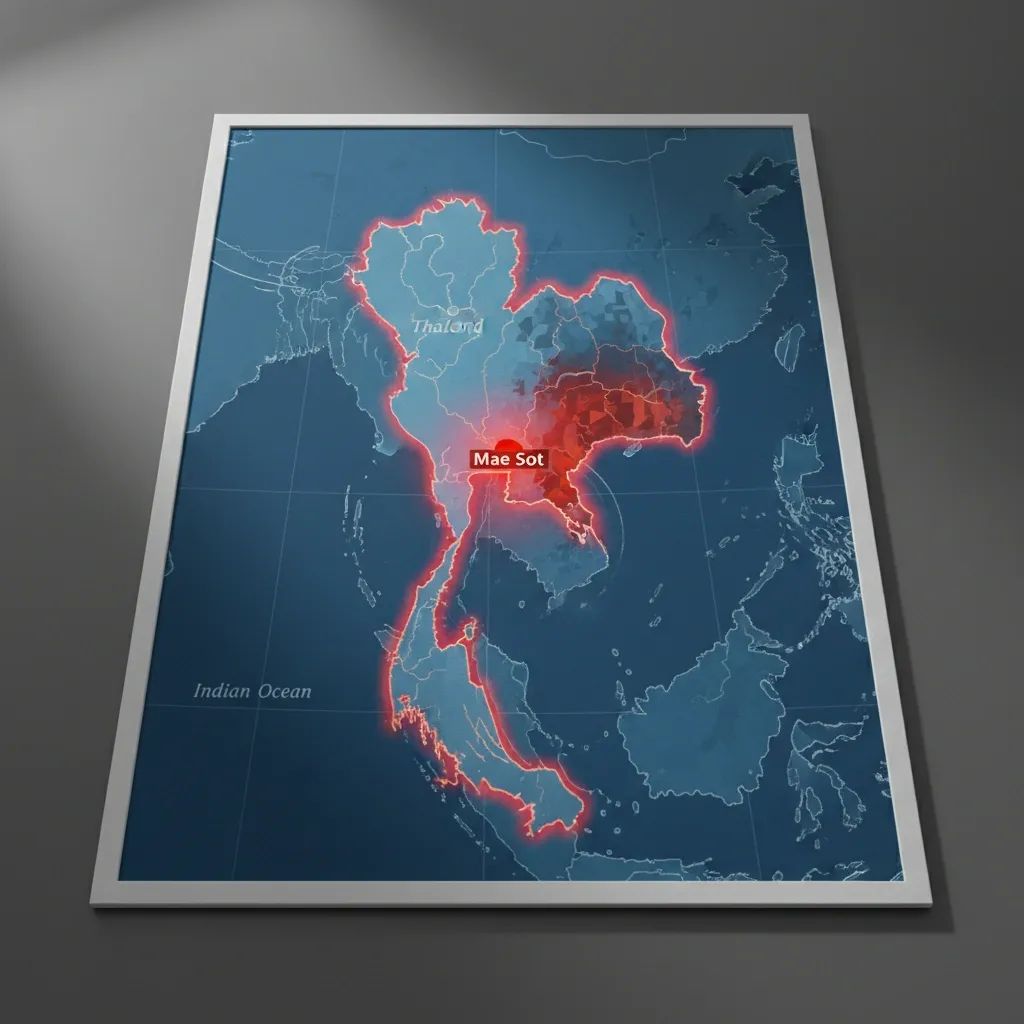
• Thailand connection: Some victims were lured from Mae Sot district in Tak Province, then smuggled across the border to Myanmar's notorious KK Park in Myawaddy, directly opposite Thailand's frontier.
• Economic impact: The syndicates handled fraud schemes worth over 29 billion yuan (around 148 billion baht), with casino operations and telecommunications scams targeting populations across Southeast Asia.
• Diplomatic pressure: Beijing's willingness to execute foreign nationals for crimes committed outside China territory raises questions about jurisdiction and bilateral cooperation frameworks in the Mekong region.
The Execution Wave and Its Scale
Between late January and early February 2026, China's judicial system carried out two major rounds of capital punishment. On January 28, authorities executed 11 members of the Ming clan syndicate, followed by four senior leaders of the Bai family gang in the first week of February. All were convicted on multiple counts: intentional homicide, telecommunications fraud, online gambling operation, kidnapping, extortion, forced prostitution, narcotics trafficking, and unlawful detention.
The charges stem from operations centered in Myanmar's Kokang Self-Administered Zone in northern Shan State, a semi-autonomous region where ethnic armed groups and criminal enterprises have long operated with minimal state interference. According to Chinese prosecutors, these syndicates directly caused the deaths of six Chinese citizens and orchestrated financial crimes totaling 4.16 billion US dollars.
One case that galvanized Chinese public opinion involved the Bai clan's sprawling operation in Laukkai, Kokang. Court documents revealed the gang ran 41 separate criminal compounds, protected by private armed forces, and processed more than 3,400 separate fraud cases with a combined value exceeding 1.1 billion yuan (about 5.6 billion baht). Victims were coerced into operating romance scams, cryptocurrency schemes, and fake investment platforms targeting mainland China, Hong Kong, Taiwan, and overseas Chinese communities.
The Thailand Border Connection
For residents and businesses in Thailand's northern provinces—particularly Chiang Rai, Tak, and Mae Hong Son—the crackdown underscores an uncomfortable reality: the porous border with Myanmar has become a major transit corridor for human trafficking and forced labor recruitment. In January 2025, Wang Xing (also known as Xing Xing), a 31-year-old Chinese actor, disappeared from Mae Sot after being contacted via WeChat with a fake screen-test offer in Thailand. Within days, he surfaced at KK Park in Myawaddy, head shaved, undergoing "training" as an online scammer alongside roughly 50 other Chinese captives.
Wang's case drew intense media coverage in China and prompted diplomatic intervention. He was eventually freed and returned to Shanghai, but his ordeal illustrated the scale of the problem. Human rights monitors estimate that as of early 2026, more than 6,000 trafficking victims from 21 countries remain detained in Myanmar's border zones, with 3,900 of them Chinese nationals. Survivors report systematic torture, electric shocks, scalding water punishments, and 18-hour workdays operating scam call centers.
The Thai Ministry of Labour and Royal Thai Police have coordinated with Chinese authorities on repatriation efforts, but the infrastructure supporting these criminal networks remains largely intact. In late 2025, Thai and Chinese law enforcement jointly dismantled over 630 structures connected to the KK Park complex, yet new compounds continue to emerge in remote border areas beyond effective government control.
What This Means for Residents and Investors
For Thai nationals and foreign residents in Thailand, the escalation carries several direct implications:
Employment scams: Fake recruitment offers promising high-paying jobs in Thailand—often in hospitality, entertainment, or tech—continue to circulate on social media platforms popular in the region, including Line, Facebook, and TikTok. The Chinese Embassy in Bangkok issued a formal warning in October 2025 about "zero-dollar tours" and unlicensed Chinese guides forcing tourists into shopping schemes, but similar tactics are now being used to lure workers across borders.
Cross-border travel risks: Anyone traveling near the Thailand-Myanmar frontier should exercise heightened caution. The December 2024 kidnapping of 78-year-old Chinese businessman U Yian in Tachileik—directly across from Mae Sai, Chiang Rai—ended in a shootout that killed all six captors and recovered 65,000 methamphetamine pills from the safe house. Thai immigration authorities have since tightened visa checks and increased patrols along the Sai River crossing points.
Business due diligence: Companies operating in the Golden Triangle economic zone or engaging with Myanmar-based partners should conduct enhanced compliance reviews. Beijing's extraterritorial enforcement approach means that Chinese nationals involved in cross-border crime can face capital punishment regardless of where the offense occurred, as long as it harms Chinese interests. This has already affected some Thai firms with Myanmar joint ventures in the gaming and telecommunications sectors.
Regional security cooperation: Thailand has joined a ministerial-level coordination mechanism with China, Laos, and Myanmar to combat transnational crime. In practical terms, this means increased intelligence sharing, joint police operations, and expedited extradition procedures. Since 2025, Chinese authorities have repatriated over 57,000 suspects connected to Myanmar-based fraud operations, with many transiting through Thai territory under bilateral agreements.
The Broader Geopolitical Context
China's aggressive stance reflects a "zero-tolerance" policy toward crimes targeting its citizens abroad, part of a wider effort to project state power beyond its borders. In March 2026, Beijing evacuated more than 3,000 Chinese nationals from Iran following bombings near its embassy, while simultaneously issuing travel warnings for Japan amid tensions over Taiwan.
The Myanmar executions serve multiple strategic purposes. Domestically, they demonstrate the government's commitment to protecting citizens, a key legitimacy pillar for the Communist Party. Regionally, they assert Chinese legal jurisdiction over criminal networks operating in spaces where local authorities lack capacity or will to intervene.
Thailand's position in this dynamic is delicate. The kingdom maintains close economic ties with China—its largest trading partner—but also values the principle of territorial sovereignty. The Thai Ministry of Justice has quietly cooperated on suspect transfers while emphasizing that any enforcement actions within Thailand must follow Thai legal procedures. In practice, this has meant allowing Chinese security officials to conduct "advisory" missions in northern provinces, though the full extent of their operational role remains opaque.
Legal and Ethical Questions
The executions have sparked debate among international legal scholars. A Beijing Normal University law professor quoted in Chinese state media defended the practice, arguing that when crimes harm Chinese citizens and violate both local and Chinese law, Beijing has jurisdiction "regardless of the perpetrator's nationality or the crime's location." Critics counter that this approach effectively claims universal jurisdiction for crimes against Chinese nationals, a position that could clash with established norms of international law.
For Thailand, the implications extend to bilateral extradition treaties and mutual legal assistance agreements. If Chinese authorities can prosecute and execute Myanmar nationals for crimes committed in Myanmar against Chinese victims, the precedent raises questions about how similar cases involving Thai citizens might be handled. The Thai Cabinet has not publicly addressed this issue, but legal experts within the Office of the Attorney General are reportedly reviewing existing cooperation protocols.
The Criminal Networks That Remain
Despite the executions, the underlying criminal infrastructure persists. The so-called "Four Families"—the Ming, Bai, Wei, and Liu clans—operated across multiple jurisdictions with backing from ethnic armed organizations including the Border Guard Forces (BGF) and the Democratic Karen Buddhist Army (DKBA). While the top leadership has been eliminated, mid-level operators have reportedly relocated to Laos, Cambodia, and even the Philippines.
Kokang and Myawaddy remain the epicenters of scam operations, protected by militias that effectively control territory independent of Myanmar's central government. The compounds are sophisticated operations, featuring dormitories, training facilities, armed guards, and high-speed internet infrastructure capable of running thousands of simultaneous scam conversations. Victims are bought and sold between syndicates, with prices ranging from $5,000 to $15,000 per person depending on language skills and technical abilities.
Thai authorities have intercepted several cross-border smuggling attempts in recent months, but the sheer volume of desperate job seekers and the ease of forging work permits make interdiction difficult. The Department of Employment recommends that anyone considering overseas employment verify offers through official channels and register with the Thai embassy at their destination.
Looking Forward
The execution spree is unlikely to be the end of Beijing's campaign. Chinese state media have framed the punishments as the beginning of a sustained effort to "eradicate" cross-border criminal enterprises. Additional trials are ongoing in Yunnan Province, with prosecutors seeking death sentences for dozens more suspects connected to Myanmar-based fraud and trafficking operations.
For residents of northern Thailand, the immediate practical takeaway is vigilance. Avoid unofficial job offers, verify business partners through multiple sources, and report suspicious recruitment activity to local police. The Chinese Embassy's 24-hour hotline for citizen protection (+86-10-12308) is available for emergencies, and Thai nationals facing similar situations in border areas can contact the Ministry of Foreign Affairs' Operations Center at 1178.
The broader strategic question—whether China's extraterritorial law enforcement model will become a regional norm or spark diplomatic friction—remains unresolved. What is clear is that the Golden Triangle's criminal economy is undergoing a violent transformation, and the ripple effects will be felt across the Mekong basin for years to come.


