
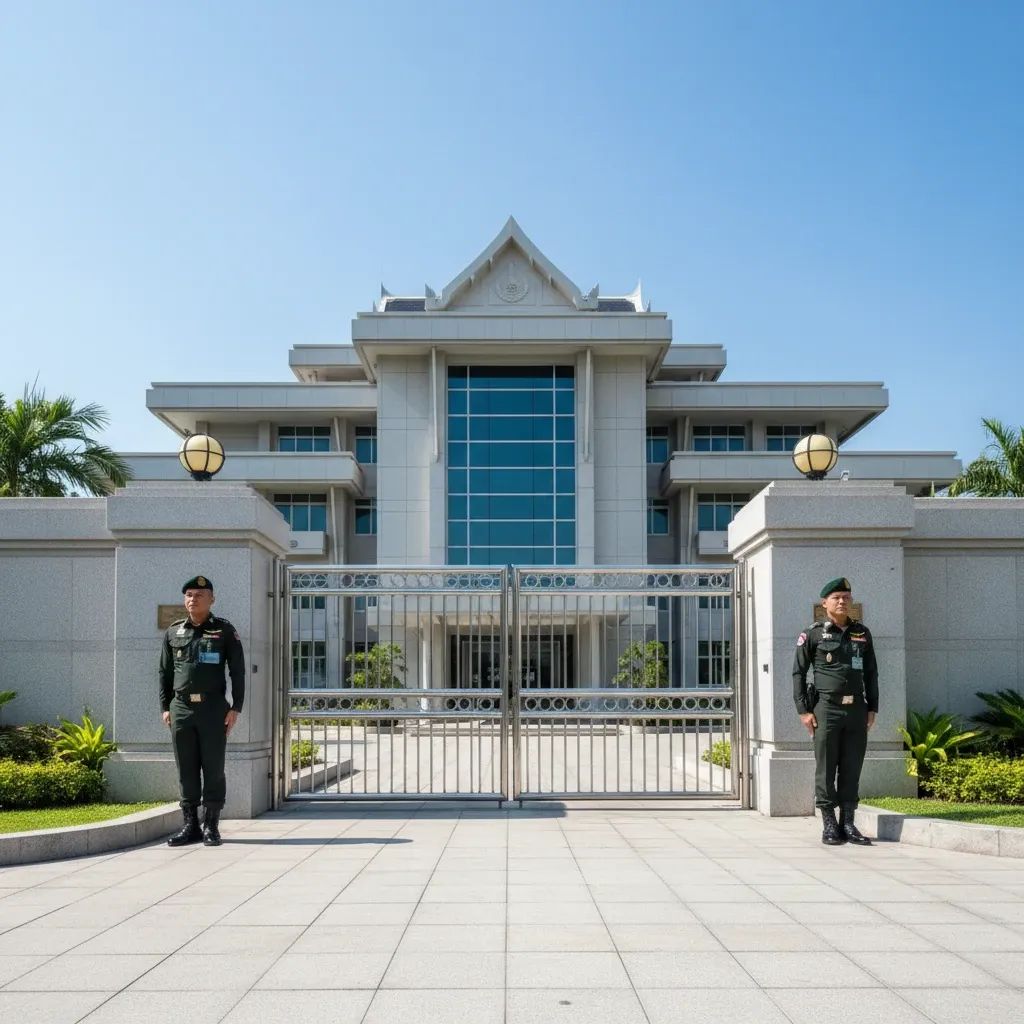
Conscript's Detention Death Triggers First Serious Military Accountability Test Under Thailand's Anti-Torture Law
The Thailand 1st Army Region has launched a formal investigation into the November 2024 death of a young conscript held at a military detention facility—a move that signals whether the country's landmark anti-torture statute will actually reshape how authorities treat soldiers in custody, or whether institutional opacity will persist.
Private Phetcharat Kamlangying collapsed on the tenth day of a fifteen-day detention sentence at the 12th Military Circle Prison in Prachinburi for the administrative offense of unauthorized absence. He died en route to Fort Chakrabongse Hospital. Within weeks, the case became a referendum on military accountability itself.
Why This Matters
• The 2022 anti-torture law finally empowers civilian courts to prosecute military personnel for custodial abuse—but only if investigations are conducted transparently and thoroughly. This case is the first major test of whether those powers translate into real consequences.
• 26 conscripts have died under contested circumstances in military detention since 2009, yet convictions were rare before 2023. If this investigation yields accountability, it signals systemic change; if it stalls, the law remains theater.
• Families now have legal recourse and compensation pathways that did not exist two years ago, but only if they can compel disclosure of medical records, autopsy findings, and CCTV footage—which remains contested in Phetcharat's case.
The Official Narrative Meets Family Skepticism
The Thailand Army spokesperson, Major General Winthai Suvaree, presented the explanation plainly: sudden cardiac failure. An autopsy showed an enlarged heart; no physical trauma was evident. The medical diagnosis seemed to close the matter. Except that the family had begun receiving information—much of it contradictory—from the facility and hospital staff.
Former People's Party MP candidate Nitchanan Wangkahat began documenting concerns raised by Phetcharat's relatives on social media in late November. What emerged was a web of inconsistencies that no single autopsy report appeared to fully address.
When Phetcharat's body arrived at the crematorium at Wat Samakkhi Samoson, the mortician made a discovery that raised immediate questions: a metal spoon was lodged inside the remains after cremation. The mortician explicitly stated he had inspected both the body and the casket before placing them in the furnace and observed no spoon.
The Spoon, the Breathing Tube, and the Missing Medical Records
Hospital records indicated that emergency staff performed endotracheal intubation during resuscitation attempts—a procedure that requires insertion of a breathing tube directly through the mouth. If a spoon had been present, attending physicians would have encountered it during airway management. Yet when Fort Chakrabongse Hospital's director later confirmed that Phetcharat was declared dead on arrival, the question of how an object could remain undetected through emergency procedures became logically fraught.
Major General Winthai countered by stating that military conscripts routinely carry spoons during field training exercises outside their units—standard equipment for deployed operations. This explanation seemed plausible until the 12th Military Circle Prison director stated separately that detainees are explicitly prohibited from possessing metal utensils inside the facility. These two official statements—one from the Army's public-facing spokesperson, the other from the prison's command—directly contradicted each other.
When Phetcharat's aunt, Maliwan Kamlangying, was invited to review CCTV footage on February 24, she observed that approximately four of the twelve individuals visible in the detention barracks were obscured by camera blind spots. The critical moments of his collapse and immediate aftermath occurred precisely in those unmonitored zones—the very location where staff response would be most visible yet remained invisible to the record.
The family requested x-ray imaging of the head and neck region. The hospital had conducted such imaging, given that the autopsy noted a missing tooth. Yet only torso imaging was released. Medical records remained incomplete. The mortician described feeling a hard object inside Phetcharat's mouth but did not investigate further. After cremation, the spoon was found.
The Barracks Conflict and the Anonymous Allegation
According to an eyewitness account provided to Nitchanan by another conscript, tensions had emerged during daytime work assignments. The conscripts were ordered to cut timber in nearby woods. Phetcharat and another detainee—referred to as "Private B"—disagreed over work distribution and effort allocation. Such friction occurs in confined environments; what followed allegedly did not.
That evening, according to the informant, Private B—described by the informant as a barracks leader and a "favorite of senior officers"—allegedly summoned Phetcharat and commanded him to perform push-ups as punishment. The account then escalates: three forceful kicks delivered to the chest, followed by loss of consciousness.
Critically, this alleged assault occurred in a CCTV dead zone, ensuring no visual record would exist. The informant further alleged that other soldiers were instructed to maintain silence about the incident.
Major General Winthai explicitly denied that any physical altercation had occurred, stating that the autopsy revealed no trauma consistent with blunt force injury to the chest or abdomen. Yet the family continued to question why sudden cardiac death—a condition that typically presents with documented warning signs or pre-existing pathology—would occur under these contested circumstances.
The Closed-Door Conference and Information Withholding
On February 24, the 12th Military Circle Prison facility invited Nitchanan and Phetcharat's family members to a "conference." Military officers requested that journalists leave the room, citing the sensitivity of classified information that could not be disclosed to external parties. They stated that family members could subsequently grant media access if they wished.
Nitchanan objected and requested public transparency in the proceedings. The facility's officers held firm. Reporters waited outside.
After viewing the CCTV footage, Maliwan raised an observation: the footage did not show visible chest compressions or active resuscitation techniques despite Phetcharat's collapse. While others were moving in response, the visible portions of the barracks showed limited evidence of lifesaving measures—the standard emergency response any trained facility would deploy.
The hospital declined to release detailed medical records. The family received autopsy summaries but not imaging reports. The x-rays of Phetcharat's head and neck—despite findings of a missing tooth—were withheld. This piecemeal disclosure of information hardened the family's conviction that something was being obscured rather than clarified.
The Broader Pattern: 26 Deaths, Limited Accountability
Phetcharat's case exists within a documented pattern. Since 2009, approximately 26 conscripts have died in military detention or barracks settings according to cross-referenced Thai military records and documentation by Thai human rights organizations. The official causes assigned include sudden illness, suicide, and acute medical emergencies. A substantial subset, however, involved documented or alleged beatings, excessive physical punishment, or medical crises arising under contested circumstances.
Before February 22, 2023, when Thailand's Anti-Torture and Enforced Disappearance Act of 2022 became effective, prosecuting military officers for custodial abuse was extraordinarily difficult. Military courts handled military cases; civilian oversight was minimal; institutional loyalty often trumped evidence. The new statute fundamentally changed the landscape by transferring jurisdiction to civilian Corruption and Misconduct Criminal Courts, establishing explicit criminal penalties for torture and enforced disappearance, and requiring independent investigation into all custodial deaths.
Two Convictions Signal Possible Shift
Two convictions have followed under the new law, though they remain exceptional:
Private Woraprach Padmasakul died in August 2024 after intensive physical abuse at a Chonburi military installation. In May 2025, the Corruption and Misconduct Criminal Court in Rayong convicted two military instructors to 15 and 20 years imprisonment respectively, and eleven senior enlisted personnel to ten years each.
Private Kittithorn Viangbanpot died in July 2023 following aggressive punishment that led to sepsis. The Corruption and Misconduct Criminal Court in Chiang Mai sentenced two trainers to one year imprisonment each.
These convictions demonstrate that civilian courts will act when evidence meets the threshold of documented abuse. Yet they also remain exceptional—two convictions from 26 documented deaths across 17 years reflects either extraordinarily low abuse rates or extraordinarily high barriers to prosecution.
Practical Implications for Families and Conscript Protection
If you have a relative serving as a conscript, the legal infrastructure now provides substantially greater protection than existed prior to 2023. The Rights and Liberties Protection Department under the Thailand Ministry of Justice has provided assistance in 33 cases under the anti-torture law as of February 22, 2026, distributing over 8 million baht in victim compensation and rehabilitation services. This encompasses not only financial restitution but also institutional coordination with the National Human Rights Commission of Thailand (NHRCT), public apologies, and psychological treatment.
Barriers to Access Remain
However, access to this protection depends on several conditions that remain unevenly met. Military facilities remain difficult for civilian oversight bodies to access and inspect. The NHRCT and external auditors face institutional barriers when attempting to examine detention conditions, interview detainees, or conduct independent investigations. Families must often navigate complex bureaucratic procedures and hire private advocates—as Nitchanan has done—to obtain information that should be routine.
International scrutiny has intensified. International human rights organizations including Amnesty International and Fortify Rights have called for greater accountability, independent monitoring, and cultural change within military institutions. The Minnesota Protocol—the UN standard for investigating potentially unlawful deaths in custody—and the Mandela Rules on prisoner treatment establish benchmarks against which Thai military detention can be measured. Advocates argue that alignment with these standards remains incomplete.
The Investigation That Will Signal Everything
The 1st Army Region commander ordered the probe and temporarily reassigned the 12th Military Circle Prison's director to headquarters—a procedural step that signals administrative recognition of irregularities yet does not automatically indicate culpability or corrective action. Major General Winthai has publicly stated that the military will not shield personnel found to have engaged in misconduct or negligence. If the investigation substantiates assault, negligence, or other violations, he indicated that criminal and administrative consequences would follow.
The Senate Committee on Political Development, Public Participation, Human Rights, Freedoms, and Consumer Protection scheduled an inspection of the Bangkok Special Prison for February 27 to examine detention conditions, medical access, and grievance mechanisms—a move suggesting legislative bodies are taking custodial welfare increasingly seriously across both civilian and military settings. The timing suggests that institutional attention is focusing on detention practices more broadly, providing political context for the Phetcharat investigation.
Where Skepticism Takes Root
The inconsistencies between official statements—the spoon protocol contradiction, the CCTV footage gaps, the withheld medical imaging—have created a credibility gap that no press briefing has closed. When families emerge from closed-door meetings with more questions than answers, and when basic medical documentation remains unreleased, institutional trust erodes.
The pattern of 26 deaths over 17 years, combined with newly documented convictions for abuse-related fatalities in other military units, suggests systemic issues rather than isolated incidents. When a single autopsy attributes sudden death to cardiac failure—and is presented alongside unexplained physical evidence, contested circumstances, CCTV blind spots, and family accounts of visible beatings—assertions of transparency become insufficient.
The Cross Cultural Foundation (CrCF) and Thai Lawyers for Human Rights (TLHR) have mobilized legal resources on similar cases, recognizing that statutory protections mean little without enforcement and institutional culture change. They have documented patterns suggesting that military training methods remain shaped by older disciplinary traditions that the 2022 law explicitly prohibits.
The Pivotal Question
Whether this investigation becomes a genuine examination or a procedural exercise designed to satisfy minimum requirements will signal whether Thailand's anti-torture law has genuinely shifted incentives and behavior within the military, or whether institutional inertia and opacity continue to protect systems that produce death certificates where transparent investigation should precede any official conclusion.
For Phetcharat's family, for the 26 other conscript families whose losses remain contested, and for conscripts currently serving in Thailand's Armed Forces, the answer to that question will determine whether they are protected by law or merely reassured by language.


