
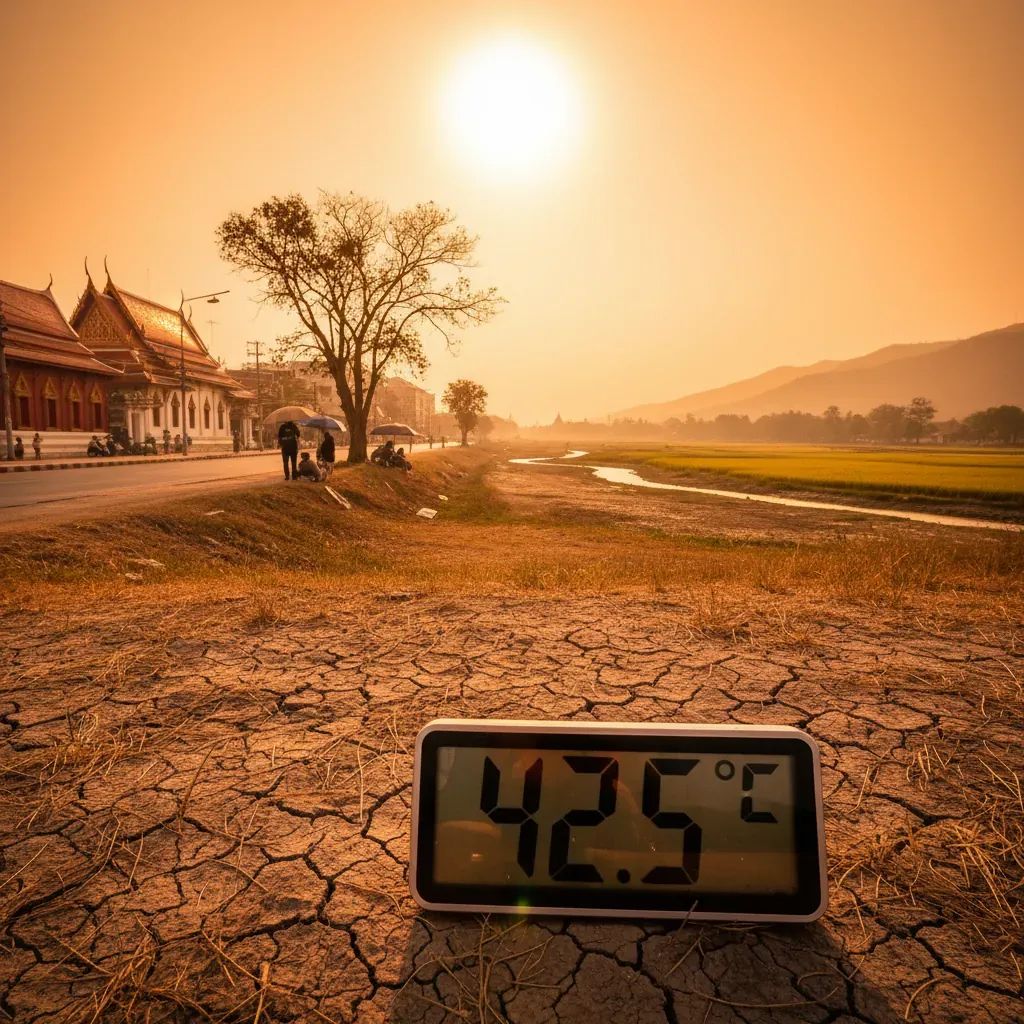
Thailand faces an intense week of scorching temperatures and scattered thunderstorms as a stalled heat system anchors itself over the upper mainland. The Thailand Meteorological Department issued guidance Saturday highlighting that peak daytime readings will approach 41°C across the North, Northeast, and Central zones, while isolated thunderstorms with gusty winds threaten at least 11 provinces.
Quick Takeaways
• Temperatures will peak between 38–41°C in upper regions, creating serious health hazards for outdoor workers and vulnerable groups
• Afternoon thunderstorms with gusty winds are forecast in provinces from Phitsanulok to Nakhon Ratchasima
• Haze conditions will persist due to stagnant atmospheric patterns, particularly affecting those with respiratory conditions
How the Heat System Trapped Itself in Place
The atmospheric mechanics behind this severe spell center on a thermal low-pressure zone establishing over upper Thailand, creating essentially a containment vessel for extreme heat. Warm surface air expands, rises, and cools at altitude—but in this case, the surrounding environment isn't much cooler, so the rising air sinks back down, creating a stagnant cycling pattern. Strengthening southerly and southeasterly winds at the mid-levels are funneling moist air into this zone, which destabilizes the column and sets conditions for afternoon storm development.
This differs from typical monsoon systems that sweep moisture through consistently. Instead, these storms will arrive sporadically and pack intensity over narrow areas. Yet that intensity is a concern. Convective activity from storm cells can produce significant wind damage—enough to affect weakened structures and vegetation. Along coastal areas of the eastern Gulf, wave action will periodically reach or exceed 1 meter in storm zones.
Regional Breakdown: Where Heat Peaks Hardest
Northern Territory takes the brunt of this system's intensity. Daytime maxima will hover between 38–41°C with almost no overnight relief, as nighttime minimums only slip to 17–25°C. Provinces such as Phitsanulok and Phetchabun face the highest thunderstorm likelihood. Weak winds lack the power to ventilate accumulated haze, which compounds respiratory concerns during daylight hours.
The Northeastern plateau mirrors this intensity, reaching 39–40°C during business hours. Cities including Loei, Bueng Kan, Chaiyaphum, and Nakhon Ratchasima will experience scattered afternoon thunderstorms. Overnight temperatures between 23–27°C offer minimal cooling relief, keeping nighttime conditions uncomfortably warm for those without mechanical air conditioning.
Central Thailand, encompassing Bangkok's metropolitan corridor, will occupy the 37–41°C band. The capital's concrete infrastructure absorbs solar radiation and re-radiates it long into evening, making conditions feel substantially hotter than official readings. Nighttime minimums of 24–27°C provide little respite.
The Eastern seaboard from Chachoengsao through Trat experiences slightly lower peaks of 33–39°C, though this remains dangerously hot. Moderate winds provide air circulation but can also trigger thunderstorm activity over waters and coastal lowlands.
Southern coastlines experience the mildest conditions, with daytime readings between 33–38°C. East-coast provinces near Nakhon Si Thammarat, Songkhla, and Yala may see isolated light precipitation, offering minor relief compared to the mainland north.
Immediate Health Adjustments Required
Anyone spending hours outdoors during this period faces genuine medical risk. Heat illness emerges insidiously—dehydration and electrolyte depletion happen rapidly at 38°C-plus. Baseline fluid intake should reach 2–3 liters daily, escalating significantly for those engaged in physical labor. Water alone proves insufficient; electrolytes lost through perspiration require replacement to prevent cramping and cardiovascular strain.
Timing shifts offer measurable benefit. Concentrating outdoor work in early morning hours (5–8 AM) or late afternoon (5 PM onward) reduces exposure to the worst peaks. Midday rest periods must occur in shade or air-conditioned space. Even extended sun exposure during peak hours can trigger dizziness or heat cramps in susceptible individuals.
Haze and air quality concerns deserve attention. Stagnant atmospheric conditions accumulate particulates, and residents with asthma, chronic bronchitis, or cardiac conditions should monitor air quality readings and limit strenuous outdoor activity. Children and elderly populations experience compromised thermoregulation—their bodies manage heat stress less efficiently than healthy adults.
Farmers and pet owners face parallel concerns. Livestock and companion animals endure identical heat stress. Provision of continuous shade, fresh water, and monitoring for signs of distress becomes important. Small animals and birds prove particularly vulnerable to rapid thermal swings.
Preparing for Afternoon Thunderstorms
The 11 provinces flagged for thunderstorm activity should treat afternoon forecasts as serious planning constraints. Though individual storm cells typically persist only briefly, the activity demands preparation.
Secure all loose exterior items: potted plants, patio furniture, signage, and roof-mounted equipment require securing or relocation indoors. Gusty winds during storms can transform everyday objects into hazards. Clear gutters thoroughly so drainage functions during intense rainfall; verify that tree limbs overhanging structures are trimmed clear to prevent branch-fall damage.
Motor vehicle operators should avoid stationary positioning beneath large trees, particularly in rural zones where emergency response times extend significantly. Flooding can materialize rapidly in low-lying terrain when intense rainfall overwhelms drainage capacity. Highway travel during thunderstorm watches demands heightened caution—visibility collapses suddenly and wet pavement compromises tire adhesion.
Provincial disaster management coordinators and the Thailand Royal Police maintain monitoring protocols, yet personal readiness comprises the critical first defense. Residents in watch-list provinces should consult Thailand Meteorological Department updates regularly.
The Seasonal Pattern Context
Late March consistently marks the escalation phase of Thailand's hot season, which builds momentum from February through May, with April typically representing peak extremes. This particular week demonstrates the intensity routine for late-spring conditions. The thermal dome will gradually weaken as monsoon circulation patterns establish dominance, though this transition typically delays until mid-May or early June depending on year-to-year variability.
The practical reality demands straightforward adaptation: minimize midday sun exposure, maintain adequate hydration protocols, monitor air quality conditions if respiratory concerns exist, and regard afternoon thunderstorm watches as genuine threats if you occupy affected provinces. These constitute legitimate public health and safety concerns requiring behavioral modification.


