
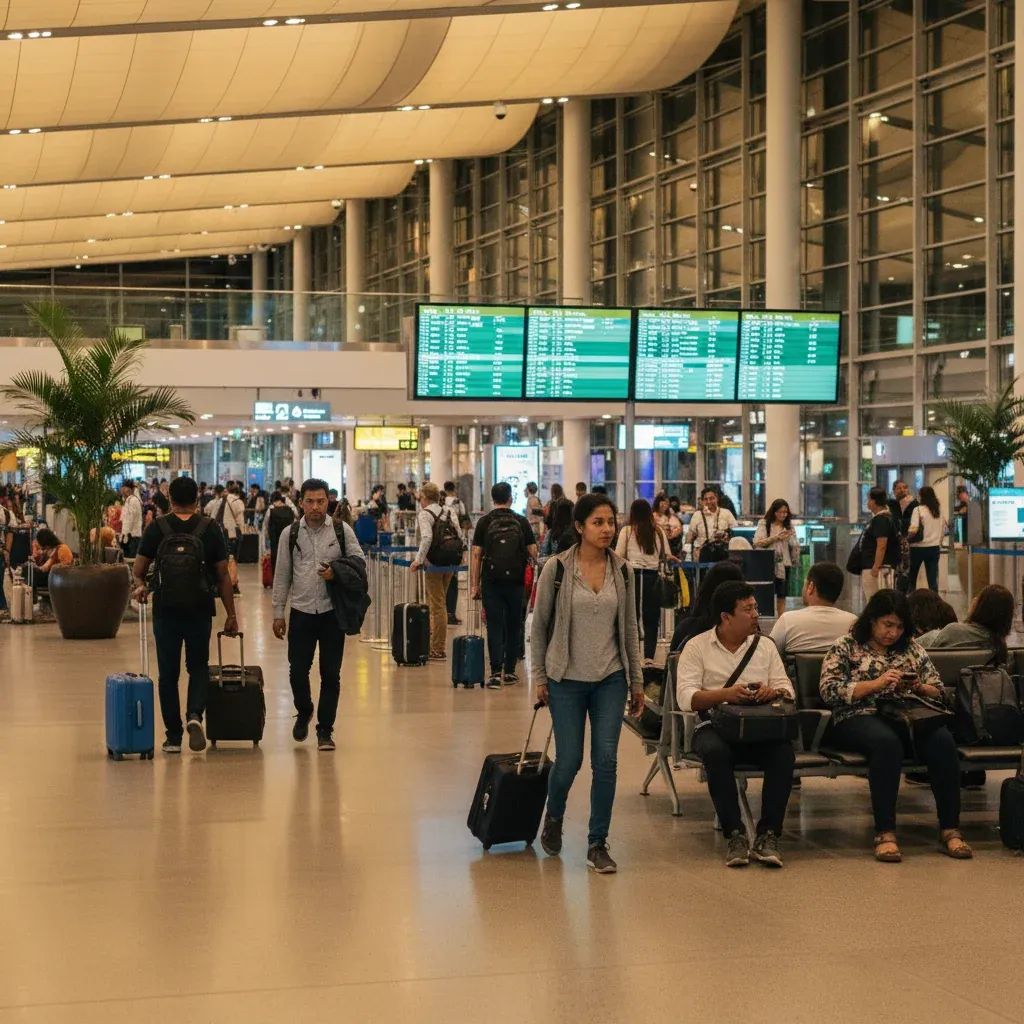
Europe's jet fuel reserves are critically low—roughly 42 days' worth—and if resupply chains remain severed by the Iran-induced closure of the Strait of Hormuz, widespread flight cancellations could unfold within six weeks, potentially by late May 2026. For travelers and residents in Thailand, this European crisis carries real implications: higher ticket prices, reduced airline capacity on key routes, and potential rebooking chaos during peak summer travel season.
The crisis stems from Iran's blockade of the Strait of Hormuz, a shipping chokepoint through which approximately 75% of Europe's jet fuel imports previously flowed. The International Energy Agency (IEA) issued the alert after benchmark prices in Europe surged to $1,838 per ton in early April—more than double the pre-conflict rate of $831. For context, fuel now accounts for 20-40% of an airline's operating budget, a burden that has already forced KLM to cancel 160 intra-Europe flights throughout May and Lufthansa to ground up to 27 aircraft.
Why Residents and Travelers in Thailand Should Pay Attention
While the shortage is geographically concentrated in Europe, the knock-on effects reach Southeast Asia in three immediate ways. First, European carriers operate key long-haul routes to Bangkok, Phuket, and Chiang Mai; any capacity reduction or surcharge adjustment will filter down to ticket availability and pricing for those connections. Second, Asia-Pacific airlines source significant volumes of jet fuel from the same Middle Eastern refineries now offline, meaning parallel supply stress could tighten inventories at Suvarnabhumi and Phuket International if tanker traffic reroutes toward Europe. Third, the spike in global benchmark prices is already pushing up fuel costs across all regions, including Thailand, where carriers may pass incremental expenses to passengers through temporary surcharges or higher base fares.
Thailand's own aviation sector—Thai Airways, Bangkok Airways, Thai AirAsia, and Thai Lion Air—has so far reported stable fuel availability. Domestic refineries and blending terminals maintain roughly 30 days of jet-kerosene stocks under normal demand, and the Kingdom is geographically closer to alternative supply routes out of Singapore, Malaysia, and India. Nonetheless, industry sources caution that any prolonged disruption in the Gulf could tighten regional allocations, especially during the high-season months of June through August when tourist arrivals peak and aircraft movements intensify.
The Mechanics of Europe's Fuel Crunch
Before the Hormuz closure, Gulf refineries shipped approximately 400,000 barrels per day of jet fuel to Europe. That volume evaporated overnight. In response, European buyers have scrambled to secure replacement cargoes from the United States and Nigeria, pushing U.S. exports to record levels in April and Nigerian flows to significant volumes. Yet the IEA calculates that even at maximum capacity, alternative sources can replace only a fraction of the shortfall, leaving Europe's six-week buffer shrinking by the day.
Several Italian airports have already instituted emergency rationing protocols, with some limiting fuel deliveries for short-haul flights. That restriction forces carriers to stage fuel stops or cancel marginal routes. Budget operator Ryanair has publicly floated a 10% schedule reduction, while EasyJet reported substantial additional fuel costs for early 2026.
What Carriers and Regulators Are Doing
Airlines for Europe (A4E)—a lobby group representing Lufthansa, Air France-KLM, EasyJet, and Ryanair—has called on the European Commission to suspend the EU Emissions Trading Scheme (ETS) for aviation on a temporary basis, arguing that the added carbon cost is untenable when fuel prices have already doubled. The group also wants Brussels to waive passenger-compensation rules under EC Regulation 261/2004 for cancellations triggered by fuel shortages, classifying them as extraordinary circumstances beyond carrier control.
The European Commission has indicated it will unveil a relief package addressing broader energy-market disruption from the Iran conflict, though specifics on jet fuel remain vague. One proposal under discussion mirrors the joint natural-gas procurement mechanism launched during the 2022 Ukraine crisis: a coordinated buying platform that would pool demand and negotiate bulk contracts with non-Gulf suppliers. Separately, member states are reviewing strategic petroleum reserve requirements to clarify allocation priorities.
On the operational side, carriers are deploying a tactic called tankering—filling aircraft to maximum legal fuel weight at airports where supply remains stable, then flying onward without refueling at constrained hubs. The practice adds weight and burns slightly more fuel in aggregate, but it smooths out allocation bottlenecks. It also underscores how tight margins have become: airlines are trading efficiency for certainty.
Parallel Stress in Asia-Pacific
The Asia-Pacific region historically draws significant jet fuel from Middle Eastern refineries, making countries such as Vietnam, Myanmar, and Pakistan acutely vulnerable. Vietnam Airlines and VietJet have both raised fuel surcharges on international routes, while Pakistan International Airlines (PIA) temporarily suspended some long-haul service in mid-April, citing inability to secure affordable fuel at either end.
For Thailand-based travelers, the most tangible risk lies in connecting itineraries. A typical Bangkok–Frankfurt–New York routing could see the Frankfurt leg canceled if Lufthansa cannot secure adequate kerosene at its hub. Passengers would then face rebooking delays, potential overnight stays, or rerouting through Gulf hubs—ironically the same region driving the shortage. Travel-insurance policies typically exclude force majeure clauses tied to war or government action, meaning out-of-pocket costs for missed connections may not be recoverable unless the original ticket was purchased with a flexible-rebooking rider.
What Residents in Thailand Can Do
Book early and lock in prices. Airlines typically load fuel surcharges 48–72 hours before departure; advance purchases at current rates offer some insulation.
Favor direct routes. Non-stop Bangkok–Europe services on Thai Airways, EVA Air, or Lufthansa eliminate connection risk. If the fuel crunch forces hub cancellations, point-to-point flights stand a better chance of preservation.
Monitor alternative hubs. Gulf carriers—Emirates, Qatar Airways, and Etihad—remain operationally stable because their home refineries lie outside the blockade zone. Routes via Dubai or Doha may offer more reliable schedules than European transfers.
Check rebooking policies. Flexible or refundable tickets cost more upfront but provide leverage if cancellations cascade in June or July.
Track industry updates. Monitor announcements from Thai carriers and international aviation news for fuel-availability developments and schedule changes.
Impact on Ticket Prices and Summer Travel Plans
Industry analysts project that if the Hormuz blockade persists beyond May, average round-trip fares on Europe–Asia routes could rise 15-25% by late June. That would translate to a significant increase on a Bangkok–London economy ticket. Premium cabins, which already carry higher fuel surcharges, may see smaller percentage increases but larger absolute jumps.
Budget carriers, which operate on thinner margins and hedge less fuel exposure, face the starkest trade-offs. AirAsia X, which flies Kuala Lumpur–London, has warned that sustained high fuel prices make long-haul low-cost service increasingly challenging. If the carrier adjusts its European network, travelers from Bangkok, Chiang Mai, and Phuket who connect via KL will see reduced budget options, pushing residual demand onto full-service competitors and further inflating fares.
Long-Term Implications for Aviation and Energy Security
Even if a ceasefire reopens the Strait of Hormuz in the coming months, the IEA estimates it will take up to two years for refinery output, tanker logistics, and storage inventories to return to pre-conflict norms. In the interim, Europe is accelerating adoption of Sustainable Aviation Fuel (SAF)—synthesized from waste oils, agricultural residues, and renewable hydrogen—which can be blended into existing infrastructure without engine modifications. Current EU mandates require 2% SAF blending by 2025 and 6% by 2030, but the crisis may prompt an expedited ramp.
For Thailand, the episode reinforces the strategic value of domestic refining capacity and diversified import channels. The PTT Group operates coastal refineries with combined jet-fuel output sufficient to meet a significant portion of national aviation demand, insulating the Kingdom from the worst scenarios. Nonetheless, any prolonged global squeeze would still elevate costs and constrain growth in the tourism and logistics sectors, which together account for nearly 20% of GDP.
From a geopolitical standpoint, the fuel shortage underscores the vulnerability of single-point-of-failure supply chains—a lesson Southeast Asia absorbed during the pandemic's semiconductor and medical-equipment crunches. Policymakers in Bangkok are reviewing strategic reserve policies for jet kerosene to cushion future shocks.
The Bottom Line
Europe's jet-fuel reserves are draining at a pace that could ground significant portions of the continent's airline network by late May 2026. While Thailand enjoys relative supply stability, travelers and businesses dependent on European connections face higher fares, reduced schedules, and elevated rebooking risk through the summer. Booking early, favoring direct routes, and considering Gulf-hub alternatives will help mitigate disruption. For the aviation industry at large, the crisis is accelerating the shift toward sustainable fuels and decentralized supply—a transition that, once complete, should make global air travel more resilient to geopolitical turbulence.


