
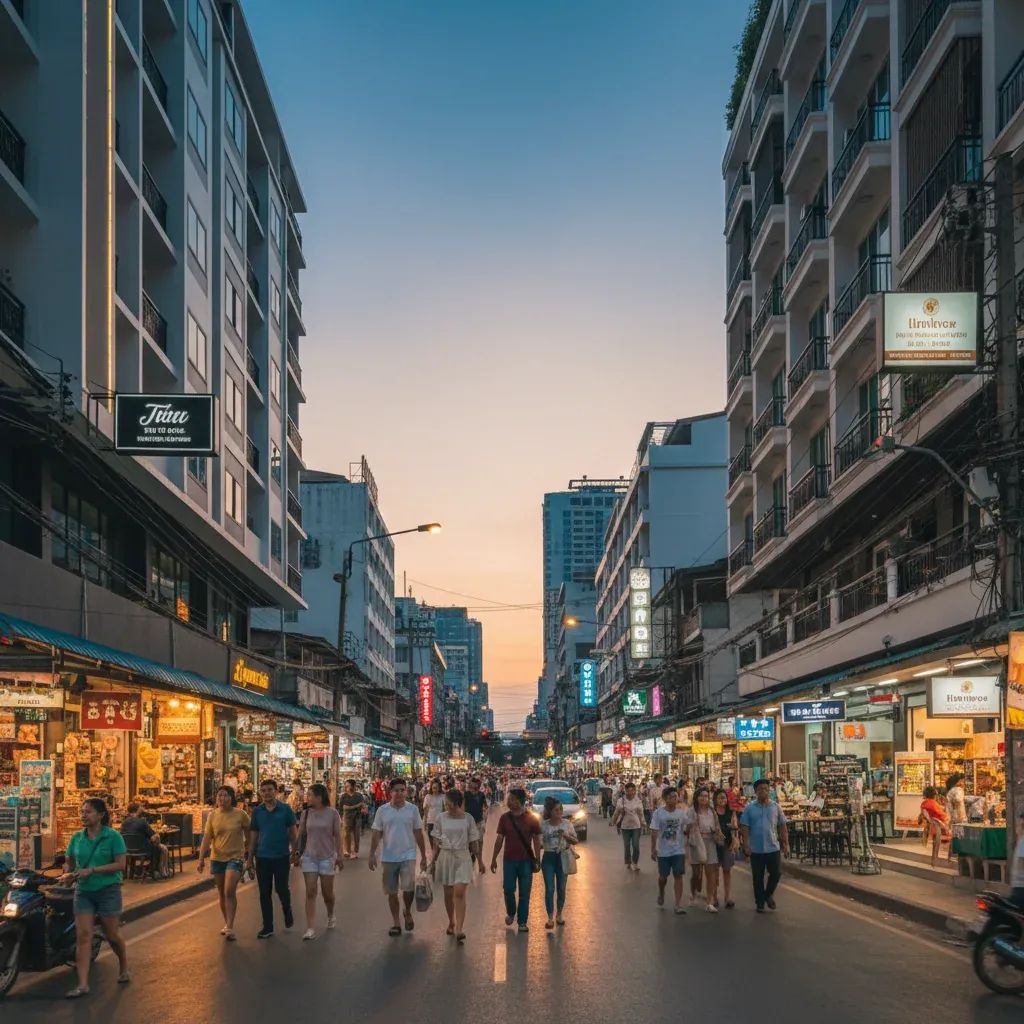
The Thailand Alcohol Control Committee has greenlit plans to permit 24-hour alcohol sales in designated zones within the Eastern Economic Corridor (EEC), following a 90-day pilot program that revealed no uptick in traffic accidents—a finding that could reshape nightlife, hospitality, and tourism infrastructure across the country's fastest-growing economic region.
Important Timeline Clarification: This article covers a policy decision made in April 2026. The pilot program ran from December 2025 through March 2026, with full implementation expected by late May 2026.
Why This Matters:
• Pilot results: Alcohol sale hours expanded from 11:00 AM to midnight between December 2025 and March 2026, with no measurable increase in road crashes compared to the previous year.
• Timeline: The framework must pass public hearings and royal decree publication, expected by end-May 2026.
• Geography: The Eastern Aviation City Promotion Zone around U-Tapao International Airport in Rayong Province is the first confirmed area; Pattaya and other tourism-heavy districts within the EEC are likely next.
• Restrictions remain: Buddhist holidays will still enforce alcohol bans, and all existing laws—no sales to under-20s, no drinking in vehicles—stay in place.
The Pilot That Changed the Conversation
Between December 2025 and March 2026, Thailand's Ministry of Public Health tested the waters by lifting the longstanding 2:00 PM to 5:00 PM sales blackout, extending permitted hours from 11:00 AM straight through to midnight. Traffic accident data tracked by Montien Kanasawat showed collision rates held steady year-over-year, even during the expanded afternoon and evening window.
That result gave the Thailand Alcohol Control Committee, chaired by Health Minister Pattana Prompat, the confidence to advance a more ambitious proposal: round-the-clock sales in select EEC zones. The committee formally endorsed the concept at an April 2026 meeting, directing the EEC Office to identify which areas should qualify based on investment potential and economic activity.
What This Means for Residents and Businesses
For anyone living, working, or investing in the EEC—particularly in Chonburi, Rayong, and Chachoengsao provinces—the shift represents more than convenience. It signals a deliberate pivot toward hospitality-led growth.
Two categories of license-holders will qualify for 24-hour permits:
Event and exhibition venues, including convention centers and large-scale festival grounds.
Restaurants operating within approved EEC zones, provided they comply with all health, safety, and licensing requirements.
Business associations in Pattaya, where nightlife and entertainment underpin much of the local economy, have lobbied for years to relax sales windows. They argue that international tourists expect consistent alcohol availability and that rigid time restrictions put Thailand at a competitive disadvantage against regional rivals like the Philippines or Vietnam, where alcohol retail is far less regulated.
The reform is expected to unlock extended operating hours for bars, clubs, and late-night dining establishments, potentially lifting revenue for thousands of small and medium enterprises tied to the hospitality sector. For expats and long-term residents, it may also simplify grocery shopping and remove the bureaucratic oddity of supermarket aisles cordoned off mid-afternoon.
Regulatory Roadmap and Legal Safeguards
The proposal is not yet law. It must complete several steps:
• Public hearings to gather stakeholder input, including health advocates and law enforcement.
• Formal notification to provincial authorities within the EEC.
• Publication in the Royal Gazette, which triggers the legal start date.
Officials estimate the process will take approximately 60 days, putting full implementation around late May 2026. During that window, the Thailand Ministry of Public Health and the EEC Office will finalize the geographic boundaries of the eligible zones.
Critically, the committee emphasized that all existing alcohol laws remain enforceable. That means:
• Sales to anyone under 20 years old are still prohibited.
• Drinking in vehicles, on trains, and at transit hubs remains illegal.
• Buddhist holidays—including Makha Bucha, Visakha Bucha, Asalha Bucha, and the start of Buddhist Lent—will continue to prohibit alcohol sales nationwide.
The Thailand Alcohol Control Committee is also assuming responsibility for issuing holiday sales bans, a power previously exercised by the Prime Minister's Office.
Why the EEC, and What Comes Next
The Eastern Economic Corridor is Thailand's flagship megaproject, spanning three provinces along the Gulf of Thailand and anchored by U-Tapao International Airport, Laem Chabang Port, and the planned high-speed rail link to Bangkok. The government has poured more than ฿1.5 trillion (US$45 billion) into infrastructure, aiming to transform the region into a hub for advanced manufacturing, logistics, and tourism.
Relaxing alcohol regulations is part of a broader effort to make the EEC more attractive to foreign direct investment and international visitors. The Eastern Aviation City Promotion Zone, which surrounds U-Tapao, was designated as the first pilot area for 24-hour sales because of its proximity to a major international gateway and its concentration of hotels, conference centers, and commercial developments.
Pattaya, located just 30 kilometers south of U-Tapao, is the most tourism-dependent city in the region, drawing roughly 10 million visitors annually before the pandemic and recovering steadily since. Local business groups have argued that outdated sales restrictions deter high-spending tourists and create enforcement headaches for venues that cater to international guests operating on different time zones.
Provincial authorities in Rayong and Chachoengsao are expected to submit their own zone applications once the legal framework is finalized, potentially expanding coverage to industrial parks, resort complexes, and entertainment districts.
The Safety Debate: What the Data Shows
The 90-day trial period was designed to test the hypothesis that extending alcohol availability would lead to more drunk-driving incidents. It didn't. Traffic statistics compiled by the Thailand Ministry of Public Health showed no statistically significant change in collision rates during the December-to-March window, even as sales hours stretched from 11:00 AM to midnight.
Thailand has one of the world's highest rates of traffic fatalities. Between 2019 and 2023, nearly 33,000 people died in incidents linked to drunk driving. Earlier studies have produced conflicting results. A Centre for Alcohol Studies (CAS) report found that extended nightlife hours in five tourist zones—Bangkok, Phuket, Pattaya, Chiang Mai, and Koh Samui—correlated with a 12% increase in traffic injuries and a 13% rise in deaths, alongside a 115% jump in drunk-driving arrests.
The discrepancy may come down to enforcement. Public health advocates and law enforcement officials have long argued that weak enforcement of drunk-driving laws, rather than alcohol availability per se, is the root cause of Thailand's traffic safety crisis. In February 2026, the Royal Thai Police announced a zero-tolerance crackdown, including immediate legal action for offenders, roadside checkpoints in tourist hotspots, and treating refusal to take a breathalyzer test as equivalent to a drunk-driving offense.
Regional Context and Tourism Competition
Thailand's move mirrors broader trends across Southeast Asia, where governments are recalibrating alcohol policies to compete for tourism revenue. Vietnam imposes no national restrictions on alcohol sales hours, and the Philippines delegates authority to local governments, resulting in a patchwork of rules that generally favor 24-hour availability in metro areas.
These regional competitors pose a direct challenge to Thailand's hospitality sector, and the EEC policy shift is designed to level the playing field for venues competing for international tourists and business investment.
What Residents Should Watch
For those living in the EEC, the next 60 days will determine which neighborhoods and commercial districts fall within the new regulatory perimeter. To find out if your business or residence qualifies, contact your local EEC Office or provincial government office, as official zone maps will be released during the public hearing phase.
Key areas likely to be included based on current designation:
• Properties near U-Tapao International Airport in Rayong
• Walking Street and commercial districts in Pattaya
• Major hotel, resort, and event centers throughout the three provinces
• Industrial parks and logistics hubs near Laem Chabang Port
Property owners in these zones should expect increased demand for retail and hospitality space once the framework takes effect. Businesses interested in obtaining 24-hour permits should prepare their applications now, ensuring they meet health, safety, and licensing requirements set by local authorities.
Expats and long-term residents should also monitor enforcement patterns. The Royal Thai Police has pledged heightened scrutiny of drunk driving. Fines for drunk-driving violations (driving with a blood-alcohol level above 0.05%) can reach ฿100,000 (US$3,000) plus imprisonment. This represents the maximum penalty and applies to serious violations; lesser infractions carry proportionally smaller fines.
Buddhist holidays continue to impose nationwide sales bans, typically affecting around 12 days per year. During these periods, alcohol sales are prohibited across all of Thailand, not just outside the EEC. These dates are set annually by the Thailand Ministry of Culture and posted publicly.
Finally, the reform does not alter zoning laws or licensing requirements for bars, restaurants, or retail outlets. Operators must still comply with local permits, health inspections, and noise ordinances. The change simply removes the time-of-day restriction on when alcohol can be sold—provided the venue is located within an approved EEC zone.


