
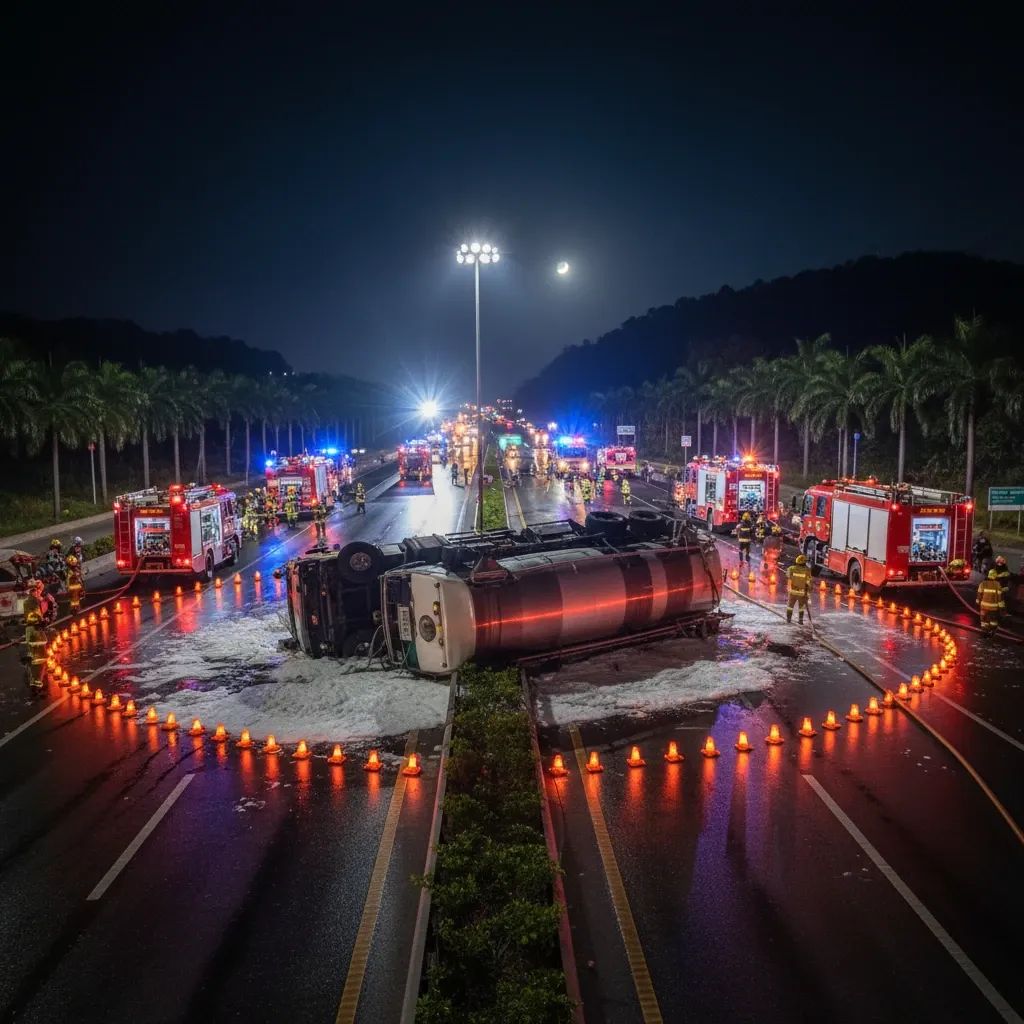
On April 13 around 10 PM, a fuel tanker carrying 16,000 liters of mixed petroleum products—E10 gasoline, E20 blend, and diesel—overturned on the southbound bypass of Route 37 near Hua Hin, a major artery connecting Bangkok to popular coastal destinations including Cha-am and Prachuap Khiri Khan. The incident blocked traffic for over six hours and exposed serious gaps in Thailand's commercial vehicle safety oversight. The driver, a 57-year-old identified as Praphan, admitted falling asleep after weeks of consecutive delivery runs with minimal downtime, revealing an industry practice that routinely prioritizes schedules over driver rest and safety.
Why This Matters
• Traffic gridlock for 6+ hours forced travelers onto narrow side roads, creating 90-minute delays for commuters heading to southern destinations and coastal towns
• Driver fatigue remains inadequately regulated in Thailand—there is no standalone statute criminalizing drowsy driving, only negligence charges after injury or death occurs
• Environmental containment prevented catastrophe: responders prevented fuel from reaching nearby canals, stormwater drains, and aquifers, but only through quick action, not structural safeguards
• Commercial trucking operates under relentless pressure to deliver without adequate rest requirements or enforcement mechanisms
The Mechanics of the Rollover
The tanker went down at kilometer 36+700 in Thap Tai subdistrict shortly after 9:50 PM on April 13. Witnesses described the vehicle listing rightward and toppling into the southbound lane, its cargo—a volatile mixture totaling 16,000 liters—pooling across the asphalt within minutes. Praphan emerged uninjured from the cab but immediately disclosed that he had been delivering fuel daily without sufficient rest between runs, a detail that pointed directly to driver fatigue as the cause.
The Thailand Highway Police, reinforced by officers from Hua Hin Police Station and district officials from both Hua Hin and Pranburi, cordoned off a 200-meter safety perimeter as bystanders retreated to safe distances. Firefighting units from Air Force Wing 5 and Hua Hin Airport deployed foam-equipped trucks to suppress vapor ignition risk, a precaution that proved decisive. Specialized containment booms captured pooled fuel before it reached nearby drainage channels—a critical intervention given the region's monsoon season and the risk that fuel could contaminate downstream water sources.
By 3:45 AM on April 14, heavy-duty cranes had righted the tanker and cleanup crews scrubbed hydrocarbons from the road surface. No fire erupted and no secondary explosions occurred, yet this fortunate outcome should not obscure the serious hazards that were at play. Had conditions been slightly different—a spark, a delay in foam deployment—the incident could have escalated from a traffic disruption into an environmental and public health crisis.
A Regulatory Vacuum with Predictable Consequences
Thailand does not yet criminalize fatigue-related driving as a standalone offense. Instead, crashes traced to sleepiness fall under general negligence provisions in the Criminal Code and traffic law, meaning penalties only apply after an accident causes injury or death. This reactive framework leaves an enforcement gap that advocacy organizations, most notably the "Drowsy Don't Drive" Foundation under royal patronage, have been pressing to narrow.
Data from the Royal Thai Police Road Safety system (PRS) indicate that drowsy driving accounts for roughly 10–15% of reported crashes, though the true figure likely exceeds this substantially because fatigue is notoriously difficult to establish at the scene. During Songkran in April 2026, the Thailand Traffic Safety Authority recorded 344 accidents, 317 injuries, and 71 fatalities nationwide during the first two days. While speeding (45.71%) and drunk driving (24.76%) dominated the rankings, unsafe lane changing (19.05%) and fatigue rounded out the leading causes.
Commercial trucking drivers face amplified exposure. Industry conventions often mandate back-to-back runs with scant downtime, and Thailand's long-haul corridors—particularly the Bangkok-to-Southern-provinces axis—feature inadequate, poorly lit rest stops. The Ministry of Public Health has recommended that operators screen drivers for obstructive sleep apnea (OSA), a condition that fragments nighttime rest and leaves sufferers prone to sudden microsleeps during daytime hours. Yet compliance remains patchy, and enforcement of maximum driving hours is sporadic outside high-profile holiday campaigns.
What This Means for Residents and Motorists
If you regularly commute on Route 37 or other main highways in southern Thailand, treat every tanker with heightened caution. Maintain at least a five-second following distance behind heavy goods vehicles; their braking distance when fully loaded exceeds 100 meters at highway speed. Watch for erratic lane-keeping, sudden swerves, or repeated drift correction—telltale signs of a drowsy driver.
For commercial operators, the Hua Hin rollover underscores the financial case for rest compliance. A rolled tanker means lost cargo, impounded equipment, potential criminal liability, and reputational damage that cascades through supply chains. Installing in-cab fatigue-monitoring systems—such as AI-powered platforms now deployed by select Thai logistics firms—can flag drooping eyelids or prolonged lane drift and alert fleet managers in real time, enabling preventive intervention before disaster strikes.
Residents should also know that the Thailand Department of Land Transport (DLT) mandates periodic mechanical inspections for tankers, yet enforcement varies by province. If you spot a commercial vehicle with defective lights, bald tires, or visible fuel leaks, note the license plate and report it via the DLT hotline (1584). Anonymous tips have prompted roadside inspections that removed unsafe rigs from service before accidents occurred.
The Environmental and Economic Ripple Effect
For Hua Hin residents and expatriates, the six-hour closure translated into detours through narrow side roads and commute delays exceeding 90 minutes for travelers heading south toward Prachuap Khiri Khan town or Chumphon. Local businesses near the bypass reported a marked drop in late-night customers as navigation apps rerouted traffic away from the area, illustrating how a single tanker rollover affects the regional economy in concrete ways.
The environmental stakes were equally serious. Gasoline that escapes containment seeps into stormwater drains and taints canals, poisoning aquatic life and contaminating water supplies. Cleanup crews spent the early hours of April 14 scrubbing the road surface with detergent to remove residual hydrocarbons—a necessary precaution before Thailand's monsoon season, when surface slicks become skid hazards and runoff accelerates contamination downstream.
Had the tanker ignited, the blaze could have engulfed adjacent properties and ruptured underground utility lines, potentially cutting power and water supply to thousands.
Momentum Toward Legislative Reform
While Thailand lacks a dedicated drowsy-driving statute, momentum is building. The "Drowsy Don't Drive" Foundation has drafted legislative language that would empower traffic officers to order roadside rest for drivers exhibiting fatigue symptoms—bloodshot eyes, repeated yawning, or failure to maintain lane markings—and impose fines for non-compliance. The proposal remains under review by the National Road Safety Committee, which targets reducing traffic fatalities to 12 per 100,000 population by 2027, down from roughly 20 per 100,000 in recent years.
In the interim, prosecutors can pursue reckless-endangerment charges under Section 390 of the Criminal Code when a fatigued driver causes injury or death. Penalties range from fines to imprisonment, depending on severity. Civil liability—compensation for medical bills, lost income, and property damage—adds financial teeth to the deterrent, though it offers little solace to victims or affected communities.
Practical Guidelines for Long-Distance Travel
The Ministry of Public Health advises all drivers—professional or private—to:
• Sleep at least seven hours before long trips. Caffeine and loud music offer only brief respite; they do not reverse fatigue.
• Stop every 150 kilometers or two hours. Even a 10-minute nap in a secure rest area can restore alertness and prevent microsleep.
• Avoid sedating medications. Cold remedies and antihistamines impair reaction time as much as moderate alcohol consumption.
• Travel with a companion who can share driving duties or maintain conversation to stave off drowsiness.
For tanker operators, international best practice calls for pre-trip inspections of brakes, tires, valves, and emergency shutoff systems; load balancing to prevent weight distribution problems that can cause rollovers on curves; route planning that avoids congested zones and identifies safe pullover points; and driver training in defensive techniques, including how to recognize the early signs of fatigue and execute controlled stops.
A Pattern That Demands Response
The Hua Hin rollover is part of a troubling sequence of serious commercial vehicle incidents on Thai highways. These crashes share common factors: mechanical stress, human fatigue, and insufficient regulatory oversight converging on Thailand's arterial highways.
For expatriates and long-term residents, these incidents highlight the unpredictable hazards of intercity travel. Route 37 is a vital link between Bangkok and beach towns and fishing ports along the Gulf of Thailand. When a tanker goes down, the ripple effects—traffic snarls, environmental contamination, and fire risk—touch thousands. Staying informed about road closures via apps like ViaMichelin or the Thai Highways mobile platform can save hours and keep you clear of hazard zones.
The Road Ahead
The swift response by Hua Hin authorities and military firefighting units prevented tragedy on April 13. Yet prevention, not reaction, must become the standard. As Thailand pursues modernization of its logistics sector and compliance with EURO 6 emissions standards for heavy trucks, integrating anti-fatigue technology—lane-departure warnings, drowsiness detection cameras, and mandatory electronic logbooks—should become standard requirements, not optional upgrades.
The message is clear: if your eyelids droop, pull over immediately. The fuel station, the client, and the next delivery can wait. A rolled tanker leaking gasoline onto a busy bypass cannot. For Praphan, a moment of drowsiness cost him and the region far more than any delay ever could have.


