
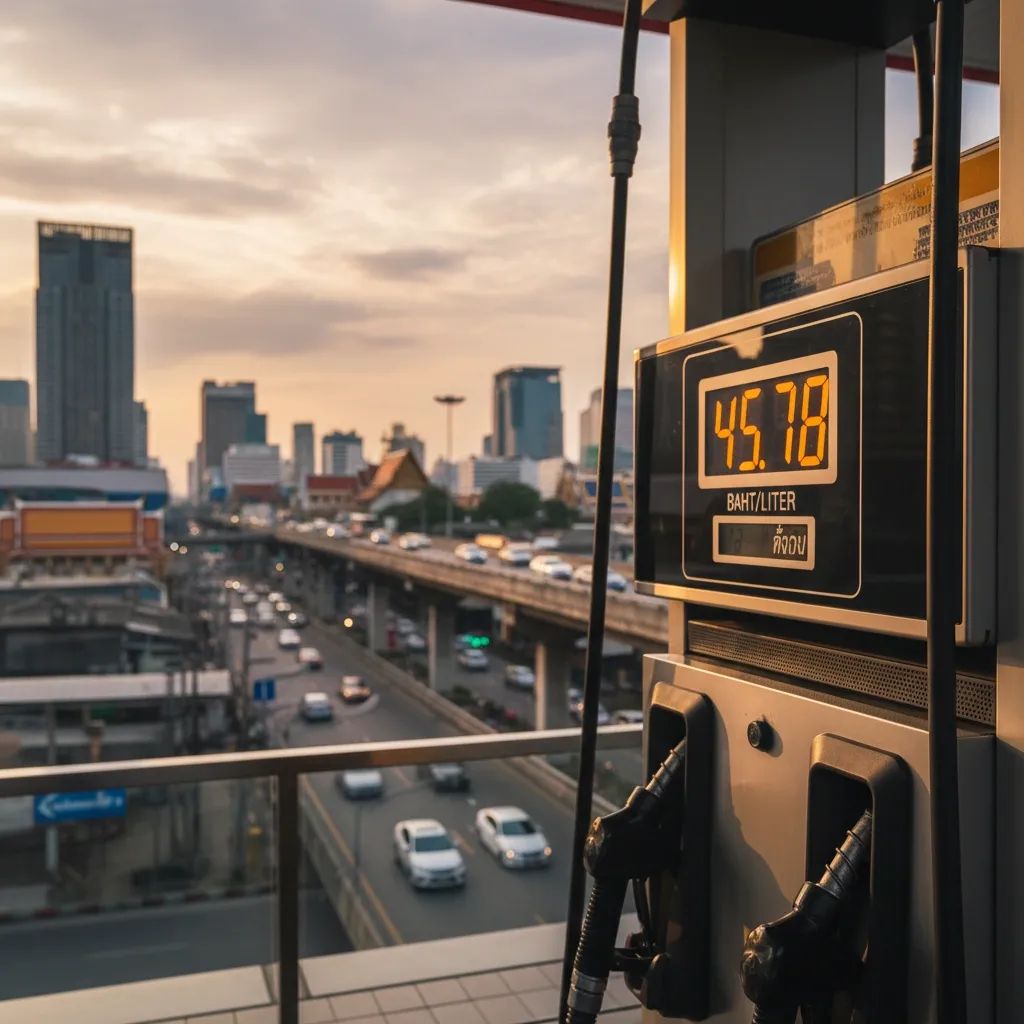
Diesel Reaches 50 Baht: Thailand Enters a New Economic Reality
The Thailand Oil Fuel Fund has finally surrendered. On April 5, the committee managing the decades-old subsidy mechanism voted to cut diesel support by 2.61 baht per liter, allowing retail prices to breach the 50-baht threshold for B7 diesel (biodiesel blend)—not as a temporary spike, but as a structural baseline that ordinary Thais will navigate for the foreseeable future. For millions commuting to work, operators running logistics networks, and hospitality businesses bracing for Songkran, the calculus has shifted. This is no longer a crisis to endure; it has become a condition to manage.
Why This Matters
• Diesel B7 is now 50.54 baht per liter, a jump of 2.80 baht in a single adjustment, with further increases possible if Middle East tensions escalate.
• Chiang Mai hotel occupancy during Songkran is projected to fall to 50–60%, translating to lost revenue of approximately 414 million baht compared to 2025.
• Daily cash drain from the Oil Fuel Fund exceeds 1,159 million baht, forcing the government to authorize a 150,000 million baht credit backstop just to keep the fund solvent.
• Tourism spending is expected to contract 3.7% during Songkran, the first year-on-year decline since pandemic recovery began in 2022.
Impact on Your Budget and Business (What You Need to Know Now)
For salaried employees: Expect diesel to stabilize near 50 baht through April, with upside risk if Middle East hostilities intensify. Budget an additional 500–800 baht monthly for personal vehicle commuting. Public transport—buses, minivans, taxis—will absorb costs differently. Expect fare increases of 5–10 baht per trip within weeks as operators pass through expenses.
For business owners in logistics, food distribution, and transport: Monitor announcements from the Thailand Ministry of Finance for fuel vouchers or tax relief programs. Government signals indicate intent to pursue targeted cash transfers for low-income households rather than blanket subsidies—a shift that may create eligibility criteria affecting your customer base and supply chain dynamics.
For property renters and real estate investors: Inflation will persist through Q2 and Q3, potentially softening demand as households compress discretionary spending. Real estate appetite, particularly in the secondary market, may weaken as purchasing power erodes.
The Fund's Collapse: How Years of Masking Reality Caught Up
For two decades, the Oil Fuel Fund functioned as a political painkiller. When global oil prices spiked, the fund absorbed the difference, presenting Thais with prices that bore no resemblance to actual import costs. Successive governments—left and right, populist and technocratic—exploited this mechanism to manage inflation perception and win voter favor. The system worked until it didn't.
By early April, the fund's accumulated deficit had reached 49,403 million baht. The mechanics are straightforward: the global price of crude remains elevated due to Middle East tensions; Thailand imports nearly 100% of its crude and must pay in dollars; the baht weakened against the dollar in recent months, amplifying import costs; and the fund's reserves, finite by design, evaporated under the arithmetic of daily subsidy payments.
The Thailand Ministry of Finance is now processing emergency decrees to guarantee a 150,000 million baht credit facility, effectively converting short-term subsidy spending into long-term public debt. Economists are blunt: future taxpayers will finance today's price caps.
The Geopolitical Multiplier: Why Global Events Matter Locally
The immediate trigger is geography. The Strait of Hormuz, through which 30% of seaborne oil flows, has become a chokepoint. Escalating tensions between Iran and the United States, including periodic threats to close the waterway, have sent crude futures to significantly elevated levels—substantially higher than pre-conflict prices.
Thailand's vulnerability is structural. The country produces negligible crude domestically and depends entirely on imports from the Middle East, West Africa, and Russia. Refining capacity is significant, but it does nothing to insulate against global price movements or currency fluctuations.
The Energy Crisis Monitoring Center has classified the current situation as Level 2.2—a supply shortage with no anticipated resolution within 30 days. Contingency protocols for Level 3 (severe shortage) exist in government files: fuel rationing, restricted pump hours, mandatory allocations to essential services, and sector-wide energy consumption caps. Officials have been careful not to invoke them yet, but the threshold is no longer academic.
Where Thais Feel It First: Transport, Food, Tourism
The impact is not uniformly distributed. For a Bangkok office worker driving a sedan, the weekly fuel bill climbed by an additional 150–200 baht—roughly equivalent to two cheap meals. For businesses operating on thin margins, the pressure is existential.
Hospitality and Transport Sector Squeeze
Along Pattaya Beach, jet ski rental operators report a 40% collapse in customer volume despite maintaining flat rental rates at 1,200 baht per 30 minutes. One operator acknowledged the arithmetic: fuel expenses now consume nearly half of gross revenue, leaving minimal buffer for profit. "If diesel reaches 55 baht," he said, "we close." That threshold is not theoretical; it sits just a few adjustments away.
Chiang Mai, historically Thailand's Songkran epicenter, is experiencing tourism contraction of unprecedented speed. The Thailand Hotel Association estimates occupancy rates during the festival will reach 50–60%, compared to near-full capacity in 2025. Revenue forecasts have been slashed from 1,350 million baht to 936 million baht—a 31% evaporation that cascades through restaurants, transport services, and retail.
A University of the Thai Chamber of Commerce survey reveals the behavioral shift: 56.6% of Thais now plan to celebrate Songkran within their home province, while 28% plan to skip domestic travel entirely and remain home. Foreign visitors, deterred by increased airfares and visa-processing delays, are equally absent. Khao San Road operators—dependent on European backpackers for 80% of bookings—saw advance reservations plummet from 80% occupancy to 60%.
Even Bangkok's fine dining sector is retracting. Michelin-starred restaurants report 70% cancellation rates in mid-March as diners adopt a wait-and-see posture, unwilling to commit to discretionary spending in an economically volatile environment.
The Structural Trap: Why the Fund Was Always Fragile
The Oil Fuel Fund was architected with a critical flaw: no statutory definition of "crisis." This vagueness granted successive administrations broad discretion to deploy subsidies regardless of fiscal sustainability, transforming a stabilization tool into a permanent populist mechanism.
Multiple Pricing and Tax Vulnerabilities
Dr. Noranong Chaisingha, an energy policy researcher, identifies a second structural weakness: the LPG pricing mechanism. Thailand calculates domestic LPG rates based on a hypothetical Singapore import price rather than the actual cost of natural gas extraction from fields in the Gulf of Thailand. This artificial benchmark inflates the subsidy burden while obscuring true production economics. Rungchai Chantasing, a consumer board member, argues that pricing reset reflecting local extraction costs could reduce LPG prices by 1–1.50 baht per kilogram—a shift that would hemorrhage the fund's already-depleted reserves.
A third vulnerability: Thailand's fuel tax architecture embeds multiple levies—excise duty, municipal fees, fund contributions—that together represent 34% of the retail price. These are fixed regardless of global price swings, limiting the government's ability to cushion consumers without legislative action.
Smuggling and Supply Chain Risks
There is also the perverse incentive of artificial scarcity. Because Thai fuel prices are held below neighboring countries' market rates, the Department of Special Investigation has opened probes into alleged hoarding and black-market exports in Surat Thani, where 57 million liters of diesel vanished from inventory records. If smuggling is confirmed, border controls and export restrictions will add bureaucratic friction to an already-stressed supply chain.
What Government Is (and Isn't) Trying
The Anutin administration (Prime Minister Anutin's government) has publicly committed to structural energy reform rather than temporary fixes. The April 5 cabinet approval of a phased subsidy removal framework—allowing diesel prices to float within a narrow band tied to crude benchmarks—represents acknowledgment that the subsidy model is unsustainable.
Dr. Noppadol Kannika, a risk policy scholar, proposed a "middle-path strategy" that the government has partly adopted: balancing fiscal sustainability with inflation control through graduated, predictable price adjustments rather than shock-based jumps.
However, the 150,000 million baht credit facility is fundamentally a financial patch. It converts implicit subsidy spending into explicit public debt—a mechanism that delays fiscal reckoning rather than resolving it.
Alternative Pathways Experts Propose
Academic voices advocate more radical restructuring. Dr. Athipat Mutitacharoen of Chulalongkorn University's Economic Research Center has urged publication of a phased price adjustment schedule—increments of 0.50 to 1 baht per liter over defined periods—enabling businesses and households to adapt and plan. Transparency, he argues, reduces shock and enables market actors to make rational decisions.
Dr. Anucha Anuwatanasombat, an energy economist, calls for abandoning Singapore-based pricing entirely and calculating LPG from actual domestic production costs. Dr. Noranong Chaisingha advocates targeting cash transfers to vulnerable populations rather than broad subsidies, simultaneously reducing fiscal burden and black-market incentives.
The Transition Ahead: Medium-Term Adaptation
Thailand's energy mix will gradually shift toward biofuels, natural gas imports (LNG), and potentially small modular reactors (SMRs) for baseload power generation. But this transition operates on a five-year horizon, not quarterly cycles. Consumers and businesses are forced to adapt using immediate tools: carpooling, switching to electric scooters, timing travel for off-peak periods, and tracking daily price updates from the Energy Policy and Planning Office.
The Thailand Ministry of Energy confirms the country maintains 60 days of strategic fuel reserves—sufficient for short-term disruptions but inadequate if Middle East conflict extends into summer. Contingency plans exist, but their deployment remains discretionary.
The Practical Reality
Thailand is not facing temporary energy volatility. The subsidy model that masked market prices for decades has exhausted itself. Diesel at 50 baht per liter is not a crisis endpoint; it is the new operating baseline. Households, businesses, and policymakers are now navigating an economy reorganizing around scarcity rather than abundance.
For residents planning Songkran travel, the calculus has simplified: shorter distances, lower costs, or no travel. For entrepreneurs, cost reduction and efficiency gains are no longer optional. For government, the path forward requires difficult choices—reform energy pricing structures, target assistance to vulnerable groups, and accelerate clean energy adoption—rather than deploying borrowed money to postpone an inevitable adjustment.
Adaptation, not nostalgia for cheap fuel, is the rational response.


