
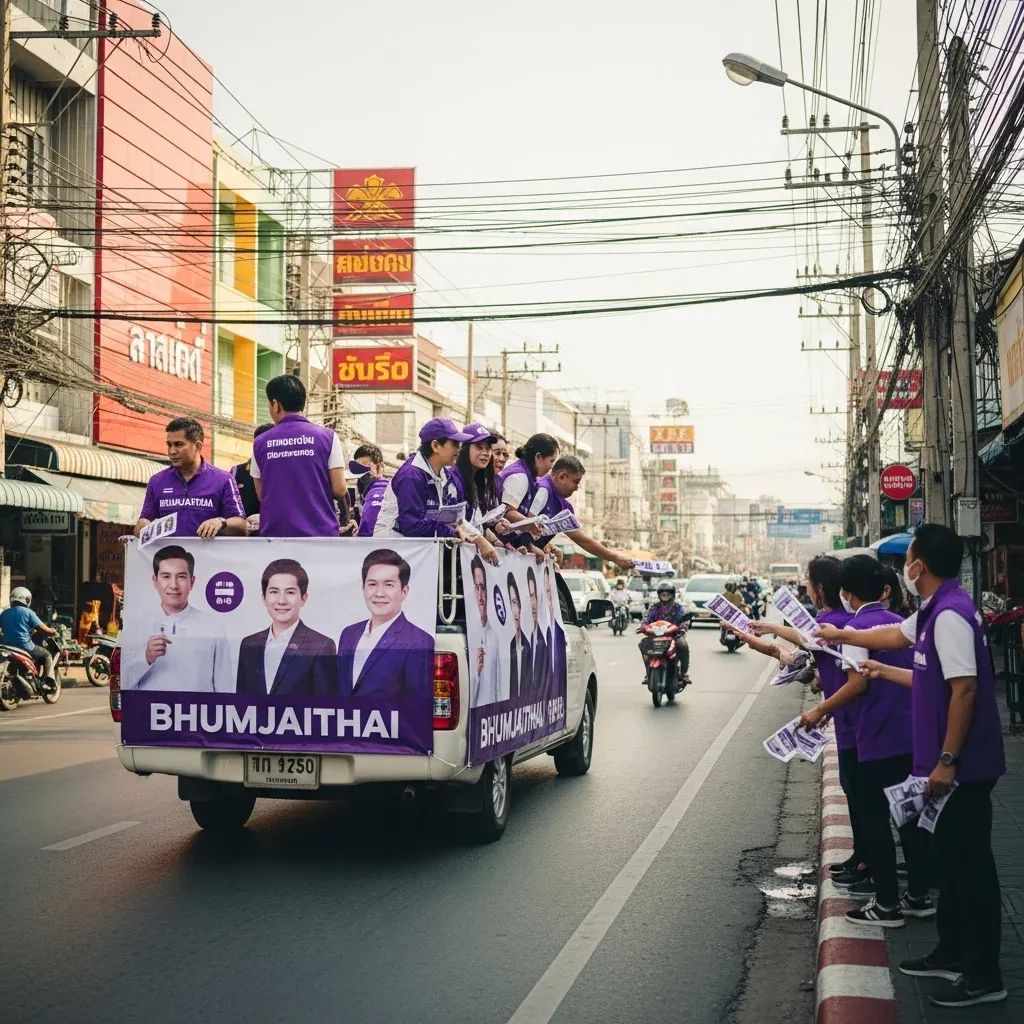
The Thailand Bhumjaithai Party has vowed to reclaim every one of Chon Buri’s 10 parliamentary seats, a declaration that—if it sticks—would flip control of the Eastern Seaboard province and steer billions of baht in future budgets toward its own priorities.
Why This Matters
• Budget muscle – Whoever wins Chon Buri will influence how ฿1 billion is spent on infrastructure from Laem Chabang Port expansions to Bang Saen flood defences.
• Service access – MPs decide which sub-districts receive new public-health clinics and elderly-care centres, critical as the province’s over-60 population climbs past 18%.
• Investor signals – A decisive Bhumjaithai sweep would entrench the party led by Deputy Prime Minister Anutin Charnvirakul and reassure industrial-estate developers banking on policy continuity.
• Voter convenience – The Election Commission has added 3 special polling hubs for seniors and people with disabilities; check your assigned location before 8 February.
A Turf War Reignites on the Eastern Seaboard
Chon Buri last flipped just three years ago, when the then-Move Forward Party turned a long-time conservative stronghold orange, pocketing 7 of 10 seats. That upset rippled well beyond local politics, signalling urban voters’ appetite for bolder reforms. Today, veteran MP Suchart Chomklin—now running under the Bhumjaithai banner—argues that wave has receded. He told reporters the province has returned to a “brotherhood” model where hometown politicians stay visibly on call, and, in his words, “no outsider will be left standing on 9 February.”
Chon Buri’s Track Record: From Orange Wave to Blue Machine
Residents who backed Move Forward in 2023 cite disappointment that their MPs were rarely seen after the ballots were counted. Constituency clinics promised during the previous campaign reportedly opened sporadically, and social-media outreach never turned into face-to-face help when floods hit Banglamung. Bhumjaithai strategists have used those grievances to paint their rivals as Bangkok-centric. If the tactic works, the province would swing from a fragmented delegation—currently split among Move Forward’s successor People’s Party, Pheu Thai, Palang Pracharath, and United Thai Nation—to a single-party bloc able to bargain collectively for projects.
The Ground Game: Canvassing vs Keyboard
Unlike the slick online rallies favoured by the People’s Party, Bhumjaithai is betting on old-school door-knocking. Trucks blaring the party jingle now cruise Sukhumvit Road daily, and Suchart has logged fifteen community visits in two weeks. People’s Party leader Natthaphong Ruengpanyawut held a late-night waterfront rally in Sri Racha but has struggled to match Bhumjaithai’s density of small-group meetings. Analysts at Kasetsart University say turnout in semi-urban tambons could decide 3 marginal seats, making the labour-intensive strategy potentially decisive.
What This Means for Residents
Road upgrades or rail first? – Bhumjaithai backs accelerating the Motorway 7 spur to Ko Si Chang, while the People’s Party wants funding shifted to commuter rail. Expect your daily commute costs—and property values near stations—to hinge on who wins.
Cannabis regulation – As the party that decriminalised medical cannabis nationally, Bhumjaithai pledges streamlined licences for growers in Phanat Nikhom and Nong Mon. Farmers eyeing an extra revenue stream should watch the seat count.
Health-care staffing – All candidates talk universal coverage, but only Bhumjaithai explicitly promises 1,000 new community nurses in coastal districts. That would cut waiting times, currently averaging 98 minutes at provincial hospitals.
Local complaint channels – If you rely on MPs to chase down paperwork in Bangkok, consider that People’s Party incumbents emphasise legislative debates, while Suchart stresses weekly mobile offices in fresh markets.
Business & Investment Ripple Effects
Industrial-estate executives in Laem Chabang quietly admit they prefer policy predictability over ideology. A Bhumjaithai clean sweep would align provincial MPs with the current coalition in the House, smoothing approval for the EEC tax-incentive renewal due mid-year. Conversely, a mixed result could resurrect talk of tightening environmental rules on petrochemical plants—popular with activists but a headache for exporters. Japanese suppliers have already delayed warehouse leases until they see February’s outcome.
Looking Ahead: Key Dates to Watch
• 1 February – Last day pollsters may legally publish opinion surveys.
• 3–4 February – Early voting at 51 district venues; expect traffic closures around Muang Chon Buri hall.
• 8 February (07:00–17:00) – Election Day. Bring your Thai ID card; a digital wallet QR alone is not accepted.
• 9 February morning – Unofficial seat tally announced; markets often react before noon.
Voters in Chon Buri have long prided themselves on choosing homegrown politicians. Whether that loyalty now favours the blue-flag Bhumjaithai or shifts back to the orange-hued reformists will determine not just the province’s voice in Bangkok, but also the shape of its ports, hospitals, and pay-cheques for the next four years.


