
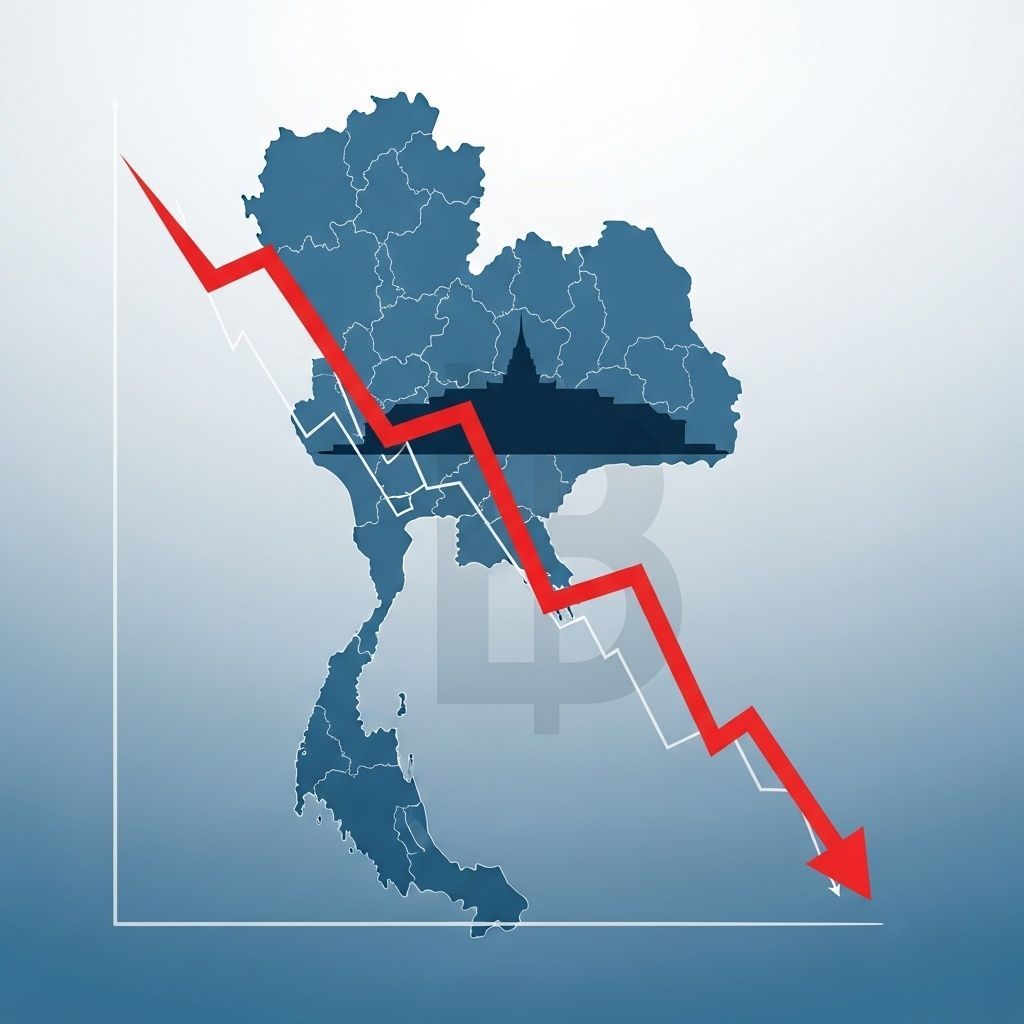
Thailand is entering another stretch of political guess-work just as the year closes and global investors lock in their 2026 strategies. Market chatter from Bangkok’s trading rooms to Phuket’s hotel lobbies now centres on one question: will Prime Minister Anutin Charnvirakul press the button on an early dissolution of parliament in mid-December, and if he does, what happens to growth, trade talks and the kingdom’s fragile credit profile?
Investors toggle the pause button
Foreign funds that once hunted for yield in emerging Asia are suddenly drawing a line under new Thai exposure. Portfolio managers cite the prospect of a caretaker government, a possible election campaign that drags into Songkran, and the memory of past power vacuums. The result is visible in softer daily turnover on the Stock Exchange of Thailand, a baht that refuses to firm, and delayed capital-expenditure announcements by multinational firms in Rayong’s Eastern Economic Corridor. Veteran banker Kobsak Pootrakool says the atmosphere resembles the stop-start pattern of late 2013, when rallies on Ratchadamnoen Avenue crimped private investment by about 16 percent. This time, economists at Krungthai Compass warn, the hit could be deeper if trade headwinds coincide with political limbo, slicing 2026 growth to 0.5-1 percent, far below the 3 percent baseline the Finance Ministry pencilled in only three months ago. In short, confidence—already dented by record household debt and flash floods in the south—is now sitting on a knife-edge.
Trade deadlock with Washington: why it matters on Silom Road
Thai negotiators had hoped to wrap up a limited Thailand-US trade pact before Christmas. Instead, the USTR has suspended formal talks, citing security linkages to Cambodia that Bangkok views as unrelated. Exporters of electronics, auto parts and processed food who rely on tariff preferences for the US$38 billion American market are recalculating 2026 revenue. The Federation of Thai Industries fears Thai goods could face duties as high as 37 percent if no deal emerges, eroding thin margins just when Vietnam and Mexico are adding share. Commerce Ministry insiders whisper that the stalemate has already pushed some factory expansion plans toward neighbors such as Malaysia. For office workers on Silom Road, the trade impasse may sound remote, yet it threatens bonus pools, overtime shifts and the wider services ecosystem that depends on export-linked income.
Credit-watch season at rating agencies
Ratings teams at Moody’s, S&P and Fitch are poring over Thailand’s spreadsheets with unusual intensity. Recent notes moved the outlook on the sovereign to Negative at two of the three houses, while S&P kept a neutral stance but warned of “persistent political fluidity.” The agencies are uneasy about public debt hovering near 60 percent of GDP, the slow lane of demographic change and the potential for fiscal slippage if populist promises multiply during an early election campaign. A downgrade—even by a single notch—would ripple through state-owned enterprises, provincial infrastructure bonds and corporate treasuries, raising borrowing costs just when refinancing needs peak. Thailand has dodged downgrades before, but the current triangle of weak growth, large fiscal deficits and political churn has analysts talking openly about the first cut since the Asian crisis era.
Lessons from past dissolutions
History offers sobering parallels. Since the 1940s Thailand has dissolved parliament 14 times, and each episode clipped GDP in the following quarter. The 2006 dissolution during mass protests shaved roughly 0.3 percentage point off output, while the twin elections of 2014 coincided with a technical recession. Researchers at Thammasat University note that government investment typically stalls because a caretaker cabinet cannot sign major procurement deals. Past patterns also show that business leaders adopt a wait-and-see stance, diverting liquidity into safe assets such as government bonds. The difference now is that Thailand’s share of global supply chains is larger; any pause in decision-making around logistics, digital infrastructure or renewable energy could amplify the drag.
What could turn the tide
There are still levers that could restore calm. The appointment of technocrats such as Ekniti Nitithanprapas at Finance and Suphajee Suthumpun at Commerce signals an attempt to firewall economic policy from electioneering. Officials are also accelerating disbursement under the Let’s Go Halves Plus subsidy to keep consumption ticking over, while the Board of Investment prepares outbound roadshows aimed at Japanese and Middle Eastern investors. Should Washington issue the long-awaited green light for talks, the boost to exporter sentiment could be immediate. Meanwhile, analysts say that even a short-lived caretaker phase—if followed by a clear, stable coalition—might mitigate the worst growth shocks and reassure the ratings agencies watching Bangkok’s budget arithmetic.
Reading the tea leaves for 2026
Ultimately, Thailand’s trajectory next year hinges on two clocks: one in Government House counting down to a possible dissolution, and another in Washington counting down to the moment trade negotiations restart. If both stall, the economy risks flirting with near-zero growth, higher funding costs and a downgrade that would shadow the baht for years. If, however, Parliament’s reset produces a decisive mandate by the second quarter and a US trade deal materialises, GDP could rebound toward 3 percent by year-end. For households coping with high living costs, and for entrepreneurs weighing expansion, the next few weeks may determine whether 2026 feels like another uphill slog or the long-delayed return to momentum that Thailand has been promised since the pandemic era.


