
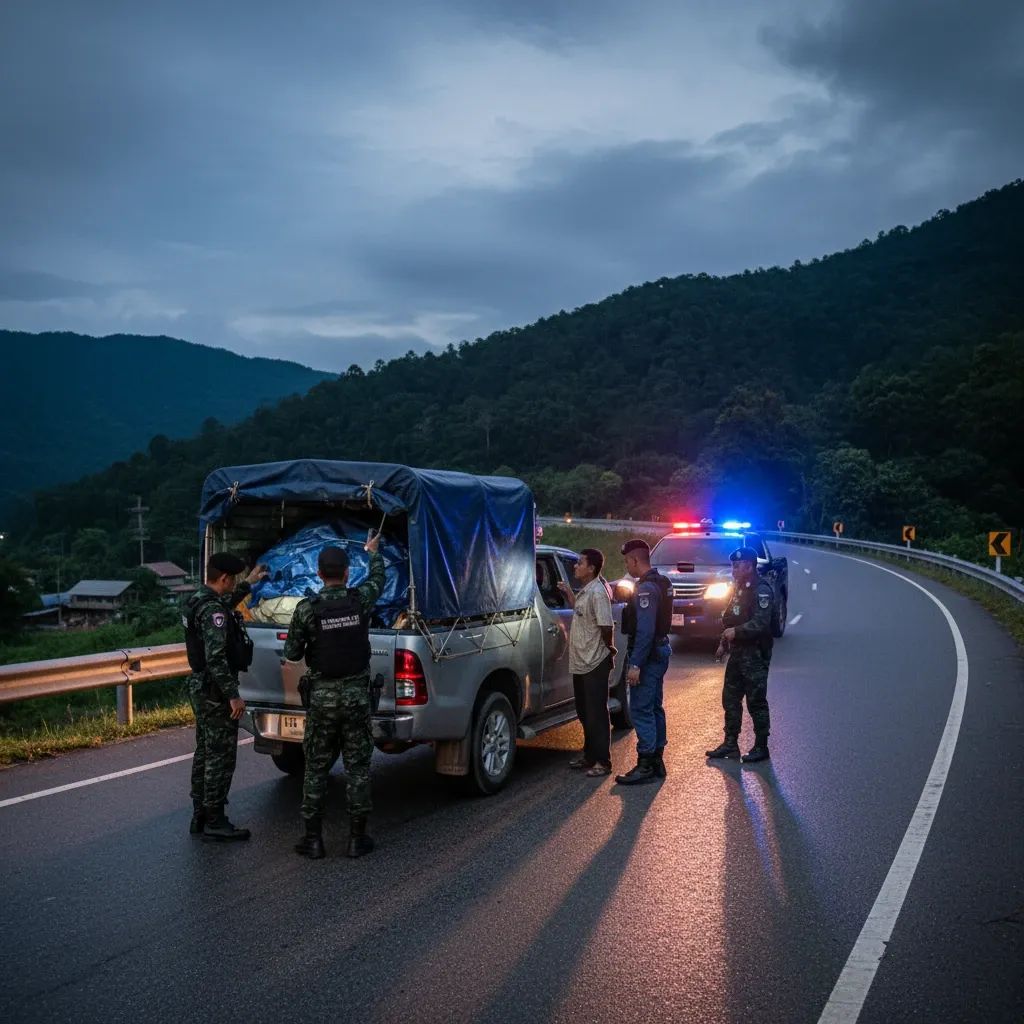
Thailand's Anti-Narcotics Bureau suffered casualties during a pre-dawn raid in Chiang Rai province on August 18, when a suspect detonated a grenade during a confrontation that left one dead and a police officer injured. The incident highlights growing violence tied to cross-border drug trafficking networks in the northern border zone.
What This Means for Your Safety
For those living in Chiang Rai, this incident brings immediate safety concerns. Residents in border subdistricts such as Huai Chomphu and Ban Du should remain alert to sudden police activity and avoid areas cordoned for operations. Residents near known trafficking corridors—particularly in Mueang, Mae Sai, and Mae Chan districts—should be especially cautious. Travelers and expatriates are advised to monitor provincial police announcements and steer clear of rural areas during enforcement sweeps, which often occur at dawn and can involve gunfire or explosive devices.
The use of explosives against law enforcement marks a troubling escalation and signals that traffickers are willing to use increasingly lethal tactics to avoid arrest.
The Deadly Confrontation in Mueang District
Officers from the Anti-Narcotics Bureau Division 3, backed by military units from the Command for Drug Interdiction and Suppression Unit 35 and rapid-response forces, moved to arrest Sinchai Phrangphrainam at a residence in Moo 9, Huai Chomphu subdistrict, around 7:00 AM that morning. Sinchai faces charges for trafficking methamphetamine pills (ya ba) under an active warrant.
As the joint task force closed in, Wiraphan Phrangphrainam, 45, Sinchai's father and himself a wanted fugitive on narcotics charges issued by Mae Suai Police Station, opened fire with a shotgun and attempted to throw a hand grenade at the approaching officers. The explosive detonated prematurely near Wiraphan, killing him instantly at the scene.
Police Senior Sergeant Major Phongsak Klangtaisong sustained shrapnel wounds to his left arm and was taken to Fang Hospital, where he is in stable condition. Sinchai was not present during the raid and remains at large; authorities are conducting follow-up operations to locate him.
The Thailand Royal Police confirmed that Wiraphan had previously served as a village headman in the area, highlighting the complex challenge when community figures become implicated in trafficking networks.
Why This Escalation Matters
• Armed resistance is intensifying: Suspects now deploy military-grade explosives during raids, raising the stakes for law enforcement and nearby communities.
• Chiang Rai remains a transit hub: The province has recorded drug seizures 50 times higher than last year, signaling a major shift in trafficking routes back to Thailand's northern corridor.
• Arrests don't stop supply: Despite massive busts—including 1.1 tons of methamphetamine and ketamine in June—street prices for meth continue to fall, indicating persistent oversupply.
Chiang Rai's Expanding Role in Regional Trafficking
The Chiang Rai violence comes as authorities crack down on major traffickers. Between May and August 2026, authorities have dismantled multiple large-scale networks and seized record quantities of contraband:
On May 6, 2026, provincial police arrested 10 suspects tied to four separate networks, confiscating 4.6 million methamphetamine pills, along with significant amounts of crystal meth (ice) and ketamine. Investigators noted a tactical shift: traffickers increasingly recruit minors as couriers and establish shell companies to mask logistics operations.
Just over a month later, on June 15, 2026, the Regional Police Commander for Region 5 announced the seizure of 578 kg of crystal meth and 529 kg of ketamine—over 1.1 tons combined—from six suspects who admitted to ferrying drugs for a Myanmar-based broker at 1M baht per trip, with at least three prior runs completed.
On August 1, 2026, officers recovered 8 million methamphetamine pills abandoned in a pickup truck parked inside a cemetery, a tactic believed designed to evade checkpoints.
The Regional Police Commander for Region 5 disclosed that drug interception rates in Thailand's northern region have surged 50-fold year-on-year, driven by trafficking syndicates reverting to overland routes through Thailand after tightened controls elsewhere in Southeast Asia. Mobile X-ray scanners have been deployed at key chokepoints to counter the influx.
High-Value Targets and Cross-Border Networks
In April, Thapananthorn "Nuchen", a most-wanted trafficker with a 1M baht bounty, was arrested in South Korea. The Department of Special Investigation (DSI) subsequently raided eight properties in Chiang Rai on June 30, seizing digital assets worth 34.3M baht linked to money laundering.
Sinchai, the target of yesterday's operation, is considered a significant regional distributor. His father's willingness to deploy lethal force during an arrest attempt reflects the desperation—and resources—of entrenched networks.
Testimony from captured couriers consistently points to Myanmar-based brokers coordinating large shipments, with Chiang Rai's border districts serving as both staging areas and distribution nodes for onward transport to Bangkok and southern provinces.
What Authorities Are Doing
The Thailand Government launched Operation 90 Days earlier this year, a coordinated offensive across all 18 districts of Chiang Rai aimed at detection, interdiction, and rehabilitation. Re-screening protocols for high-risk areas and expanded treatment facilities for users are core components of the strategy.
Despite these efforts, wholesale meth prices have dropped to decade lows, a paradox indicating that enforcement has yet to meaningfully constrain supply. Analysts warn that as long as production centers in Myanmar and Laos remain active, northern Thailand will continue to function as a primary conduit.
Ongoing Investigations and Next Steps
Forensic analysis of the grenade and firearms recovered from the scene is underway to trace their origin and supply chain. The Thailand Anti-Narcotics Bureau continues to coordinate with military intelligence units and the DSI to track Sinchai's movements and dismantle his network.
Wiraphan's death will be subject to an internal review to determine compliance with use-of-force protocols, a standard procedure when suspects are killed during operations. Questions remain about how he evaded capture despite an active warrant.
The broader enforcement campaign in Chiang Rai is projected to continue through the end of the year, with additional checkpoints and aerial surveillance planned for known transit routes. Authorities estimate that dismantling the top five trafficking networks operating in the province could reduce methamphetamine flow into Thailand by 30%, though achieving that goal requires sustained cross-border cooperation with Myanmar and Laos—an ongoing diplomatic challenge.


