
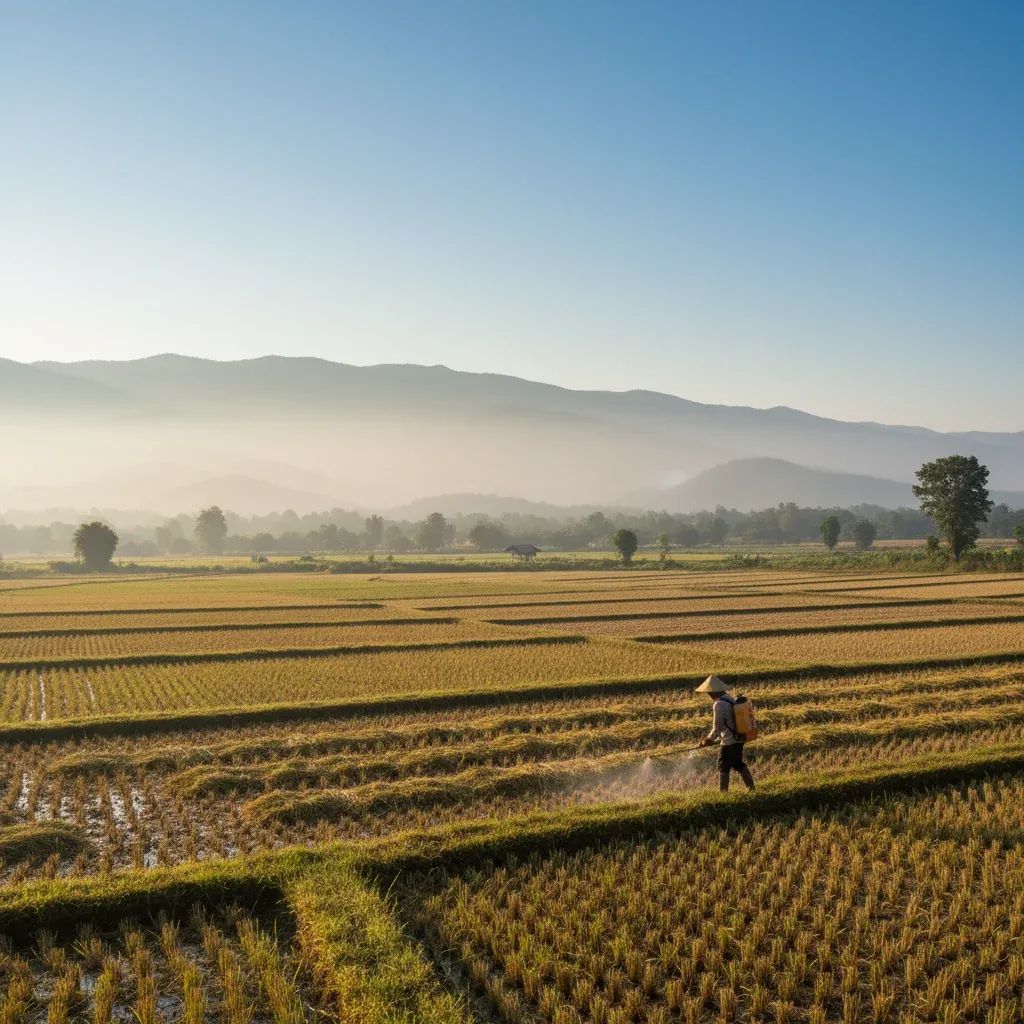
Thailand's Department of Agriculture has confirmed that over 2,000 farmers in Chiang Rai Province have abandoned traditional field burning in favor of microbial solutions, a shift that could redefine agricultural air quality management across the kingdom's northern and central plains. The transition uses a locally developed bacterial spray called Soil Digest, composed of 5 strains of Bacillus, which decomposes rice stubble in 5-7 days and has demonstrated yield increases of up to 20%.
Why This Matters
• Air Quality Impact: Field burning remains a primary driver of PM2.5 pollution during harvest season, contributing to dangerous "red level" air quality readings across central Thailand in recent months.
• Financial Incentive: Microbial treatments cost 70-100 baht per rai, eliminate fertilizer expenses by up to 15%, and boost rice yields by 10-20% according to field trials.
• Legal Risk: The Thailand Ministry of Agriculture and Cooperatives banned agricultural burning from February 1 to March 31, 2026, with violators facing disqualification from all ministry subsidy programs.
• Climate Benefit: The technology cuts methane emissions from rice paddies by 20%, directly supporting Thailand's international climate commitments.
The Microbial Alternative Explained
For decades, farmers across Thailand's central plains have relied on the simplest post-harvest method: torching leftover rice straw. The practice clears fields quickly at minimal cost, but transforms the skyline into a grey haze each dry season. Now, a biological intervention is gaining traction as both an environmental necessity and an economic upgrade.
The core technology employs bacterial cultures that digest cellulose-rich plant material. Thailand's research institutions—including the National Science and Technology Development Agency (NSTDA), Department of Agriculture, and Chulalongkorn University—have developed competing formulations, but the principle remains consistent: spray the stubble immediately after harvest, let the microbes break down the organic matter for one week, then plow the decomposed material back into the soil.
The NSTDA's BioD I product and the Department of Agriculture's proprietary strains both complete decomposition in 5-10 days, compared to 30 days for natural decay. Soil Digest, the formulation most widely adopted in Chiang Rai, uses five Bacillus species selected for their ability to thrive in flooded paddy conditions and tolerate the high heat of Thailand's dry season.
Performance Data From Northern Fields
Field trials in Chiang Rai Province have produced measurable results. Farmers using microbial treatments report softer soil, faster field preparation, and reduced reliance on chemical fertilizers. The Department of Agriculture estimates that treated fields see yield increases of 10-20%, attributed to higher nitrogen, phosphorus, and organic carbon levels in the soil.
Water quality in treated paddies also improves. Farmers note that irrigation water remains clear and odor-free, conditions that promote healthier root development. The microbial process converts stubble into nutrient-rich humus, effectively turning agricultural waste into a soil amendment worth several hundred baht per rai.
Environmental metrics are equally compelling. The Thailand Department of Land Development has confirmed that microbial decomposition reduces methane emissions by 20%, a significant figure given that rice cultivation is one of the kingdom's largest sources of agricultural greenhouse gas. Carbon dioxide emissions from field burning are eliminated entirely, replaced by carbon sequestration as organic matter is incorporated into the soil.
Regional Adoption and Government Support
The Thailand Ministry of Agriculture and Cooperatives has rolled out a nationwide campaign titled "Plow In, Build Sustainable Soil, Restore the Environment" to promote stubble incorporation. The initiative provides free or subsidized access to microbial products such as PDD.17 accelerant and Super PDD.2 bio-ferment, both developed by the Department of Land Development.
Rayong Province in the east and Chiang Rai in the north have emerged as early adopters. In Rayong, agricultural learning centers now offer courses on producing bio-compost and microbial ferments to reduce input costs for mangosteen and palm oil cultivation. The Department of Land Development has established community soil-fertilizer centers in both provinces to distribute starter cultures and technical guidance.
Satellite monitoring by the Department of Agricultural Extension shows that hotspots in agricultural zones declined 12.7% in 2025 compared to 2023, though the agency cautions that overall burning remains elevated. Data from April 2026 recorded the highest number of agricultural fire hotspots on record, driven by a combination of stubborn farmer habits and transboundary haze from neighboring countries.
The Health and Legal Calculus
PM2.5 pollution from agricultural burning poses acute health risks, particularly for children, the elderly, pregnant women, and individuals with respiratory or cardiovascular conditions. Exposure triggers coughing, sinus infections, bronchitis, and asthma exacerbations, and long-term exposure increases lung cancer risk. During peak burning season, Thailand's central provinces—including Lopburi, Nakhon Ratchasima, and Nakhon Sawan—regularly report air quality in the red zone, where outdoor activity is hazardous.
The 2026 burning ban carries real consequences. Farmers caught violating the February 1-March 31 prohibition lose eligibility for government rice price support, crop insurance, and low-interest loan programs. The policy represents a shift from advisory warnings to enforceable penalties, backed by satellite fire detection systems that make violations difficult to conceal.
Meteorologists warn that the 2027 dry season (January-April) could produce worse air quality than 2026, driven by a strengthening El Niño pattern. Environmental advocates are pressing for passage of a Clean Air Act to establish permanent legal frameworks for emission control, moving beyond seasonal bans.
Comparative Context: Microbial Solutions Across Asia
Thailand is not alone in exploring biological alternatives to burning. Vietnam has tested two microbial solutions, NTT-02 and NTT-03, with results showing 15% increases in total organic carbon, 12% gains in nitrogen, and 10% improvements in phosphorus after treatment. Rice yields improved 8-10%, and decomposition time dropped from 28 days to 14-18 days.
In India, field trials in Haryana and Maharashtra used Trichoderma, Aspergillus, Pseudomonas, and Bacillus cultures to decompose rice, wheat, and sugarcane residue. Decomposition required 30 days for grain crops and 45 days for sugarcane, with no yield loss compared to burning and measurable improvements in soil health.
China's rice paddy studies confirm that incorporating crop residue with microbial assistance improves soil structure, nutrient availability, and organic matter retention, while reducing dependency on synthetic fertilizers.
Economic and Cultural Barriers
Despite promising results, adoption remains uneven. Many Thailand farmers continue to burn because it requires no upfront cost, no labor, and no waiting period. A match and five minutes accomplish what microbial treatment requires a week and 100 baht per rai to achieve.
Cultural inertia also plays a role. Older farmers, particularly in central Thailand, view burning as a necessary step to control pests and diseases. Convincing them that microbial decomposition achieves the same outcome—while enriching rather than degrading the soil—requires sustained education and demonstration plots.
The Thailand government has begun addressing the cost barrier by subsidizing microbial products and offering technical training through provincial agricultural offices. The Department of Agricultural Extension runs mobile clinics that teach farmers how to mix and apply bacterial cultures, and how to time the treatment with plowing schedules to maximize results.
What This Means for Residents
For anyone living in Thailand, particularly in the northern and central regions, the shift from burning to biological decomposition represents a tangible improvement in seasonal air quality. If adoption scales beyond the current 2,000 farmers in Chiang Rai, the kingdom could see measurable reductions in PM2.5 readings during the dry season, reducing hospital admissions for respiratory illness and improving quality of life for vulnerable populations.
The economic implications extend to food security and land productivity. Healthier soil produces higher yields with less chemical input, stabilizing rice prices and reducing Thailand's environmental footprint. For expats and long-term residents, the transition signals a government willing to enforce environmental regulations with financial penalties, a departure from the historically lax enforcement of agricultural pollution controls.
Travelers and residents planning outdoor activities should continue monitoring air quality forecasts, particularly from January through April. Even with microbial adoption increasing, transboundary haze from Myanmar and Laos remains a variable that domestic policy cannot fully control. The Thailand Meteorological Department and Pollution Control Department provide daily AQI updates, with red-level warnings indicating hazardous conditions that justify avoiding outdoor exercise and using N95 respirators when outside.
The Road Ahead
The Thailand Ministry of Agriculture and Cooperatives has set a target of expanding microbial stubble treatment to 1 M rai by 2027, focusing on provinces with the highest burning rates. Success depends on sustained subsidy funding, farmer education, and enforcement of the seasonal burning ban.
Environmental groups argue that voluntary adoption will never achieve the scale needed to eliminate agricultural burning entirely. They advocate for a permanent legal prohibition backed by fines and criminal penalties, modeled on industrial emission standards. The government has resisted a blanket ban, citing concerns about farmer livelihoods and the practicality of enforcement in remote rural areas.
For now, the 2,000 farmers in Chiang Rai represent a proof of concept: that microbial decomposition is technically feasible, economically viable, and environmentally superior to burning. Whether that model spreads to the millions of rai still torched each year remains the defining question for Thailand's air quality future.


