
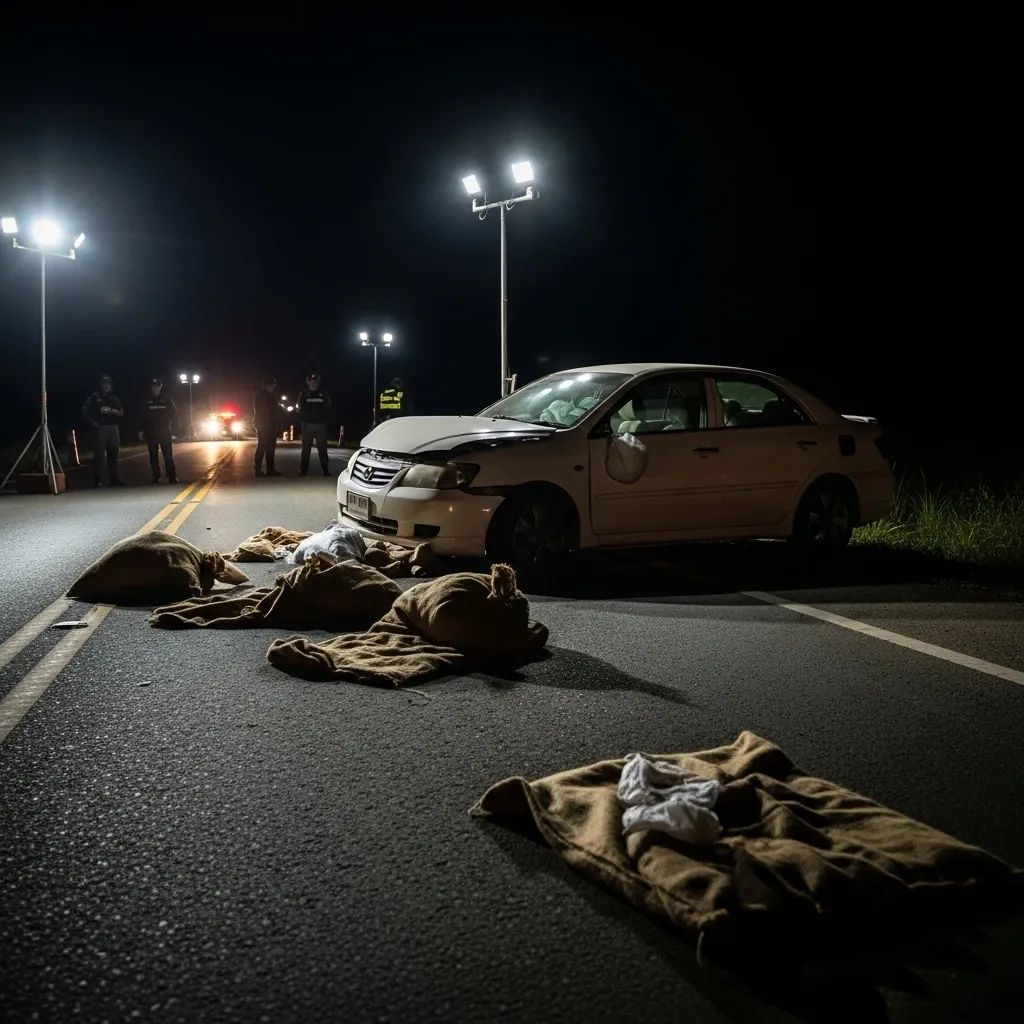
Thailand Border Patrol Police have disrupted a major drug trafficking operation in Chiang Rai's northern frontier, seizing 4 million methamphetamine pills worth approximately 400 M baht on the street following a high-speed pursuit that ended with a suspect crashing his vehicle and fleeing on foot. The August 12 bust underscores the intensifying struggle to control narcotics flowing from Myanmar's Shan State through the porous Golden Triangle border into Thailand's interior.
Why This Matters
• Record seizures continue: Thailand has confiscated over 997 M meth pills in just 8 months, with border provinces like Chiang Rai accounting for a substantial share.
• Smuggling routes are shifting: Trafficking networks increasingly use the Mae Chan-Chiang Saen corridor and Mekong River crossings to evade detection.
• Regional cooperation is expanding: Thailand has allocated 16 M baht to joint operations with Myanmar, Laos, and Vietnam to dismantle cross-border syndicates at the source.
The Pursuit and Capture
Officers from the Border Patrol Police Company 327's narcotics suppression unit received intelligence about a large shipment moving by vehicle along Highway 1016, the Mae Chan-Chiang Saen route in northern Chiang Rai. When a black Mitsubishi Pajero approached the checkpoint in Pa Sak subdistrict around dawn, uniformed officers signaled the driver to stop for inspection. Instead, the vehicle accelerated, smashing through the barricade and damaging its right front tire.
Police opened fire on the tires to disable the fleeing SUV and gave chase for approximately 25 kilometers through rural roads before the vehicle lost control and veered onto the median near Ban Doi Si Kaeo village in Pa Sak subdistrict, Chiang Saen district. The driver, later identified as 30-year-old Saenphu, a resident of Mae Ngoen subdistrict in the same district, jumped out and attempted to escape on foot down a roadside ditch. Officers apprehended him within minutes.
A search of the Pajero revealed 20 rainbow-colored burlap sacks, each containing roughly 200,000 meth pills—a combined haul of 4 M tablets. Saenphu, a Thai national, was taken into custody and now faces charges under Thailand's narcotics laws. Authorities are interrogating him to identify upstream suppliers and downstream distributors within the trafficking network.
Border Province Under Pressure
Chiang Rai sits at the epicenter of Thailand's methamphetamine crisis. The province borders both Myanmar and Laos, making it a natural transit point for drugs manufactured in conflict-ridden Shan State laboratories and smuggled southward into Thailand's densely populated regions. Just days before this seizure, on August 8, the Pha Mueang Task Force engaged in a five-minute firefight with an armed smuggling convoy near the Wiang Kaeo 3 crossing point in Sri Don Mun subdistrict. The suspects, estimated at 10 to 15 individuals carrying sacks, escaped after opening fire on troops, leaving behind 1.93 M meth pills.
Earlier this year, in May, a Thailand Navy patrol unit discovered 4 M pills abandoned on Koh Pha Kham island in the Mekong River, evidence that traffickers sometimes jettison cargo when law enforcement closes in. Taken together, Chiang Rai's seizures in 2026 alone have exceeded tens of millions of tablets, reflecting both the scale of the problem and the aggressive posture of Thai authorities.
What This Means for Residents
For people living in Thailand—especially in the north and northeast—this surge in enforcement translates to heightened police presence, more frequent roadblocks, and stricter scrutiny of vehicles traveling rural highways. Travelers on the Mae Chan-Chiang Saen and Chiang Rai-Chiang Khong routes should expect delays at checkpoints as officers prioritize interdiction over traffic flow.
Property owners and renters should also be aware that traffickers increasingly rent warehouses and safe houses to stockpile shipments before onward distribution. In May, police dismantled a network that leased multiple storage facilities across Loei and other northeastern provinces to evade detection, arresting 33 people across 11 cases. Anyone approached with requests to lease property for vague purposes or at above-market rates should report suspicious inquiries to the Thailand Office of the Narcotics Control Board (ONCB) hotline.
Foreign residents and visa holders are reminded that Thailand's anti-narcotics statutes carry severe penalties, including life imprisonment for trafficking and mandatory minimum sentences for possession. Even inadvertent involvement—such as unknowingly transporting a package for an acquaintance—can result in prosecution. The government's "Annihilate Drugs" campaign prioritizes prosecution and asset seizure, with 7,677 M baht in suspected drug proceeds confiscated in the first half of fiscal 2026.
National Crackdown Gains Momentum
Prime Minister Anuthín Charnwírakun's administration has elevated narcotics suppression to a national priority, implementing a comprehensive strategy that spans prevention, enforcement, treatment, and international cooperation. Over the past eight months—between October 2025 and May 2026—Thai authorities arrested 203,637 suspects—a 20.36% increase over the same period the previous year—and confiscated 997 M meth pills, 39.4 tons of crystal meth (ice), and substantial quantities of heroin and ketamine.
The Northeastern Border Suppression Command (Unit 24) reports particularly dramatic gains along the Laos frontier. Over nine months ending in July, the unit logged 854 interdiction operations, seizing 172 M meth pills, 13,000 kg of ice, 221 kg of heroin, and over 1,000 kg of ketamine. Ice seizures in the region have jumped 95.3% compared to the previous year (2025), while heroin interdictions are up 55.6%, suggesting traffickers are diversifying product lines and testing enforcement gaps.
In Sakon Nakhon province alone—a northeastern border area—combined civilian and military units have made 6,535 arrests so far in 2026, confiscating 6.68 M meth pills and 84 kg of ice. The June 22 pursuit of a sealed van in Nakhon Ratchasima province yielded another 5 M pills valued at 48 M baht.
The Myanmar Production Problem
Myanmar remains the dominant methamphetamine producer in East and Southeast Asia, with clandestine labs concentrated in Shan State's ungoverned territories. Political instability and ongoing civil war have created conditions where armed ethnic organizations and criminal syndicates operate industrial-scale drug facilities with near impunity. In January, Myanmar authorities announced the country's largest-ever seizure after raiding 12 labs in northern Shan State, though skeptics note enforcement is sporadic and often politically motivated. In June, Myanmar publicly incinerated narcotics worth over $600 M USD—more than double the previous year's haul—including heroin, meth, and ketamine.
Thailand serves as both destination and transit hub for this output. The United Nations Office on Drugs and Crime (UNODC) has identified Thailand as the region's largest single point of methamphetamine seizure, with 415 M pills confiscated along the Thai-Lao border in the previous year (2025). Wholesale prices in Laos have plummeted to under 10 baht per pill, evidence of oversupply and the ease with which bulk quantities cross porous frontiers.
Smuggling Routes Adapt and Multiply
Traffickers exploit multiple infiltration corridors. The Mekong River remains a primary artery, with shipments departing Shan State, passing through Bokeo Province in northern Laos, and entering Thailand via Chiang Saen and Chiang Khong ports. Drugs are concealed in cargo vessels or temporarily cached in riverside villages before being trucked inland.
Overland routes through the mountainous Thai-Myanmar border in Chiang Mai, Chiang Rai, and Mae Hong Son rely on ethnic porters and youth couriers who hike through dense jungle to evade patrols. Recent arrests have uncovered modified vehicles with hidden compartments designed to transport pills southward toward Bangkok and the lucrative southern provinces.
Thailand also functions as a conduit for precursor chemicals flowing in reverse—solvents and reagents smuggled from Thailand and neighboring countries into Myanmar's labs. The ONCB has prioritized dismantling these supply chains, recognizing that choking off precursors can disrupt production at the source.
Regional Cooperation and Smart Border Technology
Recognizing that unilateral enforcement cannot solve a transnational problem, the Thailand Cabinet has approved 16 M baht in funding for joint operations with Myanmar, Laos, and Vietnam. These initiatives include intelligence sharing, coordinated river patrols, and synchronized raids targeting high-value networks. The goal is to interdict drugs and precursors before they cross into Thailand.
Thailand is also deploying "Smart Border" technologies, including surveillance drones and sensor networks, along remote frontier zones. While progress has been made, the sheer length of Thailand's northern and northeastern borders—coupled with rugged terrain—ensures enforcement remains a game of cat-and-mouse.
Lessons from Past Legal Battles
Thailand's anti-narcotics framework imposes strict liability and harsh penalties, but successful prosecutions hinge on evidence collection and courtroom procedure. Defense attorneys routinely challenge chain-of-custody documentation, vehicle searches conducted without warrants, and coerced confessions. Residents who witness suspicious activity are encouraged to document details—vehicle license plates, times, locations—and report them to police or the ONCB's anonymous tip line, which offers rewards for information leading to major seizures.
The August 12 operation in Chiang Saen exemplifies the current enforcement model: intelligence-driven interdiction, pursuit, and immediate asset seizure, followed by interrogation aimed at dismantling larger networks. Authorities seized not only the pills but also the Pajero, which will be forfeited to the state if the defendant is convicted.
The Road Ahead
With nearly 1 billion meth pills seized in less than a year, Thailand's narcotics enforcement apparatus has demonstrated operational capacity and political will. Yet seizure statistics alone do not measure success. The question for policymakers—and for residents who live with the consequences—is whether interdiction can outpace production, or whether the flood of cheap methamphetamine from Myanmar will continue overwhelming border defenses.
For now, the message from authorities is clear: trafficking routes through Chiang Rai carry substantial risk. The 25-kilometer chase that ended in Saenphu's arrest serves as a public reminder that Thai law enforcement will pursue, interdict, and prosecute—even when suspects attempt to outrun them on Highway 1016.


