
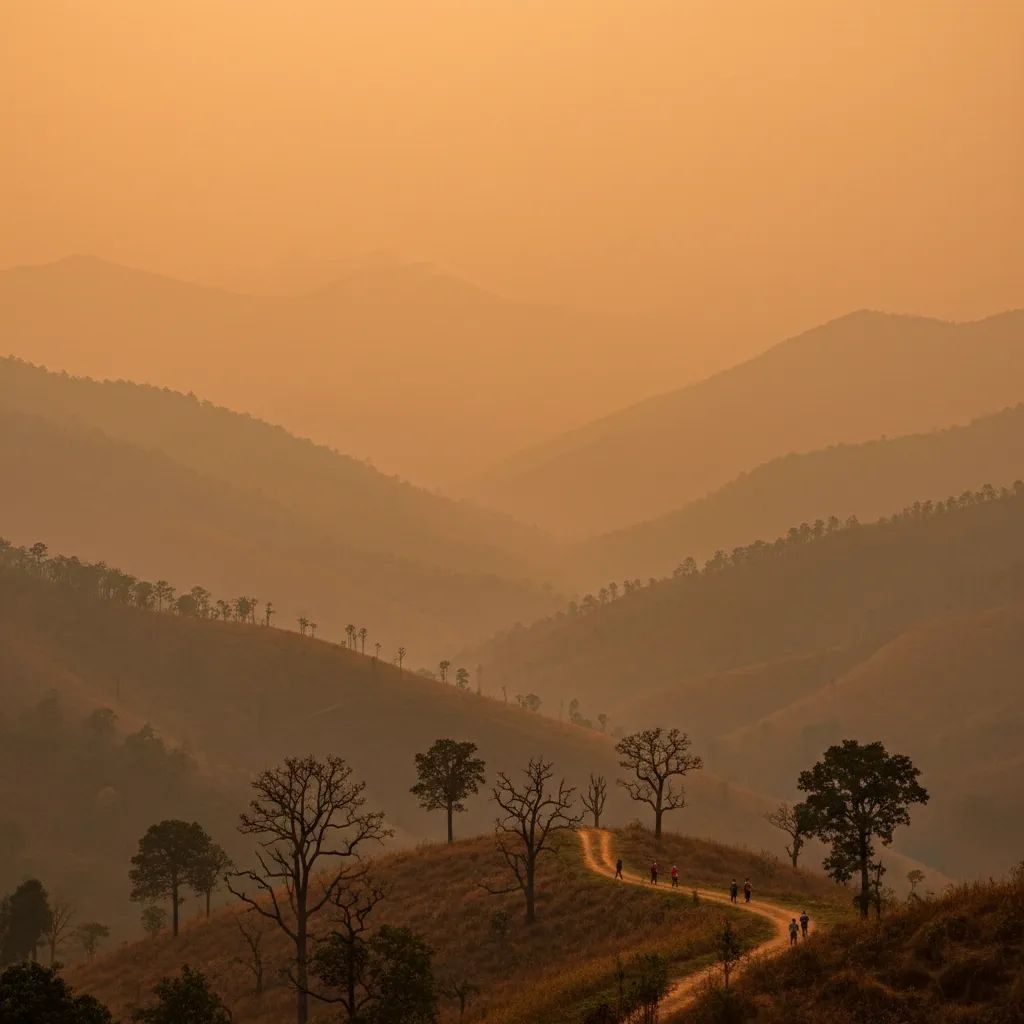
Northern Thailand's Air Crisis Enters Uncharted Territory
Between April 1 and 16, satellite sensors tracked an unprecedented 64,689 heat signatures across Thailand—the year's highest tally and a visceral reminder that the North's seasonal smoke crisis has become something more intractable. A single day in mid-April registered 5,384 separate ignition points. For residents in Chiang Mai, Nan, Phrae, and neighboring provinces, the numbers translate into one brutal reality: hazardous air quality that disrupts schools, drives visitors away, and forces conversations about permanent relocation among those with the means to leave.
Why This Matters
• PM2.5 levels consistently exceed danger thresholds across 12+ northern provinces, with Chiang Mai regularly appearing among the world's most polluted cities during April—a public health crisis affecting children, elderly residents, and anyone with respiratory vulnerabilities.
• Tourism revenue evaporated as domestic and international visitors received real-time alerts showing the region in critical pollution zones during Songkran, traditionally peak travel season.
• Farmers face a trap: land-clearing fires create the smoke that damages standing crops through reduced photosynthesis and heat stress, even as burning remains the cheapest clearing method available to smallholder operations.
The April Trap: When Policy Gaps Meet Agricultural Urgency
Thailand's Ministry of Natural Resources and Environment imposes a formal burning ban from February 1 through March 31—the nation's driest weeks. The moment it expires on April 1, fires proliferate. Agricultural logic explains why: farmers preparing fields for the monsoon's May arrival rush to clear land before seasonal rains arrive, and controlled burning remains the fastest, cheapest option. GISTDA satellite monitoring consistently reveals that most new hotspots cluster along the precise boundary between farmland and forest reserves—the friction zone where agricultural clearing meets protected ecosystems.
This creates what civil-society critics call a "regulatory gray zone." The formal ban has lapsed, but sustained heat and low humidity persist. Enforcement becomes fragmented; some fires remain deliberate, some ignite accidentally, and many spread unchecked from rural areas into national reserves before detection triggers response. Unlike the heavily monitored February-March period, April operates in quasi-legal ambiguity that producers exploit unconsciously or deliberately.
The Thailand Meteorological Department forecasted temperatures between 36°C and 42°C in mid-April, with haze on multiple days. Heat accelerates fire spread horizontally while simultaneously preventing vertical atmospheric mixing—precisely the conditions that trap smoke at ground level where people breathe.
Geography as Accelerant: The Basin Effect Explained
Chiang Mai, Lamphun, and Lampang occupy natural depressions surrounded by high mountain ranges that form what researchers call a "basin trap." Under stable atmospheric conditions—prevalent in April—smoke and fine particulates accumulate like water pooling at terrain's lowest point. Wind cannot push emissions away; vertical atmospheric mixing stalls. Meteorologists describe this as a thermal inversion: a layer of warm air compresses cooler air and pollutants downward toward street level.
Chiang Mai University researchers have documented this effect extensively, explaining why readings here often exceed Southeast Asia's worst pollution levels despite fires burning across a broader geographic expanse throughout the Mekong region. The basin geography transforms manageable fires into a concentrated public-health disaster confined to vulnerable populations within a relatively compact area. Temperature records show the basin effect peaks precisely during February through April, when upper-level wind patterns are weakest and moisture levels lowest.
This phenomenon is not temporary inconvenience—it is a structural vulnerability baked into northern Thailand's physical landscape.
Who Actually Burns: Economics, Access, and Enforcement
Over 120 million rai of forest exists across northern Thailand, yet ranger oversight covers perhaps 15% of forested area consistently. This creates a functional "vacuum zone" across approximately 85% of the territory—land with minimal human presence to prevent or detect fires early. When illegal burning ignites in these areas, fires spread unchecked until they cross into populated zones where response becomes mandatory and visible.
Farmers themselves represent a heterogeneous group. Some operate registered, low-intensity burns under government permission; others ignite fires gambling that detection won't occur or penalties won't be enforced. A third group has abandoned burning entirely, adopting mechanized land preparation—but this requires capital investment, machinery access, and acceptance of slower clearing timelines.
The agricultural incentive structure remains primary. Open burning eliminates hand-labor clearing costs, eliminates waste-disposal expenses, and spreads ash that temporarily enriches depleted soil. For subsistence and smallholder farmers operating on thin profit margins, the economics overwhelmingly favor fire. Regulatory attempts encounter systemic obstacles: compliance is voluntary when field-level enforcement is sparse; legal penalties remain light relative to cost savings; alternative methods require upfront capital most cannot access.
The Myanmar Shadow: Transboundary Smoke Flows
Thailand's air-quality crisis originates partly outside its borders. Myanmar generates fire hotspot counts comparable to or exceeding Thailand's, particularly in Shan State and border provinces directly upwind of northern Thailand. Prevailing dry-season winds carry smoke eastward across the frontier, merging with domestic emissions to create the region's worst air episodes.
Thailand's Pollution Control Department established a WhatsApp hotline enabling direct coordination with counterparts in Myanmar and Laos, allowing real-time crisis alerts and emergency requests. Under the CLEAR Sky Strategy (adopted 2023 by Thailand, Laos, and Myanmar), the three nations agreed to share hotspot data, harmonize monitoring systems, conduct joint training workshops, and transfer technical expertise. Thailand provided training to Lao officials on air-quality measurement and pollution-dispersion modeling.
Regionally, all 10 ASEAN member states have ratified the Agreement on Transboundary Haze Pollution (AATHP) and endorsed the Second ASEAN Haze-Free Roadmap (2023–2030). The ASEAN Coordinating Centre for Transboundary Haze Pollution Control (ACC THPC), established 2023, functions as the regional data hub and inter-country intelligence node.
Yet enforcement remains weak. The ASEAN consensus model—which emphasizes cooperation and non-interference—prevents any nation from compelling neighbors to enforce action. Domestic politics, budget constraints, and competing economic priorities in Myanmar and Laos mean cross-border collaboration, while improving, still falls short of the intensity required to eliminate transboundary pollution entirely. The frameworks exist; the teeth do not.
Concrete Steps for Those Living in the North
If you reside in northern Thailand, concrete interventions reduce exposure. Invest in a HEPA and activated-carbon air purifier and monitor real-time PM2.5 readings via the Thailand Pollution Control Department website or mobile applications. When readings exceed 35 µg/m³ (unhealthy range), restrict outdoor activity, seal windows, and wear N95-equivalent masks when outside.
Expatriates and long-term residents considering relocation or temporary movement during March and April should factor air quality into planning. Coastal and southern provinces experience substantially lower particulate concentrations. Those with respiratory conditions or young children should consult physicians about preventive medications or temporary relocation during peak haze.
Hospitality and retail operators should anticipate revenue volatility tied to air-quality fluctuations. Properties offering climate-controlled indoor spaces with certified clean-air systems become competitive advantages. Tour operators may diversify itineraries away from the North during fire season or provide transparent air-quality forecasts to manage expectations and reduce cancellations.
Farmers encounter a policy inflection point. The government actively promotes mechanized no-burn land preparation through subsidized access to tillers and mulchers. Upfront costs and learning curves remain barriers, yet long-term soil health gains, reduced legal prosecution risk, and alignment with emerging sustainable-sourcing standards from international commodity buyers reward adoption. Registering for controlled-burn programs—where permitted—reduces prosecution risk and provides extension-service access.
Government Response: Budget, Coordination, Structural Limits
Thailand's Cabinet approved a comprehensive two-phase haze-management framework for 2026. The preparation phase emphasizes risk mapping, farmer registration for controlled burns, promotion of no-burn agriculture through subsidized machinery, and regulation of industrial emissions and heavy-vehicle traffic. The operational phase activates during peak fire season with forest closures, checkpoint patrols, strict enforcement against illegal burning, and coordination across military, civil administration, local government, and community networks.
The government allocated 351 million baht for wildfire and haze management across 17 northern provinces, distributed through the Ministry of Natural Resources and Environment, the Department of National Parks, Wildlife and Plant Conservation, and the Royal Forest Department. Chiang Mai province, as the epicenter of both fire activity and population exposure, received the largest allocation. Responsibilities were also decentralized to local administrative organizations (Tambon and municipal councils), aiming to empower communities with authority and resources simultaneously.
Critics highlight that much local spending flows into repetitive public-relations campaigns rather than direct fire suppression or livelihood alternatives. Civil-society organizations, including Rocket Media Lab, argue that the reactive legal framework—requiring authorities to "detect fire before deploying funds"—hampers proactive intervention. Advocacy is building for a comprehensive Clean Air Management Act providing year-round authority and funding, replacing today's seasonal emergency posture with permanent prevention infrastructure.
The Compound Crisis: Health, Economy, and Environment
Public health facilities in the North report surging admissions for respiratory distress, particularly among children and elderly populations. Schools suspended outdoor activities or closed temporarily when PM2.5 concentrations exceeded safe thresholds. Effects extend beyond emergency departments: chronic exposure aggravates asthma, reduces school attendance, and elevates household stress and medical costs.
Tourism, a pillar of Chiang Mai's economy, absorbed direct blows. Hotel operators reported Songkran booking cancellations during traditionally peak weeks. International visitors, alerted by real-time air-quality apps showing the city in critical zones, rerouted to coastal or southern destinations. Recovery timing depends entirely on whether April fires taper as expected or intensify further.
Agriculture itself becomes a paradox victim. Smoke and fine dust clog plant stomata, reducing photosynthesis efficiency. When ambient temperatures exceed 40°C for sustained periods, crop stress intensifies, lowering both yield and quality for staple crops like rice, maize, and vegetables. Farmers using fire to clear land ironically see their standing crops suffocated by cumulative haze from hundreds of simultaneous burns.
Household energy consumption spikes as residents run air conditioners and purifiers around the clock, driving up electricity bills and straining the national grid. Aggregate energy demand translates directly to increased carbon emissions, partially offsetting any climate benefits from reducing deforestation.
Why Current Approaches Cannot Close the Gap
The 64,689 hotspots in 16 days—and the consistent year-over-year recurrence—demonstrates that current measures, while more coordinated than previous decades, remain insufficient to break the cycle. Sustainable solutions require multi-pronged action: expanding forest-ranger capacity to cover the 85% vacuum zone, investing in alternative agricultural technologies at scale, enforcing penalties for illegal burning consistently, and deepening cross-border cooperation with Myanmar and Laos through binding mechanisms, not voluntary frameworks.
Legal reform is essential. A Clean Air Management Act providing year-round authority and funding would replace reactive emergency responses with proactive prevention architecture. Without it, northern Thailand will cycle predictably: official burn bans in early months, regulatory gaps in April, smoke accumulation in terrain that traps it, health crises and economic losses, and pledges to perform better next year.
The structural challenge is this: three domains require simultaneous progress—domestic forest management, agricultural transformation, and cross-border governance—and none shows signs of resolving quickly. For residents navigating 2026, the reality is stark: breathable air remains contingent on convergence of political will, agricultural incentive restructuring, and regional diplomatic breakthroughs that have proven elusive across successive administrations and electoral cycles.


