
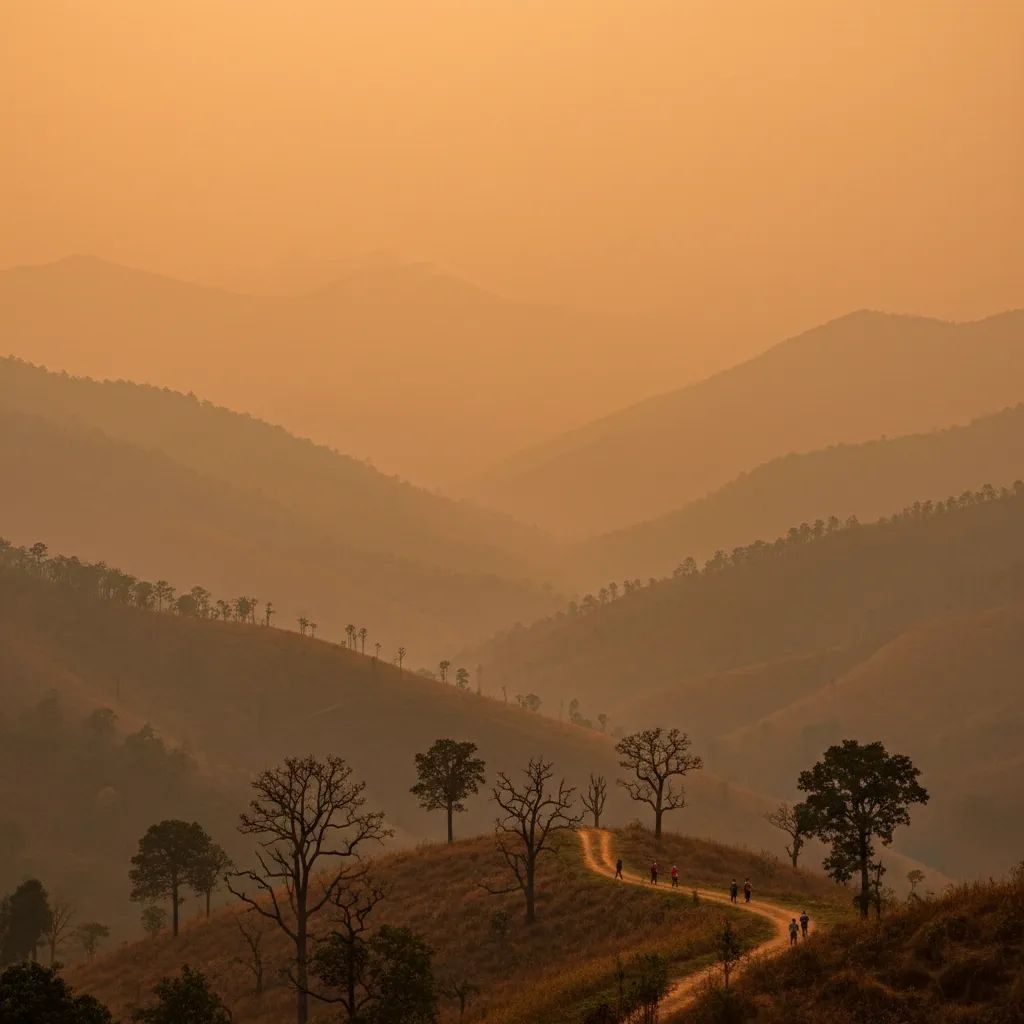
The Thailand Ministry of Public Health has activated emergency health operations across 12 northern provinces as toxic air pollution forces hotel cancellations and threatens to wipe out more than 700M baht in Songkran tourism revenue, with Chiang Mai repeatedly claiming the unwelcome title of world's most polluted city.
Why This Matters
• Hotel occupancy in northern Thailand has plummeted to 50–60% for Songkran 2026, down from typical rates of 80–90% in previous years.
• PM2.5 readings in Mae Rim district hit 409 micrograms per cubic meter on April 4—60 times the World Health Organization's 24-hour guideline.
• Clean Air Bill remains stalled in the Senate, with activists warning that legislative inaction is costing lives and livelihoods across the region.
• Thai residents planning outdoor Songkran activities face serious health risks, with authorities urging N95 masks and indoor "safe zones."
The Economic Fallout for Northern Tourism
The traditional water festival that defines Thailand's New Year celebration is colliding with an environmental crisis that shows no signs of abating. Tourism operators in Chiang Mai, Chiang Rai, Mae Hong Son, Lampang, and Lamphun report a dramatic shift in booking patterns as visibility drops and air quality indices spike into hazardous territory.
Kasikorn Research Center estimates that the upper northern region—comprising nine provinces—stands to lose at least 700M baht in tourism revenue during the five-day Songkran holiday period alone, compared to the 2,000M baht typically generated during what should be peak season. Thai domestic travelers, who traditionally drive private vehicles for regional road trips, have virtually disappeared from booking systems, accounting for just 2–5% of reservations.
International visitors, particularly from Asian markets, initially showed interest but began canceling after IQAir ranked Chiang Mai Municipality with an Air Quality Index of 195 on April 13, placing it at the top of the global pollution league table. Hotel occupancy rates tell the story: the 50–60% figure represents a catastrophic decline for an industry that depends on Songkran's traditional rush.
The immediate losses pale beside the long-term threat to investor confidence. Hoteliers and resort operators across the northern provinces warn that recurring annual pollution crises are eroding Thailand's reputation as a reliable destination, potentially driving permanent shifts in tourist behavior and capital allocation.
Health Emergency Declared Across 12 Provinces
The Thailand Ministry of Public Health escalated its response by opening Public Health Emergency Operations Centers in a dozen northern provinces, prioritizing vulnerable populations as hospitals report surging admissions for respiratory distress. Over 1.7M surgical masks and 180,000 N95 respirators have been stockpiled, while mobile health teams conduct proactive screening in high-risk communities.
Medical facilities in Chiang Mai and Chiang Rai document increasing cases of breathing difficulties and eye irritation even among people remaining indoors. The particulate matter penetrates buildings, forcing residents to seal windows and deploy air purifiers to create what authorities now call "safety zones" within homes and workplaces.
At Nakhon Ping Hospital in Mae Rim, readings on April 4 reached 409 micrograms per cubic meter—a concentration that poses extreme danger to human health. The scale of the crisis becomes clear when compared to WHO standards: the organization recommends 24-hour exposure not exceed 15 micrograms, making some northern districts nearly 30 times over the safe threshold.
More than 5,000 heat spots were detected across Thailand on April 5, while neighboring Myanmar registered over 7,000, creating a transboundary smoke cloud that meteorological conditions trap in the northern basin. Laos contributed an additional 3,785 heat spots, and Myanmar's border regions added 2,722 more, producing a regional pollution event that no single country can control.
What This Means for Residents
Anyone living in Thailand's northern provinces should treat the next several weeks as a prolonged health emergency. Government advisories strongly recommend limiting outdoor activity, wearing N95-rated masks when exposure is unavoidable, and creating filtered indoor environments. Parents with young children, elderly residents, and anyone with existing cardiovascular or respiratory conditions face elevated risk and should consider temporary relocation if possible.
The Civil Aviation Authority of Thailand monitors visibility conditions at northern airports, preparing contingency protocols if smoke reduces visual range below aviation safety standards. This introduces uncertainty for anyone planning domestic travel during what should be the country's most festive period.
The economic impact extends beyond tourism. Research from Chiang Mai University calculates that PM2.5 pollution reduces northern Thailand's GDP by 2.3% annually, with calls for government compensation exceeding 57B baht per year. Workers in outdoor industries, from construction to agriculture, lose productive days, while healthcare costs mount across both public and private systems.
For expatriates and long-term residents, the crisis exposes infrastructure gaps in environmental monitoring and emergency response. While wealthier households can afford air purifiers and N95 masks, the broader population lacks access to protective equipment, creating equity concerns that advocacy groups increasingly highlight.
The Legislative Stalemate
The draft Clean Air Management Act, which passed the House of Representatives on October 21, 2025, remains under review by Senate special committees as toxic smoke blankets the very regions the legislation aims to protect. Environmental advocates and public health organizations warn that bureaucratic delay costs lives while the political calendar threatens to kill the bill entirely.
If the incoming government fails to reintroduce the legislation within 60 days of the new parliamentary session, the draft could lapse, forcing the entire process to restart. However, on April 12, the Thailand Cabinet acknowledged 24 pending bills, including the Clean Air Act, and directed relevant agencies to expedite review and consideration.
The proposed law represents a fundamental shift from "pollution control" to "clean air for health," establishing air quality as a basic right while creating comprehensive management mechanisms. Key provisions include:
Provincial-level Clean Air Committees with authority to inspect, supervise, and control pollution-generating activities, including power to declare pollution monitoring zones. The decentralization gives local governments enforcement tools currently concentrated at the national level.
Economic mechanisms such as pollution fees, emission trading rights, and deposit-refund systems designed to incentivize compliance and fund remediation. A dedicated Clean Air Fund would support ongoing air quality management activities.
Strict liability covering civil, criminal, and administrative penalties for polluters, extending to financial institutions that fund pollution-generating projects—a provision that has sparked debate within Thailand's industrial sector.
Agricultural burning restrictions, prohibiting open-air burning for harvest or field management except in specific circumstances like pest control. This directly addresses one of the primary sources of seasonal smoke.
The Federation of Thai Industries supports the legislation's principles but requests an independent Regulatory Impact Assessment to evaluate effects on small and medium enterprises, arguing for balance between environmental protection and competitive capacity.
The Root Causes Persist
Forest fires account for the most visible smoke generation, with over 1.2M rai burned in just three days during late March 2026. Illegal burning for foraging and wildlife hunting continues despite enforcement efforts, while cross-border fires from neighboring countries contribute smoke that meteorological patterns channel directly into Thailand's northern valleys.
Agricultural burning, particularly post-harvest residue management, adds enormous particulate loads during the critical March-April window. The practice remains widespread across Thailand and neighboring countries, reflecting economic pressures and the absence of viable alternatives for smallholder farmers.
Geographic factors compound the problem. Chiang Mai's bowl-shaped topography traps pollutants under stagnant atmospheric conditions, preventing natural dispersion. Urban and industrial emissions from coal-fired power plants and large factories contribute background pollution year-round, creating a base layer that seasonal burning amplifies into crisis levels.
Authorities have deployed thousands of personnel for fire suppression and coordinated with the Royal Rainmaking and Agricultural Aviation Department for cloud-seeding operations. These tactical responses provide temporary relief but fail to address structural drivers that regenerate the crisis annually.
Outlook and Adaptive Strategies
Meteorological forecasts suggest improved ventilation conditions between April 9–12, potentially reducing particulate concentrations temporarily. However, if heat spots continue proliferating in Thailand and neighboring countries, pollution levels will likely rebound immediately. Northern provinces should expect worsening conditions through at least mid-April as the hot season intensifies before monsoon rains arrive.
Anyone living in affected areas needs a multi-week strategy rather than day-to-day improvisation. Investment in HEPA filtration systems for primary living spaces provides the most effective protection. N95 or higher-rated masks should be standard equipment for any outdoor excursion. Air quality monitoring apps like IQAir and official Thailand Pollution Control Department resources offer real-time data for daily planning.
For those with flexibility, temporary relocation during peak pollution months represents a rational response to what has become a predictable annual pattern. The tourism industry's suffering demonstrates that Thailand's northern provinces face a reputation crisis that policy delay only deepens.
The stalled Clean Air Act embodies the tension between regulatory ambition and political inertia. Whether Thailand's legislative system can deliver enforceable standards before another Songkran suffers—and another cohort of residents endures weeks of hazardous air—remains the critical question facing both government officials and the 44 provinces now experiencing above-standard PM2.5 levels.
Until comprehensive legal frameworks take effect, residents must rely on personal protective measures, tactical government interventions like rainmaking, and hope that meteorological conditions eventually shift. The jasmine water and laughter that traditionally define Songkran have given way to surgical masks and air quality apps—a transformation that threatens to become permanent without decisive policy action.


