
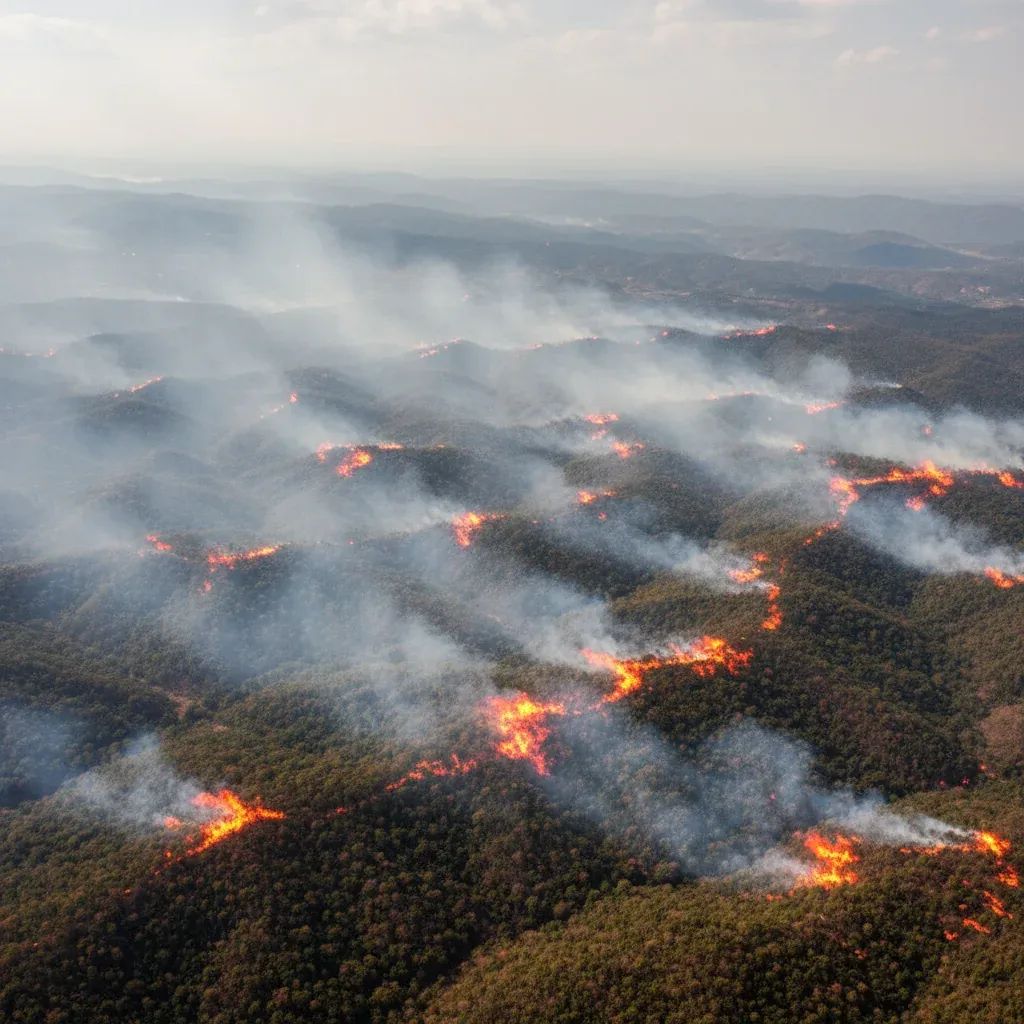
A 36-year-old man arrested in Phitsanulok province, northern Thailand, for igniting forest fires has told investigators he did so out of boredom and a desire to watch rangers struggle to extinguish the flames—a confession that has left authorities stunned and highlights a troubling dimension to the country's annual fire crisis. The arrest comes as the region battles one of its worst wildfire seasons in recent years, with thousands of hotspots recorded across northern Thailand, representing a significant increase over previous years.
Why This Matters for Residents
The legal consequences for setting fires in protected areas are severe. Under Thailand's National Parks Act and Wildlife Preservation and Protection Act, individuals caught lighting fires in national parks or wildlife sanctuaries face penalties starting at 400,000 baht and potentially up to 20 years in jail. In reserved forest areas, penalties depend on acreage burned, with sentences ranging from 1 to 10 years for fires consuming less than 25 rai (10 acres), and substantially harsher penalties for larger areas. Courts can also impose environmental damage compensation, which has reached tens of millions of baht in major cases.
The fire season has already produced severe haze across northern provinces, affecting residents' health and daily life. Nearly all of Thailand's forest fires are deliberately set by people, not natural occurrences. Authorities have intensified enforcement during peak fire season, conducting hundreds of arrests across northern provinces for forest-related offenses. For residents living in northern Thailand's fire belt—stretching from Chiang Mai and Mae Hong Son through Lampang and Phitsanulok—the burning season has been particularly brutal, with air quality indexes frequently reaching hazardous levels, forcing schools to close and residents to limit outdoor activities.
The Psychological Puzzle Behind Arson
While the vast majority of Thailand's forest fires stem from economic motives—farmers clearing land for maize cultivation, foragers improving mushroom yields, hunters flushing game—the Phitsanulok case represents a rarer psychological profile. Thrill-seeking and attention-seeking behaviors drive a minority of arsonists globally, individuals who derive excitement from watching emergency responses or creating dramatic situations.
Thailand's Royal Forest Department has documented cases where psychological factors were identified as causes for burning forest and agricultural land, though authorities rarely publicize such incidents. Social isolation, emotional distress, and inadequate coping mechanisms are common threads among individuals who set fires for non-economic reasons. Unlike revenge arson or fires set to conceal illegal logging, "spectator arson" reflects a distinct pattern—one that Thai authorities have only recently begun acknowledging publicly.
What This Means for Residents: Practical Information
For those living in northern Thailand's fire-prone areas, understanding your rights and resources is essential. If you witness someone setting fires, report it immediately to the Department of National Parks, Wildlife and Plant Conservation (call center: 1800-202-008) or local police. Provide location details, vehicle descriptions, and any identifying information about the individual.
Monitor air quality daily using the Thai Air Quality Index (AQI) app or website (air4thai.pcd.go.th). Air quality readings are updated hourly, helping you plan outdoor activities and protect your health during high pollution days. Schools and businesses often make closure decisions based on these readings.
Health support services for residents affected by haze-related respiratory issues are available through provincial hospitals in Chiang Mai, Lampang, and Phitsanulok. Those experiencing persistent respiratory symptoms should seek medical evaluation and keep records for potential health insurance claims.
The Enforcement Reality
The Thailand Department of National Parks, Wildlife and Plant Conservation has adopted a zero-tolerance approach to illegal burning. Enforcement relies heavily on satellite monitoring technology, which detects thermal anomalies in real time and transmits coordinates to ground teams. Helicopters equipped with water buckets and drones provide aerial support in terrain inaccessible to vehicles. Rapid-response teams have been pre-positioned in high-risk zones, cutting response times when new fires ignite.
Yet technology alone cannot address the socio-economic drivers that fuel the majority of deliberate burns. Agricultural fires account for the largest share of incidents, particularly in areas where maize monoculture has replaced subsistence farming. Farmers burn crop residue and clear weeds to maximize yields on limited arable land, a practice deeply embedded in the region's agricultural calendar despite official bans.
Community Partnerships and Indigenous Knowledge
Indigenous communities in northern Thailand's upland areas have emerged as crucial partners in fire management, deploying volunteer patrol teams, early-warning systems, and firebreaks based on traditional knowledge of fire behavior. These groups often operate without compensation, motivated by protecting ancestral lands and maintaining rotational farming systems that depend on controlled burns.
The challenge lies in distinguishing between controlled early burning—conducted by communities to reduce fuel loads—and uncontrolled agricultural fires that escape boundaries. Authorities have struggled to balance respect for indigenous practices with enforcement of blanket burning bans. High-risk conservation areas now face temporary closures to public access during peak fire season, reducing opportunities for both accidental and deliberate ignition.
Regional Implications and Transboundary Haze
The fire crisis extends beyond Thailand's borders. Smoke from neighboring countries—particularly Myanmar and Laos, where similar agricultural burning occurs—drifts into northern Thai provinces, compounding local pollution. Regional cooperation remains essential but coordination mechanisms are still being developed.
For residents, the practical impact manifests in restricted outdoor activities, respiratory health advisories, and reduced visibility that disrupts transportation. Tourism-dependent areas like Chiang Mai see visitor cancellations when air quality deteriorates, affecting businesses and employment.
The Phitsanulok arrest—however unusual its motivation—underscores the complex challenges facing Thai authorities. While most fires stem from economic necessity and traditional practices, enforcement pressure continues to intensify, with prosecution rates at elevated levels and penalties serving as stark warnings. As fire season continues, residents should remain vigilant about reporting suspicious activity and monitoring air quality to protect their health and property.


