
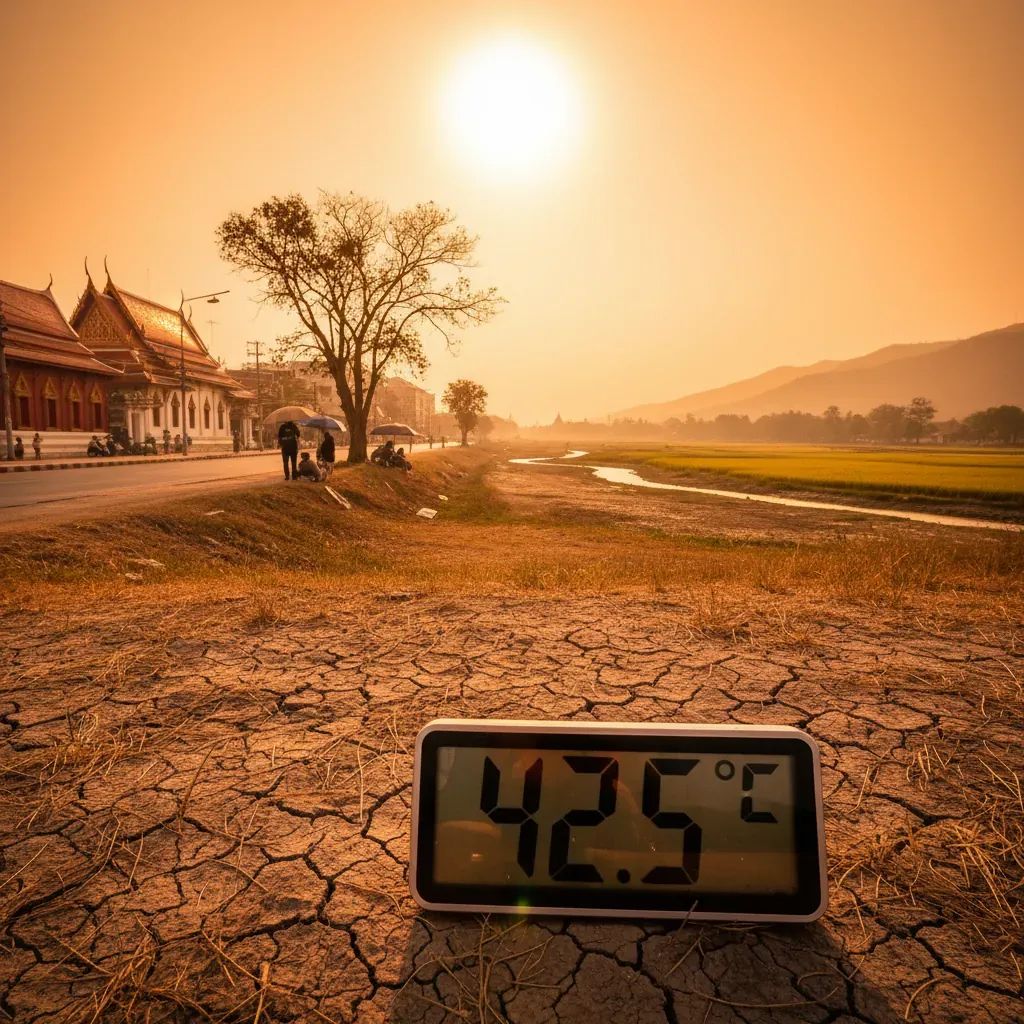
Thailand faces a collision of two weather crises this April: scorching heat pairing with destructive storms and degraded air quality. The convergence creates simultaneous health hazards—heat stress layered atop respiratory risks—that demand immediate household and workplace adaptation across the upper half of the country.
Why This Matters
• Peak danger window: April 17–20, with northern provinces reaching 42–43°C while simultaneous thunderstorms, hail, and lightning pose structural and agricultural threats across the Northeast, East, and Central regions.
• Air hazard zones: 40 provinces logged dangerous PM2.5 levels today; combined with heat, this amplifies cardiac and respiratory emergencies, particularly for children, the elderly, and outdoor workers.
• Agricultural exposure: Hailstorms and violent winds pose immediate crop and livestock losses during a sensitive harvest transition; past events destroyed entire orchards within minutes.
• Municipal systems under strain: Despite pre-positioned pumps and drainage work, many municipalities operate with insufficient budgets and staffing for comprehensive flood response.
How the Weather System Works
The meteorological pattern driving this dual crisis involves two contrasting air masses locked in confrontation. A high-pressure system originating from China has extended across the South China Sea, strengthening southerly and southeasterly winds that transport moisture across lower Northeast Thailand, the Eastern seaboard, and into the upper Gulf of Thailand. Simultaneously, the northern and upper-central plateaus remain trapped beneath intense radiative heating from direct solar exposure—the heat dome effect.
When these incompatible air masses collide over unstable terrain, the atmosphere becomes highly energetic. Warm, moist air forced upward by cooler air above triggers explosive convective development. The result: violent thunderstorms capable of producing damaging straight-line winds, hail, and lightning within minutes. The Thai Meteorological Department has now issued its 7th warning of the year, a frequency indicating an unusually volatile seasonal pattern rather than typical April variability.
Forecasters project the storm track will expand westward over the next 48 hours, bringing threats to Bangkok and its outlying provinces before moving into the mountainous North by April 19–20. The system is expected to persist until at least April 23 in isolated pockets, though the most intense activity will concentrate along the Northeast-East corridor through midweek.
Geographic Risk Exposure: Who Needs to Act Now
Eight Northeast provinces rank as highest priority: Bueng Kan, Sakon Nakhon, Nakhon Phanom, Yasothon, Amnat Charoen, Nakhon Ratchasima, Buriram, and Ubon Ratchathani. Within the Eastern region, particular vigilance applies to Sa Kaeo, Chachoengsao, Chonburi, Chanthaburi, and Trat. All residents should expect thunderstorm coverage affecting 30–40% of these zones within 24 hours.
Recent history offers cautionary context. A storm system that swept Buriram in the preceding week toppled mature trees, injuring six people and destroying roadside commercial infrastructure—beach umbrellas, rental kiosks, and service tents were flattened. Similar events across the Eastern seaboard have cost small business owners substantial capital replacement expenses.
The practical implication: secure or remove outdoor objects now. Furniture, potted plants, loose signage, and construction materials become lethal projectiles in wind gusts exceeding 50–70 km/h. Commercial operators managing outdoor rental services or food stalls face genuine business interruption risk; advance securing or temporary removal of stock is prudent.
The Dual Health Crisis: Heat and Air Converge
Thailand now confronts two simultaneous physiological threats that interact dangerously.
Extreme Heat Stress
The Heat Index—the apparent temperature the human body experiences when humidity and air temperature combine—is forecast to exceed 52°C across portions of the North and Northeast. This threshold marks the boundary between "extremely dangerous" and "heat-related death imminent" on public health scales. The Thailand Department of Health categorizes this severity level as requiring urgent intervention.
Heat exhaustion, heat cramps, and heatstroke represent progressive stages of heat-related illness. The first two are uncomfortable but reversible with rest and hydration; heatstroke, however, involves core body temperature exceeding 40°C and represents a medical emergency capable of causing permanent organ damage or death within minutes if unaddressed.
Vulnerable populations include children under 5 years, adults older than 65, pregnant women, and outdoor laborers—soldiers, police officers, security personnel, farmers, and construction workers who cannot easily retreat to air-conditioned spaces. For these groups, drinking one glass of clean water every 20 minutes becomes non-negotiable; light-colored, loose-fitting cotton clothing maximizes evaporative cooling; and complete avoidance of strenuous outdoor activity between 11 a.m. and 3 p.m. is essential.
Bangkok has established "cooling rooms" within district administrative offices, air-conditioned refuges open during March and April for vulnerable residents lacking home climate control. Elderly individuals and families with young children should note the location of the nearest cooling center in their district; transport to these facilities can provide critical heat relief.
Compounded Air Quality Hazard
The same high-pressure system limiting atmospheric mixing to concentrate moisture also traps pollutants close to ground level. 40 provinces recorded PM2.5 concentrations exceeding WHO guidelines on April 17 alone. The North and upper Northeast experience the most acute exposure due to limited wind circulation and proximity to agricultural burning.
PM2.5—particulate matter smaller than 2.5 micrometers—penetrates deep into lung alveoli and enters the bloodstream, directly damaging respiratory epithelium and triggering systemic inflammation. Combined with heat stress, which already elevates baseline inflammation and cardiac workload, air pollution amplifies the risk of heat-related cardiovascular events.
Short-term exposure produces irritated eyes, cough, nasal congestion, and throat inflammation. Prolonged exposure, particularly among occupational groups like motorcyclists, street vendors, and outdoor fitness enthusiasts, significantly increases risk for chronic respiratory disease, asthma exacerbation, and accelerated cardiovascular aging.
N95 or KN95 masks provide certified protection when fitted properly without gaps. Standard surgical masks offer only partial benefit. The critical variable is seal—a loosely applied mask provides minimal protection. Indoors, HEPA-filter air purifiers sized appropriately for room volume can reduce indoor PM2.5 by 50–80% if windows remain closed and the device runs continuously during high-pollution periods.
Individuals experiencing persistent cough, chest tightness, or shortness of breath should seek medical evaluation immediately; delaying care risks progression to acute exacerbation in susceptible populations.
Agricultural Timing and Economic Vulnerability
Farmers across the Northeast and East currently operate within a narrow window of optimal cultivation conditions. Seasonal transition periods—particularly the shift between dry-season crops and incoming monsoon plantings—carry heightened vulnerability to acute weather damage.
Hailstones, though geographically concentrated, can obliterate entire fruit orchards. Violent winds flatten rice paddies and shred greenhouse infrastructure. Livestock left exposed risk injury or death. The Thai Meteorological Department has issued direct guidance: reinforce fruit trees, prepare protective measures for crops, and shelter livestock.
For smallholder farmers operating outside formal irrigation systems, storm rainfall—while normally beneficial—is insufficient compensation for wind and hail damage, particularly when water distribution proves uneven across fields. A single storm cell can render adjacent farms vastly differently; total crop loss in one section contrasts with minimal impact 5 kilometers away.
Tourism-dependent economies, especially along the Eastern seaboard, face inventory and structural vulnerability. Beach rental operators, floating restaurants, and waterfront service businesses operate with equipment and infrastructure exposed to wind and water damage. The recent Buriram incident illustrated this fragility vividly: operational losses accumulated rapidly, and recovery required weeks of equipment replacement and facility repair.
Municipal Preparedness: Capacity and Constraints
Thai municipalities and local administrative organizations (อปท.) have activated seasonal storm protocols spanning three phases: pre-event preparation, real-time response, and post-event recovery.
Preparation measures include dredged and cleared drainage systems, with water levels lowered to maximum capacity and mobile pumping units pre-positioned at historically vulnerable locations. Bangkok deploys BEST (Rapid Response) units—specialized teams equipped with high-capacity mobile pumps, emergency vehicles, and trained operators designed to reach flooded neighborhoods within 15–30 minutes of initial distress calls.
Structural inspections have targeted large advertising billboards, utility poles, and aging municipal buildings, with authorities issuing repair or removal orders where instability is documented. Construction site managers have been warned not to obstruct drainage channels—a persistent problem amplifying urban flood risk.
However, resource constraints remain acute. Many municipalities lack sufficient capital budgets for comprehensive, long-term flood mitigation infrastructure. Staffing for disaster-response units is often inadequate relative to coverage area and operational demand. Public participation in storm readiness—such as households clearing nearby drains and securing roof-mounted equipment—remains inconsistent across districts.
The gap between preparation capacity and actual needs widens during severe events affecting multiple municipalities simultaneously, as occurred in previous April storms. Mutual aid agreements between municipalities help, but coordination failures and resource saturation can delay response.
Household and Workplace Actions
Monitor forecasts continuously. The Thai Meteorological Department website (tmd.go.th) and the 24-hour emergency hotline 1182 provide real-time updates. Smartphone applications like AirVisual and Weather Underground Thailand offer push notifications for localized alerts.
Secure loose objects immediately. Outdoor furniture, potted plants, garden tools, signage, and unsecured roofing materials become dangerous projectiles. Commercial operators should remove or anchor inventory. Construction sites require containment measures.
Prepare an emergency kit now. Assemble flashlight, batteries, first-aid supplies, prescription medications (two-week supply), bottled water (2–3 liters per person), battery-powered radio, and chargers for mobile devices. Store this kit in an easily accessible location known to all household members.
Avoid driving through standing water. Flash floods can submerge roads within minutes. Even shallow water—15 centimeters—can disable most vehicles or sweep them away. If flooding is encountered while driving, exit the vehicle and move to higher ground; do not attempt to push through.
Remain indoors during active storms. If caught outside, seek shelter immediately in a substantial building—not under trees, in open-sided structures, or near utility poles. Lightning poses an underestimated risk; approximately 50 deaths occur annually in Thailand from lightning strikes, many preventable through shelter-seeking behavior.
Check on vulnerable neighbors. Elderly residents and families with young children may require assistance with preparation or evacuation. Communities with robust mutual-aid networks experience significantly lower injury and mortality rates during severe weather events.
Regulatory and Personal Adaptation Going Forward
This April's convergence of heat, storms, and air pollution reflects broader climatic trends reshaping Southeast Asia. Traditional monsoon dynamics increasingly collide with elevated baseline temperatures, producing more extreme and less predictable weather. Heat Index readings once considered exceptional are becoming routine.
For anyone residing in Thailand—whether a lifelong resident, expatriate, or investor—understanding these patterns is essential. The intersection of heat, air pollution, and storm violence affects daily logistics, business continuity planning, occupational health protocols, and infrastructure resilience. Seasonal advisories are not bureaucratic formalities; they represent survival-relevant information in a rapidly destabilizing climate.
Remain informed. Maintain adequate hydration. Remain indoors when storms approach. Secure your environment before conditions deteriorate. These measures substantially reduce injury risk and provide psychological stability during periods of environmental volatility.


