
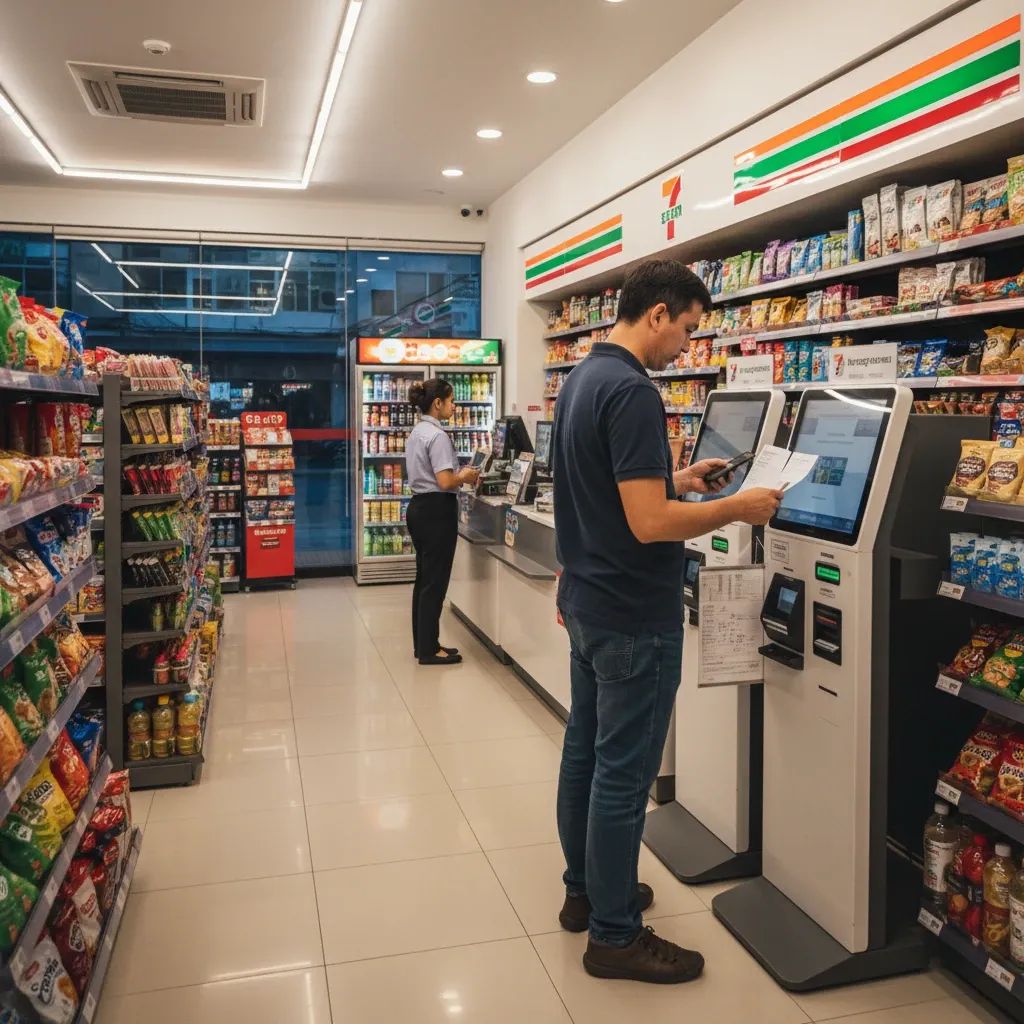
Thailand's largest convenience store operator is heading toward a shareholder showdown that could reshape how retail and financial services intersect across the Kingdom. As of April 2025, CP All Public Company Limited, the force behind more than 14,000 7-Eleven outlets nationwide, faces a stark internal rift over whether to fold three profitable subsidiaries into its parent conglomerate's virtual banking venture—a move that independent directors warn could erode both earnings and business neutrality.
Why This Matters
• Financial hit: Analysts forecast a 20-25% decline in CP All earnings if the transfer proceeds, with one subsidiary alone contributing 5.6 billion baht—roughly 20% of 2025 net profit.
• Neutral platform at risk: Counter Service, which processes payments for all banks at 7-Eleven counters, may lose its independence under a single virtual bank umbrella.
• Bill-payment fees may rise: Currently, most bill payments at 7-Eleven incur fees of 10-25 baht per transaction. If Counter Service loses its neutral platform status, these fees could increase, and service options may narrow.
• Shareholder decision: An extraordinary general meeting on May 29 will decide the fate of the plan, with the Charoen Pokphand Group barred from voting due to conflict of interest.
A Clash Between Strategy and Caution
The Charoen Pokphand Group (CPG), CP All's parent and one of Asia's most diversified conglomerates, is pushing to consolidate Counter Service, Thai Smart Card, and CP Axtra Public Company Limited (CPAXT—a cash-and-carry wholesaler serving small retailers) under ACM Holding (ACMH—CPG's vehicle designated for virtual banking operations). ACMH secured preliminary approval from Thailand's Finance Ministry in June 2024 to launch a virtual bank. The Bank of Thailand issued guidelines requiring virtual bank applicants to bring all financially significant group entities under one supervisory structure, a criterion CPG interprets as mandating the transfer.
Yet on April 17, all six of CP All's non-interested directors voted unanimously to reject the proposal, joined by the company's audit committee. Their objections center on three pillars: financial erosion, operational conflict, and governance opacity.
CPAXT delivered approximately 5.6 billion baht in profit to CP All in 2024. Counter Service, meanwhile, operates the bill-payment kiosks and money-transfer terminals ubiquitous in 7-Eleven stores, serving as a neutral conduit for every major commercial bank in Thailand. Thai Smart Card manages loyalty and prepaid card infrastructure. Independent directors argue that these assets are integral to CP All's competitive edge and revenue engine, not peripheral ventures ripe for reassignment.
The Neutrality Dilemma
Counter Service's business model hinges on impartiality. Walk into any 7-Eleven and you can settle utility bills, top up mobile credit, or remit funds through partnerships with Kasikornbank, Bangkok Bank, Siam Commercial Bank, and a dozen other lenders. Placing that platform under ACMH—a nascent competitor to those same banks—threatens to introduce conflicts of interest that could prompt commercial lenders to withdraw or limit collaboration. The independent directors warn that such a shift would "weaken its original role" and "ultimately harm CP All."
Thailand's regulators have demonstrated sensitivity to market-distorting corporate structures. In recent years, the Securities and Exchange Commission and Bank of Thailand have scrutinized related-party transactions and consolidated financial arrangements that could compromise operational neutrality. The precedent is clear: regulatory bodies will act decisively if they perceive potential conflicts of interest in financial services platforms.
Virtual Banking's Tight Runway
ACMH is one of three consortia green-lit by the Ministry of Finance to establish virtual banks—digital-only lenders designed to serve underserved populations, small enterprises, and informal workers who lack access to traditional credit. The Bank of Thailand mandates that approved consortia launch fully operational services within one year of approval, setting a mid-2026 deadline. Virtual banks must maintain a minimum 5 billion baht in registered capital initially, scaling to 10 billion baht within five years, and operate without physical branches except for limited ATM or agent-based cash services.
The timeline is unforgiving. ACMH needs to demonstrate paid-up capital, assemble risk-management systems, secure IT infrastructure capable of near-zero downtime, and consolidate its financial group—all while navigating internal dissent at its would-be anchor subsidiary. Early-stage losses are typical for digital banking ventures, and analysts expect ACMH to bleed cash before reaching profitability, further dragging on CP All's consolidated earnings if the integration proceeds.
What This Means for Shareholders
CP All's management has scheduled an electronic extraordinary general meeting for May 29, bypassing the board's opposition and placing the decision directly in the hands of minority shareholders and institutional investors. Because the transaction qualifies as a related-party deal under Securities and Exchange Commission and Bank of Thailand regulations, CPG and affiliated entities—collectively holding roughly 36.2% of CP All shares—are disqualified from voting.
That leaves the outcome in the hands of retail investors, pension funds, and foreign portfolio managers. If a simple majority approves the transfer, CP All will cede control of three profit centers to ACMH. If shareholders side with the independent directors, the restructuring stalls—but ACMH may struggle to meet the Bank of Thailand's consolidation criteria without CP All's subsidiaries, potentially jeopardizing its license application or timeline.
The Bigger Picture for Retail and Finance
Thailand's banking sector is undergoing its most significant transformation since the 1997 financial crisis. Traditional lenders have shed more than 23,000 employees—over 15% of the workforce—in the past five years as customers migrate to mobile apps and AI-powered chatbots. Siam Commercial Bank is consolidating five retail units into a single consumer banking group, retraining branch staff as financial advisors, and targeting a 20% shift of branch transactions to digital channels. Kasikornbank has rolled out voluntary early-retirement programs.
Virtual banks add another layer of competition. The Bank of Thailand intends to monitor the three new entrants closely for three to five years to ensure they promote financial inclusion without destabilizing the existing ecosystem. For CP All, the long-term appeal of embedding banking services directly into the 7-Eleven network—imagine applying for a microloan while buying lunch—is undeniable. Yet the near-term financial drag and the risk of alienating commercial bank partners loom large.
Legal and Governance Scrutiny
The audit committee's memorandum highlights concerns over transparency, operational independence, and risk management. Related-party transactions carry heightened disclosure requirements under Thailand Securities and Exchange Commission rules, and minority shareholders have historically been wary of deals that appear to favor controlling families or conglomerates at the expense of public investors.
CPG's decision to call an extraordinary meeting despite unanimous board opposition raises questions about governance norms. While legally permissible, the move underscores the tension between strategic imperatives at the group level and fiduciary duties at the subsidiary level. Should minority shareholders approve the transfer, legal observers will watch whether CP All's independent directors resign in protest—a rare but symbolically powerful step in Thailand's corporate landscape.
What Comes Next
Between now and late May, expect a vigorous proxy battle. CP All's independent directors may issue formal statements or investor presentations outlining their case. Institutional investors, who typically hold 30-40% of free-float shares in major Thai-listed companies, will weigh the trade-off between short-term earnings dilution and potential long-term upside from CPG's digital banking bet.
If the proposal fails, ACMH will need to either negotiate a revised structure that addresses governance concerns or proceed with a narrower virtual bank model that excludes CP All's assets—potentially limiting its competitive reach. If it passes, watch Counter Service's partnerships with incumbent banks and monitor whether CPAXT's wholesale margins compress under virtual bank oversight.
For residents and expatriates in Thailand, the immediate implications are subtle but real. Should Counter Service lose neutrality, bill-payment fees at 7-Eleven could rise or service options narrow. Conversely, a successful ACMH launch could bring new credit products tailored to gig workers, street vendors, and micro-entrepreneurs who currently rely on informal lenders charging triple-digit annual rates. The Bank of Thailand has made financial inclusion a policy priority, and virtual banks are the chosen instrument—but only if they can navigate the messy reality of corporate restructuring without sacrificing the very neutrality that makes platform businesses valuable in the first place.


