
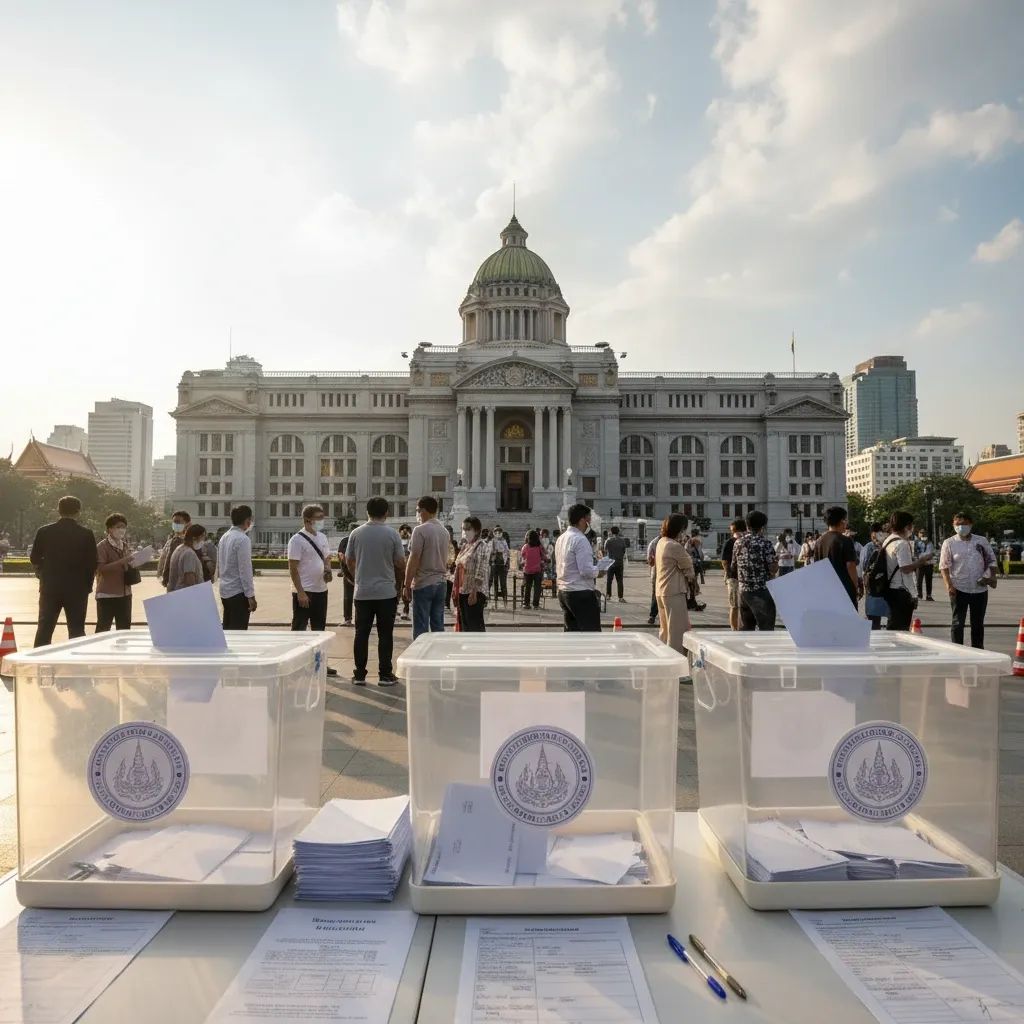
The Thailand Parliament witnessed a masterclass in political survival last month when the Klatham Party, holding 58 seats, chose neither to back nor block Anutin Charnvirakul's confirmation as Prime Minister. The March 19 vote ended with Anutin securing 293 parliamentary votes, but Klatham's deliberate abstention has now emerged as the story's real intrigue—a textbook example of Thai coalition hedging that prioritizes future leverage over immediate clarity.
Why This Matters
• Political stability watch: A 58-seat bloc remaining uncommitted could destabilize or rescue the government during crises.
• Cabinet reshuffle potential: Klatham's abstention keeps the door open for ministerial positions if coalition tensions flare.
• Expat impact: Government instability affects policy continuity on visas, taxes, and foreign business regulations.
The Arithmetic Behind the Silence
Anutin Charnvirakul's Bhumjaithai Party captured 193 seats in the February 8 general election, the largest haul in a fractured field. His new administration—a 15-to-16-party coalition endorsed on March 31—parcels out 26 ministerial posts to Bhumjaithai, nine to Pheu Thai (74 seats), and one to the Palang Pracharath Party (5 seats). The coalition commands roughly 300 seats in the lower house, a workable majority but not an overwhelming one.
Klatham emerged as the fourth-largest party with its 58 seats, yet found itself locked out of the cabinet entirely. Reports from Bangkok political circles suggest the party had demanded retention of the Agriculture Ministry—a portfolio historically lucrative for rural patronage networks—as the price of participation. When that condition went unmet, Klatham withdrew from coalition talks but stopped short of formal opposition.
The abstention was neither accident nor indifference. By refusing to cast a vote either way, Klatham preserved optionality in a system where coalitions shift like monsoon clouds.
The Man Behind the Curtain
Officially led by Narumon Pinyosinwat, the Klatham Party is in practice steered by Thamanat Prompow, a seasoned political operator with ties stretching across Thailand's ideological spectrum. Thamanat has cultivated relationships with Thaksin Shinawatra, the Pheu Thai patriarch, and General Prawit Wongsuwan of Palang Pracharath, giving him unusual cross-party reach.
Founded in April 2020 as the Thai Economic Party, Klatham rebranded and repositioned itself as a center-right force capable of playing both sides of the aisle. Thamanat has firmly denied making prior commitments to Anutin regarding coalition entry, but his political résumé suggests he rarely makes irreversible enemies.
This duality—close enough to Pheu Thai to be labeled by critics as a "branch office," yet independent enough to claim autonomy—makes Klatham a floating asset in parliamentary arithmetic. Some analysts describe it as Pheu Thai's "secret weapon" against Bhumjaithai overreach, a 58-seat insurance policy should Anutin's coalition fracture.
What This Means for Residents
For expatriates and foreign investors monitoring Thailand's political stability, Klatham's abstention is a signal rather than noise. Governments in Thailand rarely fall overnight, but they do weaken incrementally—through defections, scandals, or policy deadlock. A party that holds nearly 12% of parliamentary seats but sits outside the cabinet can either shore up or sabotage the administration depending on tactical needs.
Practical implications:
• Policy continuity risk: If coalition tensions force a cabinet reshuffle or even snap elections, expect delays in visa reforms, foreign business licensing, and tax legislation. The Thailand Revenue Department and immigration agencies operate in a vacuum when ministries are in flux.
• Budget negotiations: Klatham's opposition stance means it will scrutinize government spending bills. For businesses reliant on infrastructure contracts or subsidies, this adds a layer of unpredictability.
• Regional investment sentiment: Foreign investors often treat Thai political uncertainty as a risk premium. A coalition dependent on 15+ parties, with a significant bloc abstaining, can spook equity markets and complicate long-term planning.
Anutin is scheduled to deliver his "Thailand 10 Plus" policy statement to Parliament between April 7-9, and Klatham has pledged to "scrutinize the election process" from its opposition bench. Whether that scrutiny turns into obstruction or quiet cooperation depends entirely on what Klatham's leadership calculates it can extract.
The Bamboo Diplomacy of Thai Politics
Abstention as a tactic mirrors the broader concept of "bamboo diplomacy"—bending without breaking, adapting to prevailing winds while maintaining structural integrity. In Thailand's parliamentary system, where coalition governments are the norm and ideological lines blur quickly, this flexibility is survival skill rather than cynicism.
Klatham's move accomplishes several objectives simultaneously:
• Avoids accountability: The party escapes blame for unpopular government decisions while retaining the option to claim credit for any future successes it helps enable.
• Accrues leverage: By offering conditional support, Klatham can extract concessions on an issue-by-issue basis—whether ministerial posts, committee chairmanships, or budget allocations for rural constituencies.
• Signals to Pheu Thai: The abstention subtly reminds Bhumjaithai's main coalition partner that there is a reserve bloc available should power-sharing disputes escalate.
This is not the first time Thai parties have weaponized abstention. The tactic has been used repeatedly in confidence votes, budget approvals, and censure debates as a way to maintain strategic ambiguity. For a party like Klatham—neither large enough to dominate nor small enough to ignore—abstention transforms numerical weakness into positional strength.
What Comes Next
Anutin's 36-member cabinet now faces the task of governing a deeply fragmented electorate while managing internal coalition pressures. Bhumjaithai's dominance in ministerial appointments has already stirred resentment among smaller coalition partners, and Pheu Thai's reduced role—down from its previous prominence—suggests potential for friction.
Klatham, meanwhile, has announced readiness for its opposition role. But in Thai politics, opposition does not necessarily mean confrontation. The party's leadership has left open the possibility of issue-based support, particularly on legislation that benefits rural provinces where Klatham's voter base overlaps with Bhumjaithai's.
The next flashpoint could come during budget debates later this year or if economic instability—rising household debt, sluggish exports, or baht volatility—tests coalition unity. At that moment, Klatham's 58 seats shift from abstraction to arithmetic necessity.
For residents navigating life in Thailand, the lesson is straightforward: watch coalition arithmetic as closely as policy announcements. The Thailand Ministry of Finance may draft tax reforms, and the Thailand Board of Investment may promote incentives, but their implementation depends on a parliamentary majority that, at present, rests on a coalition held together by expediency rather than ideology.
Klatham's waiting game is a reminder that in Thai politics, the most powerful move is often the one left unmade—until the moment it counts.


