
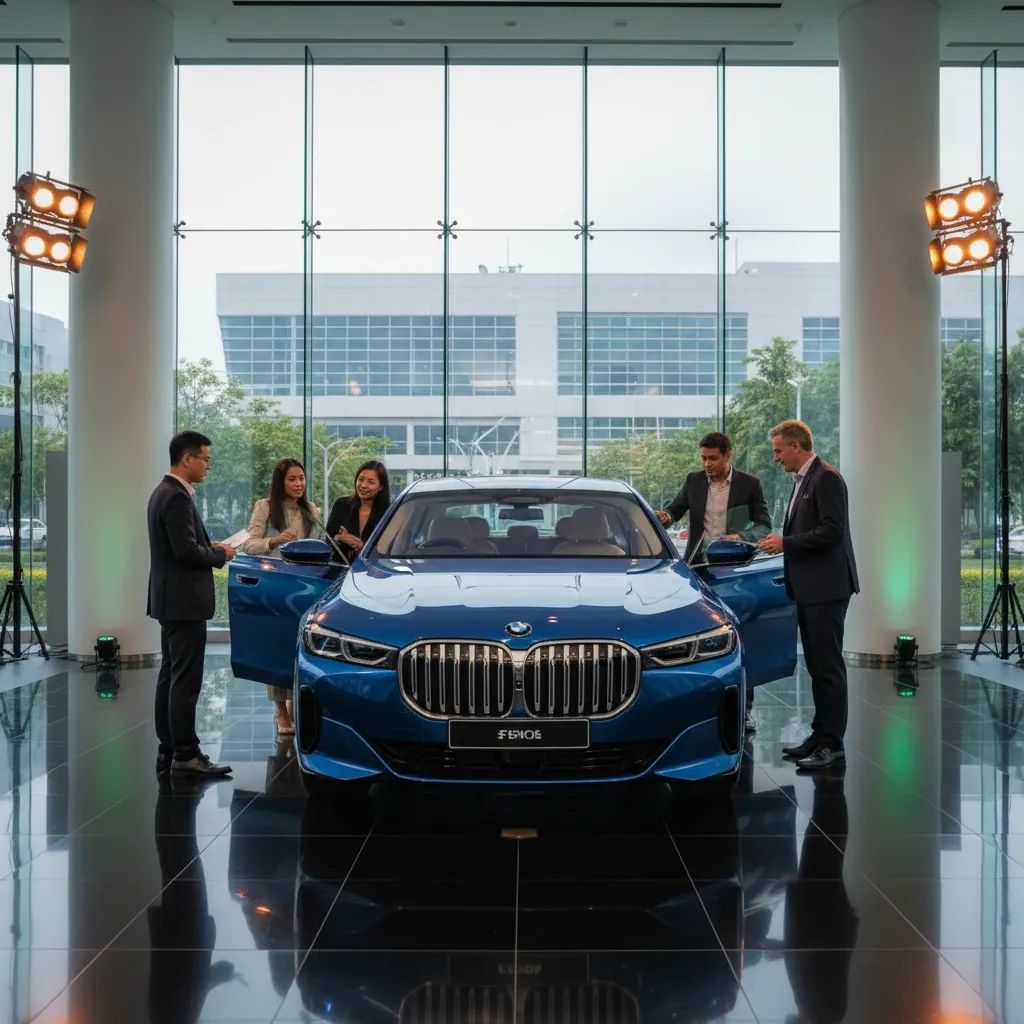
The Thailand BMW Group has revised its 2026 outlook for the premium automotive sector downward, citing escalating US-Iran tensions and resulting crude oil price volatility as the primary threat to what had been shaping up as a modest recovery for the nation's luxury car market.
Why This Matters
• Market projection shift: Premium car sales now forecast to remain flat in 2026, despite earlier optimism for single-digit growth.
• Oil price volatility: Geopolitical conflict in the Strait of Hormuz has pushed Brent crude toward $120 per barrel, impacting consumer purchasing power.
• EV strategy pivot: BMW itself expects double-digit sales growth domestically, betting on electric vehicle rollouts to counteract broader market headwinds.
• Local production expansion: The German automaker's Rayong battery plant is set to begin output in the second half of this year, supporting both domestic and export EV assembly.
What's noteworthy here is the sharp reversal. Earlier forecasts suggested the premium car market would bounce back modestly this year. Now, with oil prices spiking and geopolitical risks mounting, automakers are bracing for stagnation. While Thailand's automotive sector as a whole was projected to produce approximately 1.5 M units in 2026—a 3% uptick from 2025—the luxury side of things tells a different story.
Geopolitical Risk Reshapes Oil Markets
The conflict between the United States and Iran escalated sharply in February 2026, when joint airstrikes by Washington and Israeli forces triggered retaliatory threats from Tehran. Iran warned it would halt all Middle Eastern oil transit through the Strait of Hormuz if attacks continued, and shipping volumes through the corridor—responsible for over 20% of global oil and LNG exports—collapsed by an estimated 97%.
HSBC revised its Brent crude average forecast for 2026 upward to $80 per barrel, though spot prices have spiked well beyond that level during acute phases of the standoff. The Kasikorn Research Center projects a range of $75–90 per barrel for the full year, assuming the strait remains partially closed for one to three months. In a worst-case scenario, prices could breach $140 per barrel, according to some analysts.
For Thailand, which imports roughly 70% of its energy needs—with more than 60% of that volume transiting the Hormuz chokepoint—the implications are direct and immediate. Diesel prices above ฿33 per liter would lift transport costs by 5–12% and push general consumer prices up by an estimated 3–5%, crimping discretionary spending across the economy.
Premium Segment Caught in Crosscurrents
Luxury vehicles occupy a precarious market position. They're not daily necessities like a commuter sedan—they're lifestyle choices and status symbols. That makes them the first casualty when wallets tighten. Thailand's premium car market shrank by approximately 25% in 2024, falling from 40,000 units in 2023 to around 30,000 units. Registrations in 2025 declined a further 8.1% to 31,734 units, reflecting persistent challenges with household debt, tight auto finance approval standards, and weak purchasing power.
BMW Group Thailand acknowledged these headwinds in its latest guidance. While the company retained its position as the country's leading premium marque for the sixth consecutive year in 2025—holding a combined 47% market share for the BMW and MINI brands with 12,247 registrations—executives now anticipate the broader luxury segment will plateau in 2026 rather than expand. But here's where things get interesting: the company's own outlook paints a starkly different picture from the market as a whole. BMW projects double-digit domestic sales growth this year, underpinned by aggressive new model introductions and a strategic pivot toward electrification.
Electric Powertrains Drive BMW's Counter-Strategy
Battery electric vehicles have become the cornerstone of BMW's growth strategy in Thailand. Last year told a striking story: combined BEV deliveries for BMW and MINI surged 43% year-on-year, with the two brands controlling nearly 45% of the premium electric market. BMW alone delivered 1,261 BEVs—roughly a quarter of all premium electric registrations—while MINI's BEV sales skyrocketed 372% to 1,104 units, capturing a significant slice of the niche market.
This year, the automaker plans to launch the BMW i5 eDrive40 M Sport, a locally assembled sedan expected to feature enhanced driving range and distinctive design elements. The move signals a calculated bet that domestic assembly will improve price competitiveness and supply chain resilience. MINI enthusiasts can also expect several limited-edition models throughout 2026, tailored to niche tastes within the Thai market.
Critically, BMW is doubling down on local manufacturing infrastructure. The company broke ground on a fifth-generation high-voltage battery plant in Rayong in March 2024, with production slated to commence in the latter half of this year. The facility will supply both BEVs and plug-in hybrid electric vehicles (PHEVs) for domestic sale and export, positioning Thailand as a regional hub for BMW's electrification push in Southeast Asia.
What This Means for Residents
For drivers and potential buyers living in Thailand, the immediate takeaway is straightforward: fuel costs are likely to remain elevated through at least mid-2026, making internal combustion engine vehicles more expensive to operate, while EV and hybrid options gain relative appeal—particularly if government incentives under programs like EV 3.5 remain in place.
But the picture is complicated. Consumer surveys reveal lingering hesitation. A Deloitte poll in August 2025 found that 32% of Thai respondents had renewed interest in conventional gasoline vehicles, with 36% intending to purchase an ICE car as their next vehicle. Plug-in hybrids garnered 21% interest, while BEVs attracted 20%, reflecting concerns over upfront costs, charging infrastructure, and range anxiety despite expanding public charging networks.
For those eyeing premium brands, the flat market forecast suggests negotiating leverage may improve as dealerships work harder to move inventory. Buyers willing to embrace electrification may also benefit from promotional pricing as automakers like BMW vie for early adopters in the transition period.
Industry-Wide Implications
The Thailand Federation of Industries expects overall automotive production to reach 1.5 M units in 2026, split between roughly 950,000 units for export and 550,000 for domestic sales. While the sector has passed its 2025 nadir, recovery remains uneven, concentrated in SUVs and xEV segments rather than distributed across all vehicle classes.
BEV registrations are projected to hit 125,000 units annually between 2026 and 2028, driven by Chinese brands like BYD, OMODA & JAECOO, and GAC AION, which have established robust local manufacturing and distribution. The Royal Thai Customs Department and industry observers note that charging infrastructure expansion and advances in battery technology—faster charging, longer range—continue to bolster confidence, even as some international markets slow their EV rollouts.
Yet the Thailand luxury segment remains exposed to external shocks in ways that mass-market brands are not. Affluent buyers are sensitive to volatility in equity markets, real estate values, and business confidence, all of which fluctuate with oil prices and geopolitical risk. Moreover, financing for high-ticket purchases can tighten swiftly when lenders grow cautious about borrower balance sheets.
The Road Ahead
BMW's strategy—betting on localized EV production and aggressive new model cadence—offers a blueprint for how premium brands might navigate turbulence. By anchoring supply chains closer to end markets and emphasizing total cost of ownership rather than sticker price alone, the automaker aims to insulate itself from the commodity price swings that threaten less nimble competitors.
For Thailand's automotive ecosystem, the next 12 months will test whether electrification momentum can offset macroeconomic drag. If oil prices stabilize below $90 per barrel and the Strait of Hormuz remains navigable, the premium segment may surprise to the upside. But if conflict intensifies or China's economy falters—dampening both tourist arrivals and export demand—even BMW's ambitious growth targets could prove elusive.
Residents considering a vehicle purchase in 2026 should weigh fuel efficiency, charging access, and resale value more carefully than in previous years. The era of stable, predictable energy costs has ended, and the premium car market—long a barometer of consumer confidence—is adjusting in real time.


