
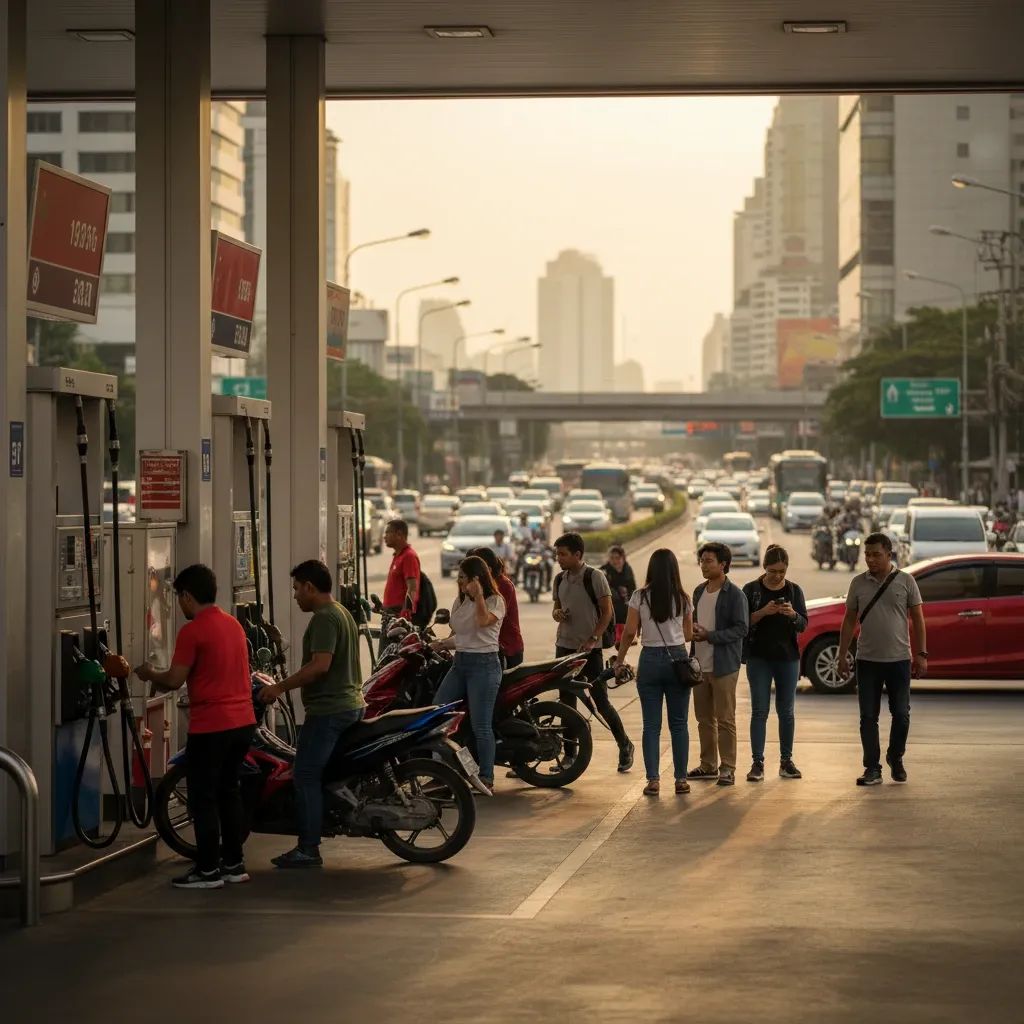
Thailand faces immediate economic pressure this week as Middle Eastern tensions drive up fuel prices and disrupt flights. By Wednesday, March 4, petrol prices are expected to spike sharply. At the same time, major airports including Suvarnabhumi and Phuket are reporting cascading flight cancellations and diversions. For people living and working in Thailand, this convergence means higher costs and travel disruptions starting now.
Why This Matters
• Your fuel costs are rising: Mark March 4 as the most likely price adjustment date, when petrol station pumps sync with global oil movements. Diesel approaches or exceeds 100 USD per barrel from 92 USD just days earlier.
• Thailand's energy reserves are thin: Current stockpiles equal only 61 days of national consumption—well below the 90-day international safety standard. A sustained supply disruption would stress the system rapidly.
• Middle East hubs are unreliable: Hub airports in Dubai and Doha, which connect Europe and the Americas to Thailand, are experiencing hundreds of daily cancellations. This affects both inbound tourism and outbound travelers.
Energy Security: The Core Problem
Thailand operates with a structural energy deficit that recent geopolitical events have exposed. The kingdom imports approximately 80% to 85% of its crude oil, with the vast majority sourced directly from the Persian Gulf region. This geographic concentration creates a vulnerability: disruptions in the Strait of Hormuz, which handles roughly 20% of the world's daily crude output (approximately 20 million barrels), directly compromise Thailand's energy supply.
How Prices Move
Domestic pricing architecture adds another layer. The Thailand Ministry of Commerce operates a formula that ties retail prices to global benchmarks with a built-in lag of roughly 24 hours. This mechanism prevents panic buying but also means prices react predictably. On Monday, March 2, no material adjustment will occur because stations reference Friday's global close. Tuesday, March 3, is a public holiday in Thailand, so recalibration is administratively unfeasible. By Wednesday morning, the cumulative impact of the week's geopolitical developments will translate into higher prices at every petrol pump across the country.
Thailand's Energy Reserves
Thailand currently maintains 7,795 million liters of combined crude and refined product reserves: 4,925 million liters physically located in-country, 1,746 million liters already in transit beyond the Hormuz chokepoint, and 1,124 million liters sourced from alternative suppliers. This totals 61 days of consumption—a comfortable buffer in stable markets but a concerning threshold during prolonged crises. The International Energy Agency recommends member economies maintain 90 days. Thailand falls 29 days short, a gap the government has attempted to address through the proposed Strategic Petroleum Reserve (SPR) system, but implementation remains projected between 2026 and 2037.
Government Policy Constraints
The immediate constraint is legal. Thailand's energy security currently relies on mandatory commercial reserves maintained by private refiners and distributors, who are required to hold 25 to 30 days of supply. However, the government cannot requisition these private stockpiles except under formal emergency declaration. This creates policy gridlock during limited but prolonged disruptions. The government retains other levers like fuel price subsidies, excise tax reductions, and biofuel blending adjustments, but each involves fiscal cost or operational complexity that makes them short-term measures at best.
Oil Prices and What They Mean
Brent crude closed at approximately 73 USD per barrel on February 27, representing a 3% jump from just days earlier and a 20% increase from the year's opening level of 61 USD. Diesel hovered near 92 USD per barrel on February 28. Analysts holding moderate assumptions forecast Brent stabilizing around 80 USD per barrel if tensions remain contained. However, if regional instability expands, the trajectory extends toward 100 to 110 USD per barrel, territory last visited during the 2008 global financial crisis.
Shipping Routes Under Pressure
The Red Sea and Suez Canal corridor presents a secondary vulnerability. This route carries approximately 12% of global trade. Insurance premiums for fuel tankers using this corridor have surged between 50% to 140% per 40-foot container, forcing many operators to reroute around the Cape of Good Hope. This detour adds 10 to 15 days to transit times and substantially increases operational costs. Thailand's export-oriented economy depends heavily on this corridor; sustained delays compress profit margins across freight-sensitive sectors.
What This Means for Your Wallet and Daily Life
Public transport operators—from Bangkok's bus fleets to provincial intercity coaches—face pressure to absorb higher diesel costs or pass them to passengers through fare increases. Electricity bills will rise incrementally as Thailand's power generation fleet relies partially on fuel oil. Retail prices at supermarkets will climb, particularly for perishables requiring refrigeration and long-distance trucking. Restaurant menus may see subtle price adjustments. Delivery fees from e-commerce platforms and food services are likely to increase within 7 to 14 days if crude prices remain elevated.
Export and Trade Impacts
For commercial enterprises dependent on Middle Eastern markets, the outlook darkens. Thailand exports agricultural products, petrochemicals, electrical machinery, and textiles to the Gulf region. If the conflict persists for one to three months with airspace closures and maritime delays compounding, export revenue losses could reach 10,000 to 60,000 million baht, particularly for goods destined for Iran, Iraq, Saudi Arabia, and the UAE.
Tourism Takes a Hit
Tourism faces dual pressures. Middle Eastern hubs like Dubai and Doha are both source markets for Thai visitors and essential connection points for Europeans and Americans. Airspace closures, flight cancellations, and rebooking delays deter discretionary travel. Medical tourism from the Gulf states—a significant revenue stream for Thai private hospitals—is experiencing cancellations. A 20% to 30% decline in inbound tourism from these markets over the next two months is plausible if the crisis persists.
Currency and Financial Markets
The US dollar typically strengthens during geopolitical crises as investors seek safe-haven assets. A stronger dollar weakens the Thai baht, which cuts both ways: import costs rise (compounding the energy problem), but export revenues improve when converted back to baht. Thai equity markets have already softened on global risk aversion, while gold prices have climbed.
Aviation Sector Under Stress
Thailand's aviation infrastructure is absorbing cascading pressures. Since Saturday, February 29, major airports including Suvarnabhumi and Phuket have processed 54 flight disruptions—a mix of cancellations, diversions, and turnarounds. On March 1 alone, Phuket Airport recorded 15 flights from four carriers—Qatar Airways, Etihad Airways, Air Arabia, and private operators—either diverted or grounded. An Etihad flight from Phuket to Abu Dhabi executed a mid-air turnaround on February 28 as Abu Dhabi's airspace closed.
Thai Carriers' Response
Thai Airways has proactively reconfigured its European-bound routes to avoid Pakistani and Afghan airspace, adding approximately 20 minutes per flight. The carrier states its current routing avoids Israeli and Iranian territory directly, and fuel surcharges remain manageable at present levels. However, the airline is closely monitoring further airspace closures; should Iraq or Kuwait restrict transits, the carrier faces additional routing complications and fuel cost increases.
Regional Airline Cancellations
Regional carriers have implemented more drastic measures. Japan Airlines suspended its Tokyo-Doha route entirely. Pakistan International Airlines ceased all Middle Eastern services. IndiGo, Air India, and Air India Express collectively canceled or rerouted more than 72 flights between February 28 and March 7, with some suspensions extended through March 28. Vietnam Airlines rerouted all Europe-bound services, adding operational complexity and fuel expenses.
The Human Cost
Passengers connecting from Europe, North America, and Africa to Thailand face multi-day rebooking delays, missed onward connections, and inflated alternative routing costs. A traveler who missed a connection in Doha reported being stranded for three days with limited rerouting options, ultimately costing 80,000 baht in additional hotels and flights.
Government Response Framework
The Thailand Cabinet has deployed fuel price management mechanisms during previous energy shocks. Fuel price subsidies for LPG and diesel can cushion consumers but require fiscal appropriations. Excise tax reductions on fuel provide direct price relief but compress government revenue. Biofuel blending ratio adjustments stretch available refined product supply but sacrifice renewable energy commitments.
The Thailand Energy Ministry is simultaneously assessing alternative sourcing from African, Russian, and other non-Middle Eastern suppliers, though logistics and pricing make these expensive and time-consuming to activate. LNG receiving terminals and floating regasification units (FSRUs) are being evaluated for capacity to absorb alternative shipments.
Practical Actions for the Week Ahead
For motorists and commuters:
• Refuel by Tuesday evening, March 3. Prices are most likely to spike Wednesday morning and persist through the following week.
• Budget an additional 200 to 500 baht per fill-up if prices climb as expected.
• Those with access to fuel cards or fleet accounts should verify supplier policies and lock rates if possible.
For air travelers:
• Check flight status constantly if you have bookings through Gulf hubs—Qatar Airways, Emirates, Etihad.
• Call the airline directly; website information lags real-time changes by hours.
• Build at least 24 hours of buffer time into your itinerary.
• If rebooking becomes necessary, act immediately; alternative routing is scarce and expensive.
• Those traveling March 4 to 10 face the highest risk of disruption.
For supply-chain dependent businesses:
• Alert suppliers and customers immediately about potential cost increases and transit delays.
• Goods moving by truck face higher insurance premiums and tighter schedules.
• Those with shipments transiting the Red Sea or Suez Canal should explore rerouting options now.
• Procurement teams should activate alternative suppliers for time-sensitive inputs.
For households:
• Prepare for incremental increases in utility bills, grocery prices (especially perishables), and delivery charges over the coming two to four weeks.
• Restaurant visits may become noticeably more expensive.
• Those dependent on public transport should budget accordingly; fare increases are likely.
What Comes Next
Energy officials are explicit about what drives outcomes in the coming days: not whether tensions will ease, but whether additional actors will enter the conflict. Current monitoring focuses on tanker traffic through the Strait of Hormuz and the Red Sea, insurance premium movements, and airspace closure announcements by additional countries.
For Thailand, this translates to a holding pattern. The country is adequately provisioned for 61 days under normal consumption but vulnerable to even moderate supply disruption beyond that window. March 4 offers the first definitive signal of how sharply domestic fuel costs will respond. What unfolds after that date depends on whether global diplomacy succeeds in containing the conflict or whether the Middle East crisis expands further.
The week beginning March 2 is a critical juncture. The outcome will reshape energy costs, inflation expectations, and consumer behavior across Thailand for months ahead.


