
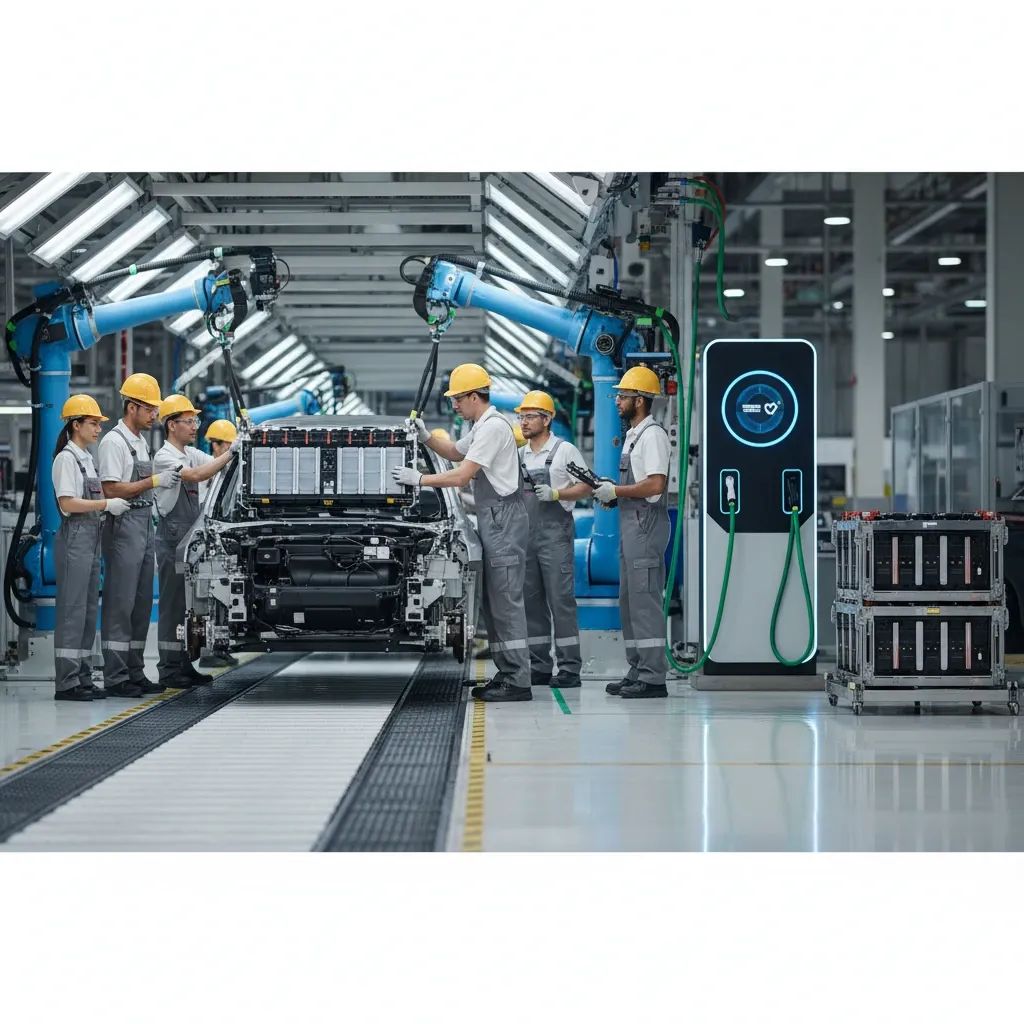
Thailand's car industry is facing two major challenges simultaneously: the baht is getting stronger, making Thai-made vehicles more expensive on global markets, and the government is pushing factories to build more electric vehicles for domestic buyers instead of exporting conventional cars. The impact is already visible—in January 2026, Thailand shipped just 58,405 vehicles overseas, the worst performance in nearly four years. This signals a fundamental shift in how Thailand's automotive sector will operate.
Why This Matters for Residents
Here's what's actually changing and how it affects you:
• Thai-made cars are becoming pricier to export—but cheaper to buy locally: The baht strengthened about 1.1% against the US dollar in early 2026 alone, extending a 9% gain throughout 2025. This makes Thai exports costlier for foreign buyers but allows the government to redirect factory capacity toward domestic EV production with subsidies reaching 50,000 baht.
• New tax rules are reshaping vehicle costs dramatically: Starting January 1, 2026, imported electric vehicles now face a 10% excise tax (up from 2%), making foreign EVs significantly more expensive. Meanwhile, Thai-assembled EVs get subsidies and tax breaks. A conventional pickup truck now faces regulatory headwinds globally while domestically competing against cheaper electrified alternatives.
• Government policy is mandating factories produce more EVs locally: The EV 3.5 policy requires manufacturers to assemble at least two domestic electric vehicles for every imported unit through 2026, escalating to 3-to-1 by 2027. This forces factories to shift production away from export-focused conventional cars toward domestic EV assembly.
Immediate Price and Purchasing Timeline
If you're planning to buy a car in Thailand, these timelines matter:
| Vehicle Type | Current Price Range | Projected 2027 Price | Key Deadline ||---|---|---|---|| Thai-assembled EV | 500,000-600,000 baht | 400,000-450,000 baht | Prices falling as competition increases || Imported EV | 800,000 baht (example) | 880,000+ baht | 10% tax takes full effect now || Conventional imported vehicle | Baseline | +10-12% increase | Before June 2026 if buying imported |
Action items for residents: If you're considering an imported vehicle (whether electric or gasoline), purchasing before mid-2026 saves you substantially on excise taxes. If you're flexible on vehicle type, waiting 12-18 months will bring Thai-assembled EVs to significantly lower price points as production scales and competition intensifies.
The Global Competitive Picture
A walk through Southeast Asia's automotive landscape shows how Thailand's position has shifted. In Indonesia, the rupiah weakened nearly 2% in January alone, pushing the currency toward 16,985 per US dollar. This currency advantage, combined with lower manufacturing costs, is fueling record exports—Indonesia shipped 518,000 completely built-up vehicles last year, an all-time record, with momentum continuing into 2026.
Vietnam's automotive sector operates differently. The nation's auto sales are projected to decline 3.7% in 2026, with export growth concentrated in electronics and technology rather than vehicles. For Thai planners, this creates an uncomfortable reality: Indonesia is accelerating with currency tailwinds precisely when Thai appreciation is working in the opposite direction.
How Government Tax and Subsidy Rules Work
The Thailand Excise Department fundamentally restructured vehicle taxation effective January 1, 2026. Here's what residents need to understand:
Electric vehicles: Thai-assembled EVs qualify for subsidies up to 50,000 baht plus tax incentives. Imported EVs now face a 10% excise tax—a fivefold increase from the previous 2% rate.
Plug-in hybrids: Models with less than 80 kilometers of electric-only range incur a 10% tax. Longer-range PHEVs receive a favorable 5% treatment.
Conventional vehicles: These face increasing regulatory pressure both domestically and in export markets due to emissions standards.
This architecture was deliberately designed to accomplish two things simultaneously: discourage export-focused conventional vehicle manufacturing while channeling factory investment toward domestic EV assembly. Australia's stricter carbon emission standards introduced in mid-2025 provided international cover for what was fundamentally a domestic industrial policy decision.
What This Means for Residents: Employment and the Used Car Market
The immediate consequence for car shoppers: Thai-assembled electric vehicles will become cheaper and more abundant as manufacturing volume scales. Conversely, imported vehicles will become markedly more expensive due to new tax structures.
Employment implications deserve serious attention. Factory workers accustomed to conventional vehicle assembly face retraining requirements or potential displacement as production lines transition toward battery assembly and electric powertrain manufacturing. These roles demand different technical skills and different wage structures. The Federation of Thai Industries (FTI) projects domestic manufacturing will expand by approximately 50,000 units in 2026, almost exclusively electric vehicles. But that growth masks significant internal restructuring and job category transformation.
Used car market impact: Conventional vehicles are being liquidated before regulatory pressure further restricts their marketability. If you own a conventional car, resale values may face downward pressure within 12-18 months as the market transitions toward electrified options. Electric vehicle resale values should strengthen as demand for secondhand EVs increases and domestic supply of new EVs becomes abundant.
Current car owners: No immediate action is required if you own a conventional vehicle. However, if you're considering trading in or selling, timing becomes strategic—sooner is generally better before regulatory headwinds further depress conventional vehicle values.
How Thailand's Major Automakers Are Responding
Major manufacturers are placing enormous bets on electrification while recalibrating geographic export strategies.
Toyota Motor Thailand, the nation's largest producer, is targeting a 19% export increase for 2026, aiming for 425,000 vehicles despite January's contraction. The company is shifting geographic focus away from Australia and Europe toward Asia and Middle Eastern markets where regulatory pressure remains comparatively lenient. In November 2025, Toyota unveiled the Hilux Travo and Hilux Travo-e electric pickups, signaling deliberate entrance into electrified light commercial vehicles.
Mazda is committing over 5 billion baht to position Thailand as a global production hub for mild hybrid electric vehicle B-SUVs (mid-size sport utility vehicles), with assembly commencing mid-2027. The company plans introducing five new electrified models and intends exporting more than 60% to Japan, Australia, New Zealand, and other ASEAN destinations.
Isuzu is pursuing vertical integration by already exporting its D-Max EV electric pickup to Europe, having commenced shipments to the UK and Australia in April 2025. Domestic D-Max EV production launches at the Samrong facility in 2026, while simultaneously investing in battery cell manufacturing to capture margins across the entire EV value chain.
Honda is consolidating production toward hybrid and electric drivetrains. The company plans at least four new model launches in 2026 spanning both hybrid and electric powertrains, with a redesigned "H mark" logo exclusively reserved for electrified offerings.
The Government's Incentive Structure
Thai policymakers anticipated that aggressive domestic EV mandates risked creating factory oversupply. They therefore constructed a sophisticated incentive system into the EV 3.5 framework: every vehicle produced for export now counts as 1.5 units toward a manufacturer's mandatory domestic assembly obligations. This mechanism subsidizes export production implicitly, allowing factories to maintain overseas shipments while simultaneously satisfying regulatory requirements for local content.
Battery sourcing rules add operational complexity. Until June 30, 2026, imported battery cells can still contribute to local content calculations, but their maximum value cannot exceed 10% of the vehicle's factory price. This timeline grants a grace period for transitioning from imported cells toward domestically produced batteries, acknowledging Thailand's current capacity constraints while betting on rapid manufacturing scale-up.
Looking Ahead: What 2026-2027 Holds
Thailand occupies an increasingly pressured competitive position within Southeast Asia's automotive landscape. Indonesia is leveraging currency depreciation and cost advantages to achieve record export volumes. Vietnam remains domestically oriented. Thailand's survival strategy depends on successfully transitioning from price-based competition toward innovation-based differentiation—winning with electrified pickup trucks, hybrid B-SUVs, and battery manufacturing, where engineering quality matters more than raw cost.
The FTI's 2026 export target of 950,000 units represents essentially flatness. But flatness in a market where Indonesia is accelerating means the baseline has fundamentally shifted. Meeting the target requires capturing market share through product innovation rather than competitive pricing.
For residents navigating these changes, the implications are multifaceted. Vehicle choice will expand for electric models as domestic competition intensifies, and pricing will become more rational as supply scales. The automotive employment base will evolve significantly—engineers, technicians, and managers will require retraining in EV technology. Factories themselves are becoming more automated and technology-intensive, which may ultimately mean fewer assembly line positions even as total manufacturing output remains stable.
Bottom line for Thai residents: If you're buying a car soon, timing matters considerably. Thai-assembled EVs will be substantially cheaper within 18 months. Imported vehicles face higher taxes now. Used conventional cars may face resale pressure, while used EVs should hold or gain value. And if you work in automotive manufacturing, retraining in electric vehicle technology and battery systems is becoming increasingly valuable.


