
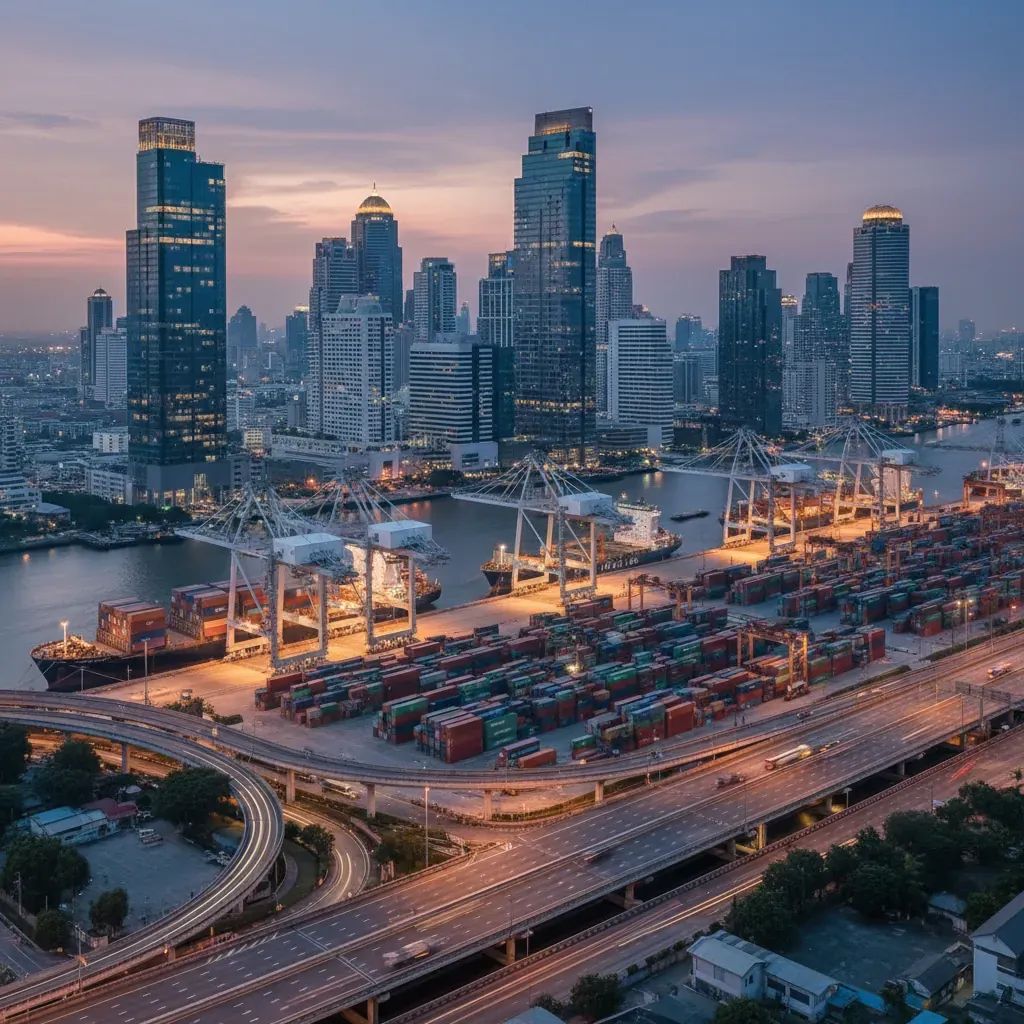
The Thailand economy faces mounting pressure from a military confrontation in the Gulf that has pushed Brent crude to $92.69 per barrel and effectively shuttered the world's most critical energy chokepoint. For residents, investors, and businesses operating across Southeast Asia, the escalating Iran-Israel conflict is no longer a distant headline—it's a direct threat to disposable income, manufacturing costs, and the viability of long-term investment plans.
Why This Matters
• Energy bills are climbing fast: Thailand's net oil imports equal 4.7% of GDP, making it one of Asia's most exposed economies to oil-price shocks
• Supply chains are fracturing: The Strait of Hormuz—through which 20% of global daily oil supply transits—has seen a "de facto closure" due to Iranian warnings and skyrocketing insurance premiums
• Inflation is accelerating: Rising fuel costs are driving up prices for food, transport, and electricity across the region
• Investment calculus has shifted: Multinational firms are reassessing market entry timelines and supply chain configurations across ASEAN
The Strait of Hormuz Chokepoint
The heart of the crisis lies 6,000 kilometers west of Bangkok, where the narrow Strait of Hormuz has become a flashpoint in the confrontation between Iran, the United States, and Israel. Since late February 2026, commercial shipping through the strait has ground to a near-halt. QatarEnergy has declared force majeure on liquefied natural gas shipments, stranding vessels in the Persian Gulf and forcing tankers to reroute around the Cape of Good Hope—a detour that adds weeks to transit times and imposes crippling "war risk" surcharges.
For Thailand and its ASEAN neighbors, which import roughly 60% of their oil from the Middle East, the disruption translates into immediate fiscal strain. The Thailand Ministry of Energy has been compelled to reassess fuel subsidy budgets as global benchmarks surge. A 10% rise in oil prices alone could worsen the current account balance by up to 0.5% of GDP for economies like Thailand and the Philippines, according to recent Goldman Sachs analysis. If the strait remains effectively closed for a full month, analysts project crude could breach $100 per barrel.
What This Means for Residents and Businesses
Higher energy costs cascade through the economy in predictable but painful ways. Transport operators in Bangkok and provincial centers are already absorbing elevated diesel prices, with inevitable pass-through to consumer goods. Electricity tariffs—partially indexed to fuel costs—are under upward pressure, squeezing household budgets and industrial margins alike.
For Thailand-based manufacturers, particularly those in export-oriented sectors like electronics and automotive parts, the twin pressures of rising energy bills and ballooning logistics costs are eroding competitiveness. Maritime insurance premiums have spiked, and extended transit times are expanding working capital requirements. A textile exporter in Chonburi or a food processor in Rayong must now account for weeks of additional inventory in transit, tying up cash and complicating delivery schedules.
Inflation is the most immediate threat to purchasing power. The Bank of Thailand faces a policy dilemma: rising import costs argue for maintaining current interest rates to anchor inflation expectations, yet a slowing global economy may demand monetary easing to support growth. Neighboring central banks in the Philippines and Indonesia are confronting similar trade-offs, with some analysts now forecasting delayed rate cuts or even hikes in Vietnam.
Rethinking ASEAN's Energy Architecture
The crisis has exposed a vulnerability that policymakers have long acknowledged but failed to address with sufficient urgency: ASEAN's dependence on Middle Eastern hydrocarbons. Even as the region pursues ambitious renewable energy targets under the ASEAN Plan of Action for Energy Cooperation (APAEC) 2026-2030, approximately 82% of energy demand is still projected to be met by fossil fuels through mid-century.
The APAEC framework, approved in October 2025, sets a goal of 30% renewables in the primary energy mix and 45% in installed power capacity by 2030. The conflict has served as a harsh stress test, revealing how quickly geopolitical instability can undermine energy security and fiscal stability.
Indonesia, Singapore, and Malaysia had already begun diversifying energy sources before the current crisis, exploring LNG suppliers beyond the Gulf and scaling up domestic renewable capacity. Thailand has prioritized domestic oil production and is actively seeking crude imports from unaffected regions. Yet switching suppliers mid-crisis is far from simple: refineries are configured for specific crude grades, existing long-term contracts carry termination penalties, and alternative suppliers may lack spare capacity.
The Nuclear and Coal Dilemma
One unexpected consequence of the LNG supply disruption is a renewed interest in nuclear energy as a stable, low-carbon baseload option. Indonesia and the Philippines are exploring Small Modular Reactors (SMRs) as part of a long-term diversification strategy. For Thailand, nuclear has historically been a politically sensitive topic, but the current crisis may shift public opinion if energy security concerns outweigh traditional resistance.
The more troubling short-term risk is a fallback to domestic coal infrastructure. ASEAN nations collectively possess substantial coal reserves, and the immediate imperative to keep factories running and lights on could tempt governments to extend the life of coal plants slated for retirement. This would stall decarbonization efforts and lock in higher emissions for years, undermining climate commitments and exposing the region to future carbon border adjustment mechanisms imposed by trading partners in Europe and North America.
Regional Integration Gains Momentum
The ASEAN Power Grid (APG), long discussed but slow to materialize, is suddenly gaining political momentum. The concept is straightforward: interconnect national grids to enable cross-border electricity trade, allowing hydropower-rich Laos or geothermal-abundant Indonesia to export surplus renewable electricity to energy-importing neighbors like Thailand and Singapore.
Implementation challenges remain formidable. Financing large-scale transmission infrastructure requires coordination among governments with divergent fiscal capacities and political priorities. Supply chain bottlenecks for high-voltage equipment and transformers, exacerbated by the same maritime disruptions affecting oil shipments, are delaying project timelines. Yet the strategic logic is compelling: a regionally integrated grid enhances resilience, smooths renewable intermittency, and reduces collective dependence on hydrocarbon imports.
Vietnam has emerged as a regional leader in solar and wind deployment, while Malaysia's hydropower sector accounts for 89% of its renewable electricity generation. Thailand is expanding solar capacity, including innovative floating solar installations suited to the country's tropical climate and abundant water bodies. The Philippines continues to leverage its geothermal resources, a legacy of volcanic geography that provides stable, dispatchable low-carbon power.
How Multinationals Are Recalibrating
For foreign investors and multinational corporations, the Iran crisis has fundamentally altered the risk-return calculus for market entry and supply chain positioning in ASEAN. Companies that once viewed the region as a stable, cost-competitive manufacturing platform now must account for heightened volatility in energy prices, logistics costs, and currency fluctuations.
Malaysia's high-value manufacturing sectors—particularly semiconductor packaging and electronics assembly—exhibit relative resilience due to product margins that can absorb moderate cost increases. Rapid relocation of these facilities remains unlikely. Vietnam's electronics manufacturing ecosystem, bolstered by years of "China Plus One" diversification, continues to attract investment despite maritime logistics disruptions.
However, capital-intensive sectors in energy-importing nations like Thailand and the Philippines are experiencing a noticeable slowdown in new project commitments. Investors are delaying final investment decisions, waiting for greater clarity on energy price trajectories and geopolitical stability.
Supply chain strategies are shifting toward multi-country redundancy. Rather than concentrating production in a single ASEAN hub, multinational firms are distributing operations across Thailand, Vietnam, Malaysia, and Indonesia, building in the ability to shift production if one location is disrupted. This approach increases capital expenditure and operational complexity but enhances resilience against both geopolitical shocks and localized disruptions like port congestion or natural disasters.
Companies with existing Gulf operations are in contingency mode, evacuating non-essential personnel and suspending projects in Iran and neighboring states. For Thailand-based firms with Middle Eastern exposure—particularly construction, engineering, and energy services companies—the crisis has forced painful decisions about contract obligations and employee safety.
Government Responses and Policy Tools
The Thailand Cabinet has limited policy levers to cushion the immediate impact. Temporary price caps on diesel and gasoline can prevent sharp spikes at the pump, but they deepen fiscal deficits and distort price signals that might otherwise encourage conservation and efficiency. The government is assisting exporters by negotiating bulk freight and insurance arrangements to mitigate rising logistics costs, though these measures offer only partial relief.
Longer-term policy responses must focus on accelerating the energy transition. This requires streamlining permitting processes for renewable projects, offering tax incentives for private investment in solar and wind, and expanding grid infrastructure to accommodate distributed generation. The Thailand Energy Regulatory Commission has a critical role in setting tariff structures that encourage efficiency without imposing undue burdens on low-income households.
Regional cooperation is equally vital. Cambodia's government has emphasized the need for deeper economic integration and collective efforts to diversify energy sources. Joint procurement of LNG cargoes, coordinated strategic petroleum reserves, and harmonized renewable energy standards can enhance bargaining power and reduce individual country vulnerability.
The Road Ahead
The conflict shows no signs of immmediate resolution, and energy markets are pricing in prolonged uncertainty. For residents of Thailand, the implications are tangible: higher transport costs, elevated grocery bills, and potential disruptions to electricity supply during peak demand periods. For businesses, the challenge is to maintain competitiveness while absorbing cost increases that cannot easily be passed on to price-sensitive consumers.
The crisis also presents an opportunity. Thailand and ASEAN can accelerate a transition that was already underway, using the current shock as political justification for difficult but necessary reforms. Phasing out fuel subsidies, investing in public transport electrification, and fast-tracking renewable energy deployment will enhance long-term resilience and reduce exposure to future geopolitical volatility.
The next 12 months will test the region's adaptability. If oil prices stabilize below $100 per barrel and shipping through the Strait of Hormuz gradually resumes, the immediate crisis may ease. But the underlying vulnerability will remain until ASEAN reduces its structural dependence on Middle Eastern energy. For investors, policymakers, and residents alike, the message is clear: the cost of inaction now exceeds the cost of transition.


