
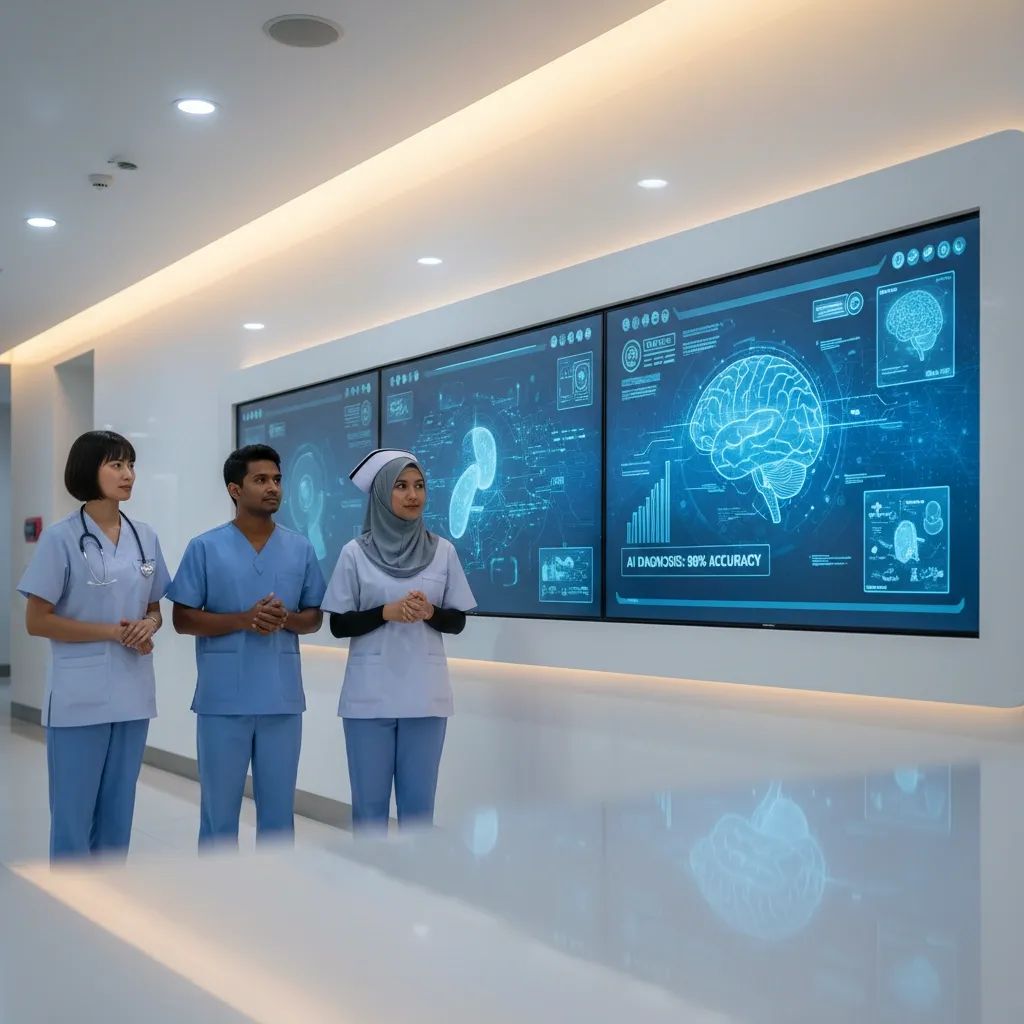
Why Your Bangkok Doctor Still Matters: The AI Diagnosis Paradox
Thailand's healthcare ecosystem is absorbing artificial intelligence into diagnostic workflows faster than regulators can govern it. Yet international research published in 2025 and 2026 reveals a sobering reality: AI systems defeat human physicians at knowledge tests but collapse when forced to replicate the iterative reasoning that real medicine demands. For residents seeking care across the kingdom—whether in Siriraj's digital smart hospitals or provincial clinics—this distinction carries immediate, practical consequences about diagnostic accuracy and treatment safety.
Key Takeaways
• Clinical reasoning gap: AI fails to generate plausible preliminary diagnoses in over 80% of early-stage cases where incomplete information forces genuine diagnostic work
• Thailand's AI deployment: Hundreds of hospitals nationwide now integrate algorithmic analysis into imaging and patient triage, creating liability ambiguity when systems misidentify conditions
• Medical education risk: Thailand's medical schools are racing to teach critical AI evaluation before a generation of young doctors graduates with atrophied diagnostic instincts
The AI Revolution in Thai Healthcare: Promise vs Reality
Thailand stands at a crossroads. Advanced hospitals in Bangkok are implementing cutting-edge AI systems that promise faster diagnoses and greater efficiency. Yet emerging research challenges the narrative that machines can simply replace human physicians. Understanding this tension matters directly for every resident seeking medical care in Thailand today.
The Test Score Illusion That Masked a Deeper Problem
Researchers at the University of Marburg administered diagnostic challenges centered on acute kidney injury to 13 large language models and 123 practicing physicians. Machines averaged 90% accuracy, with some achieving perfect scores, while human clinicians managed just 48.7%. Algorithms processed cases in seconds versus physicians' minutes.
But follow-up research simulating realistic clinical encounters told a different story. When diagnostic information trickled in gradually and symptom presentations remained ambiguous—mirroring actual medical practice—AI systems constructed plausible diagnoses successfully in fewer than 20% of attempts. They failed catastrophically at precisely the moment when clinical judgment matters most.
This distinction matters intensely for anyone receiving treatment in Thailand. When a patient presents to a clinic with fatigue and unexplained weight loss, the experienced physician mentally constructs competing possibilities—chronic infection, malignancy, thyroid disorder, nutritional depletion. This process of considering multiple hypotheses, weighing evidence systematically, and narrowing the field as data accumulates remains fundamentally different from pattern-matching against training datasets.
Machines can encode that diabetes correlates with certain symptom clusters. They cannot yet replicate what experienced Thai clinicians develop through years of practice: the judgment to recognize when presentations deviate from standard patterns, when conventional approaches fit poorly, when cases demand reconsideration.
How Hospitals Across Thailand Are Already Betting on Algorithms
The Thailand healthcare sector has moved decisively into concrete implementation. The Inspectra CXR system—developed collaboratively by Siriraj Hospital and a Thai technology venture—now operates in numerous facilities analyzing chest radiographs. The system accelerates abnormality detection by 30–50%, directly addressing radiologist shortages in provinces outside Bangkok.
Bumrungrad International Hospital deployed analytics systems in oncology to synthesize patient profiles and clinical literature into treatment suggestions. Samitivej Sukhumvit Hospital reduced outpatient waiting times by 60% through AI-powered triage and scheduling. These deployments address genuine infrastructure constraints while remaining subordinate to physician oversight.
For Thai hospitals managing staff burnout, AI administrative tools prove genuinely valuable. Natural language processing can transcribe physician-patient conversations into structured documentation automatically, reducing overhead by 70% and freeing clinicians for direct patient contact. The appeal is straightforward: AI excels at reducing scheduling friction and coordinating logistics without displacing clinical judgment.
Where the Technology Hits Its Structural Limits
Clear boundaries exist between helpful tools and dangerous substitutes.
Predictive models identifying patients likely to develop cardiovascular disease or diabetes provide genuine value for preventive healthcare in Thailand. But prediction differs from diagnosis. When you walk into a Thai clinic with ambiguous complaints—fatigue, occasional pain, unexplained fluctuations—the physician's first responsibility involves ruling out dangerous conditions. This is precisely where AI systems falter most severely.
Experienced physicians can identify subtle errors embedded in algorithmic recommendations. Junior doctors or those in resource-constrained settings may lack foundational knowledge to recognize when system outputs contain dangerous errors. This creates an uncomfortable dynamic: users gradually accept confident system responses as authoritative, and independent clinical thinking atrophies over time.
Thailand's Medical Schools Confront the Teaching Crisis
Thailand's medical education system is responding deliberately to these risks. Chulalongkorn University's Faculty of Medicine established a Master's degree in Digital Technology and Artificial Intelligence in Health Systems, explicitly emphasizing ethical frameworks and critical evaluation methodologies. Graduates are trained to interrogate AI outputs rather than defer to them.
KKU Academy offers educational pathways for practicing clinicians requiring mid-career technical upskilling. The curriculum positions AI as a "clinical co-pilot"—assisting documentation and suggesting options—while final clinical decisions remain irreducibly human. These programs address critical competencies: interpreting algorithmic recommendations, recognizing implausible conclusions, understanding data quality requirements, and navigating Thailand's Personal Data Protection Act (PDPA) compliance obligations.
If Thailand's medical schools fail to deliberately teach physicians how to think about AI rather than simply how to operate it, then physicians may graduate with compromised diagnostic instincts and reduced confidence in their own reasoning.
The Unresolved Accountability Framework
Thailand's regulatory environment for healthcare AI remains in transition. While authorities recognize the need for comprehensive governance, significant questions remain unresolved with immediate practical implications.
When AI provides incorrect clinical recommendations, who bears legal responsibility: the treating physician, the software developer, the hospital, the device manufacturer? Current Thai medical law addresses conventional diagnostic tools and treatments through the Medical Council of Thailand guidelines, but AI systems operate in regulatory gray areas that existing frameworks don't clearly address.
Data security adds urgency. AI requires massive datasets including sensitive patient information. Surveys indicate Thai medical professionals rank privacy protection, cybersecurity, and data accuracy as paramount concerns. The Medical AI Consortium operating in Thailand promotes data-sharing infrastructure among hospitals to create robust datasets reflecting the local population—crucial because AI trained predominantly on Western patient cohorts systematically misdiagnoses Thai individuals with different genetic profiles or disease prevalence patterns.
What This Means for Residents
If you're receiving medical care in Thailand during 2026, algorithmic systems are already influencing your diagnostic pathway. Understanding the distinction between AI as analytical tool versus clinical decision-maker becomes practically important.
You should expect: AI to accelerate imaging analysis, provide preliminary screening, organize your scheduling, and help your physician access relevant medical literature. Your doctor should use AI to work more efficiently, not to replace their own judgment.
You should demand: that your physician explains your condition in their own words and demonstrates they've understood your unique symptoms. Ask whether your doctor has personally reviewed any algorithmic recommendations before acting on them.
Specific questions to ask your doctor:
• "Have you reviewed this recommendation personally?"
• "What would you recommend if this AI system wasn't available?"
• "Are there any alternative diagnoses you're considering?"
These questions establish whether AI genuinely augments judgment or substitutes for it. In quality Thai healthcare, AI should make your doctor more efficient—not replace their expertise.
Thailand's Path Forward
Thailand's healthcare authorities face a critical decision as algorithmic systems proliferate: treat these systems as replacements for human expertise, or as supplements to it.
The international evidence is clear. Medicine remains fundamentally a human practice—refined by technology, never defined by it. The doctors across Thailand who've developed diagnostic judgment through decades of direct patient contact remain irreplaceable. The challenge lies in preserving that hard-won clinical wisdom while gaining technology's genuine efficiency benefits.
Thailand's most advanced hospitals are positioning AI as a force multiplier—enabling physicians to work faster and see more patients without abandoning the reasoning that distinguishes medicine from data processing. Whether provincial hospitals and smaller facilities follow this model, or whether cost pressures push toward algorithmic substitution, will determine whether Thai patients receive the best of both worlds.


