
Why This Matters
• Overstaying a visa now carries real consequences. Immigration databases automatically cross-check against Interpol records, meaning even minor infractions can escalate into detention if your name appears on an international watchlist.
• Luxury properties in tourist zones are under increased scrutiny. Foreign criminal networks increasingly use high-end rentals as operational bases, prompting enhanced police surveillance and landlord screening requirements.
• Extradition procedures have accelerated. Thailand now processes domestic charges first, then coordinates deportation through established legal frameworks, streamlining what was once a prolonged diplomatic process.
Swedish Fugitive Captured in Andaman Resort Town
A suspected Nordic crime boss was apprehended on April 9 by agents from Thailand's Immigration Bureau and local police at an upscale condominium in Phuket. The arrest marks a significant enforcement action against transnational organized crime networks that have increasingly used Thailand as an operational headquarters rather than a mere transit point.
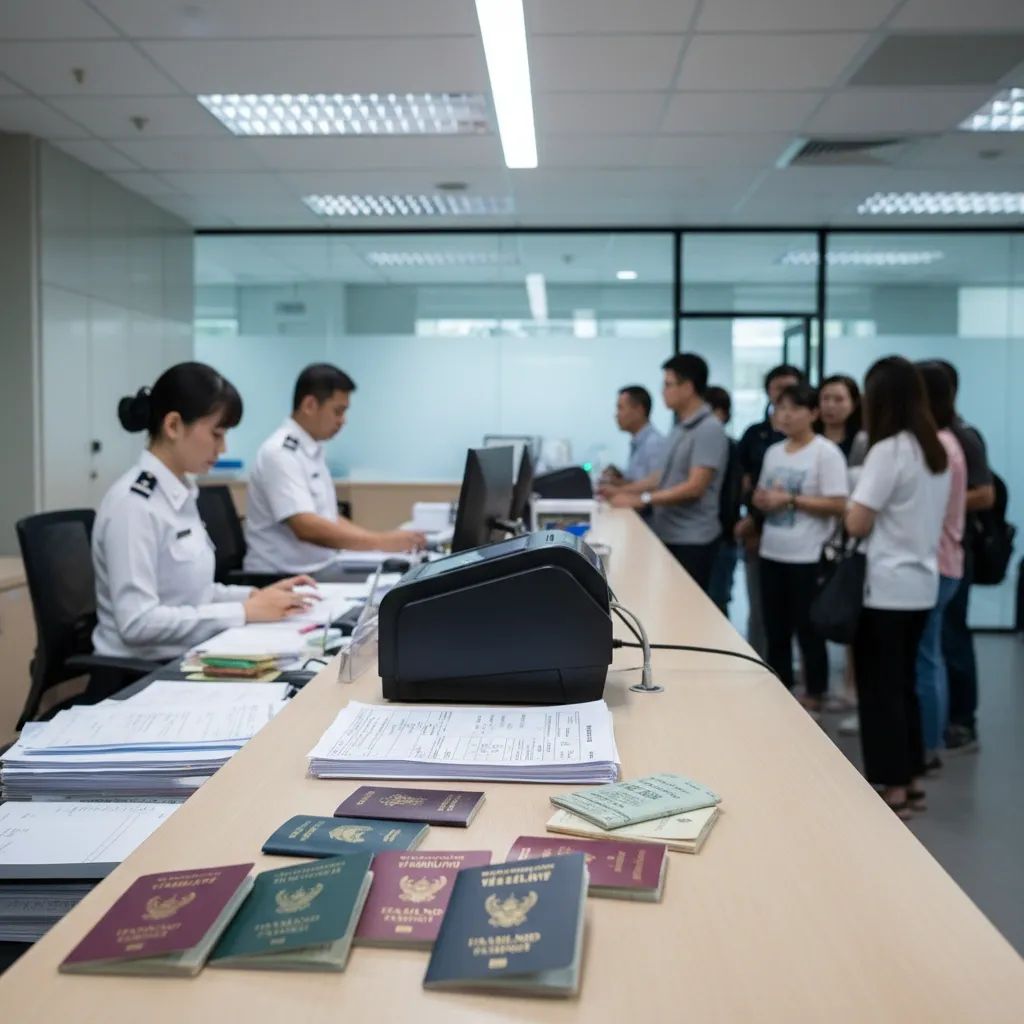
The suspect, a Swedish national identified as Mr. Boran, had entered Thailand through a standard 30-day tourist visa on January 4. He remained in the country six days beyond his permitted stay when the automated system flagged the violation and cross-referenced his name against Thailand's Interpol database. That database contained a Red Notice issued on March 9 by Swedish authorities, which formally alerted law enforcement across all 195 Interpol member nations to his whereabouts.
Within hours of confirmation, immigration officers coordinated with police units to execute the arrest. The speed of the operation reflected a wider institutional shift: Thailand's enforcement agencies now operate with substantially tighter synchronization than existed even three years ago, particularly when international warrants are involved.
Understanding the Red Notice Framework
A Red Notice functions as a global alert mechanism rather than an enforceable international arrest warrant. The distinction matters legally. Interpol's General Secretariat, headquartered in Lyon, France, must review and authorize each request before circulation. The originating country—Sweden in this case—submits evidence that a domestic court has issued an arrest warrant or delivered a conviction judgment.
Interpol's review committee applies rigorous constitutional standards. A Red Notice cannot be politically, militarily, racially, or religiously motivated. The alleged conduct must constitute serious criminality recognized under international law. Requests failing these tests are rejected outright.
In Mr. Boran's instance, Swedish prosecutors documented his involvement in a September 17, 2020 murder in Arsta, a Stockholm residential district. He was allegedly armed during the incident—a homicide classified as gang violence. Beyond that single murder, Swedish law enforcement identified him as a key participant in transnational drug trafficking operations, involvement in money laundering schemes, and coordination of violent crime spanning Nordic jurisdictions.
Once circulated, the Red Notice reaches National Central Bureaus maintained by each member nation—in Thailand's case, the Bureau within the Royal Thai Police's Foreign Affairs Division. Immigration checkpoints, airport gates, and seaport terminals receive continuous updates. Modern border systems now query these listings in near-real-time.
Why Southeast Asia Became Nordic Crime's Hub
According to Thai law enforcement officials and international security analysts, Phuket and similar Thai resort towns occupy a strategically significant position in the geography of European organized crime operations. Criminal networks have deliberately selected these locations for several tactical advantages: abundant luxury short-term rental properties, direct international flights from Scandinavian capitals, visa-on-arrival policies for EU nationals, and historically lenient surveillance of long-term foreign residents.
As documented by Thai police investigations, a Swedish national can maintain a low profile by renting a high-end villa, bypassing the scrutiny that accompanies visa renewals and border crossings every 30 days. Encrypted communications equipment, package deliveries, and operational coordination across European markets can all proceed from a private location with limited visibility. For Nordic syndicates specializing in darknet platforms, this geographic distance becomes operationally advantageous.
Multiple enforcement operations over recent years have illustrated this pattern. In 2023, Thai police raided a rented villa in Phuket, detaining three Swedish nationals—Robert Mikael Lind, age 47; Daniel Lee, age 39; and John Arya Ghavamzadeh, age 33. The trio operated a sophisticated darknet narcotics marketplace targeting Scandinavian customers, deploying the property as a logistics command post. Investigation revealed layered communication protocols, cryptocurrency payment systems, and corporate shell structures spanning multiple jurisdictions. The case originated from mobile phone seizures in a small Swedish town—a seemingly minor development that unraveled years of concealed trafficking, money laundering, and corporate obfuscation.
Subsequent detentions have reinforced this pattern. Christopher Daniel Jaochim Borg was apprehended in February 2023 on manufacturing and possession charges. Alex Akram Hussien was arrested in July 2025 for cocaine distribution. While no single individual has been publicly labeled the supreme "leader" of a unified Nordic cartel, these cases collectively demonstrate an entrenched problem: foreign criminal hierarchies using Thailand as an operational anchor rather than a temporary stopover.
Practical Consequences for Expat Residents
For anyone with established residence in Thailand, Mr. Boran's capture carries immediate, actionable implications.
Visa compliance has ceased being a minor administrative detail. Exceeding your authorized stay by even a few days now triggers substantive consequences, particularly if Thailand's Immigration Bureau cross-checks your documentation against international enforcement databases. An overstay previously resolved through a fine at departure now risks detention and cascading legal complications. The machinery is increasingly automated and increasingly unforgiving.
Geographic address now carries investigative weight. High-profile neighborhoods—Phuket, Pattaya, Chiang Mai, and affluent Bangkok districts—receive elevated attention from joint immigration and police task forces. Property management companies in these areas increasingly demand tenant identity verification against government databases. Landlords now face governmental requests for enhanced documentation. The friction of renting has intensified measurably.
The deportation sequence operates in stages. Individuals like Mr. Boran face Thai judicial proceedings for domestic infractions—in his case, visa overstay—before international extradition requests advance through diplomatic channels. Thai courts can impose fines, provisional detention, or both. This sequencing grants each jurisdiction its procedural moment before cross-border transfer proceeds. A defendant who once might have been immediately surrendered now faces a multi-week or multi-month Thai legal process before Swedish extradition begins.
How Nordic Syndicates Function
According to Royal Thai Police documentation and international law enforcement assessments, Scandinavian organized crime networks have systematically penetrated Southeast Asia over the past decade, exploiting the region's telecommunications infrastructure, digital platforms, and relatively permeable borders. Thailand emerged as the preferred operational center: its telecommunications ecosystem supports international carriers, its financial services integrate with global cryptocurrency exchanges, and—until very recently—its visa regimes permitted extended stays with minimal background verification.
These syndicates specialize in encrypted darknet marketplaces, distributing synthetic drugs and cannabis to Scandinavian end-customers while utilizing layered corporate entities and cryptocurrency to obscure proceeds. Thai law enforcement has documented that most operators maintain deliberate invisibility—leasing villas or serviced apartments, employing encrypted messaging applications, conducting entirely digital transactions.
A secondary revenue stream involves transnational firearms trafficking. Some Nordic networks source weapons in Eastern Europe and channel them through Thailand to support gang conflicts in Sweden and Denmark. Mr. Boran's illegal firearm charge aligns with this trafficking pattern, suggesting his organization may have straddled both narcotics distribution and arms supply.
The Legal Road Ahead
Mr. Boran will initially appear before Thai courts to address the visa overstay violation. Under Thailand's immigration statutes, unauthorized stay beyond an authorized visa carries potential penalties of up to 20,000 baht and provisional detention pending removal. Once that domestic proceeding concludes—typically within two to three weeks—Swedish authorities will formally petition Thailand's Attorney General's Office for extradition.
The Swedish petition will present evidence regarding the Arsta murder, documented drug trafficking involvement, and participation in organized criminal enterprises. Sweden and Thailand maintain an established mutual legal assistance framework that facilitates deportation for violent and narcotics-related offenses. Unless Mr. Boran presents evidence that deportation would violate fundamental Thai legal principles—such as risk of torture or denial of fair trial (extraordinarily unlikely given Sweden's judicial standards)—extradition approval follows standard procedure.
Upon approval, Mr. Boran will be placed on a direct flight to Stockholm under police escort. He will confront Swedish charges carrying substantial penalties. Murder committed within the context of organized crime carries potential life imprisonment under Swedish law, alongside drug trafficking and firearms offenses that compound the exposure substantially.
Thailand's Institutional Evolution
Mr. Boran's arrest reflects a broader institutional reorientation in how Thai authorities engage with foreign criminal enterprise. The Ministry of Interior and National Security Council have identified transnational crime—particularly narcotics trafficking, human trafficking, online fraud, and money laundering—as destabilizing threats requiring heightened interagency coordination.
Throughout 2025, joint operations in Bangkok, Pattaya, Chiang Mai, and southern island provinces detained dozens of foreign nationals implicated in call-center scams, darknet operations, and cryptocurrency fraud schemes. Remarkably, many held legitimate tourist or education visas, highlighting the practical difficulty in distinguishing genuine international visitors from criminal operatives leveraging Thailand for operational cover.
The government has begun deploying biometric exit controls at major airports and land borders—infrastructure designed to identify and intercept overstayers who previously escaped detection through administrative gaps. Coupled with real-time Interpol database integration at immigration counters, these technical deployments represent a substantial institutional tightening.
The Perception Shift: From Refuge to Enforcement Partner
Thai authorities are explicitly signaling their willingness to partner with Interpol and bilateral law enforcement partners in extradition matters, particularly cases involving violent crime and organized narcotics operations. The Thai government's actions in the Boran case and related enforcement operations demonstrate this commitment in practice.
A decade ago, Thailand's reputation as a permissive environment with fragmented cross-border coordination rendered it functionally ideal for international fugitives. Current enforcement actions indicate that characterization has become materially misaligned with operational reality. The government has invested in real-time Interpol database integration, biometric exit controls, and coordinated interagency task forces targeting foreign criminal networks.
For residents, this institutional shift carries practical implications. Intensified enforcement generates increased police activity in neighborhoods where foreign criminal elements concentrate. Immigration procedures have demonstrably become more rigorous. Simultaneously, the government is demonstrating institutional competence in combating organized crime—a development that enhances credibility for legitimate expats and business investors.
Thai authorities have cited the Boran case as evidence of enforcement capability and commitment to international rule-of-law standards. Residents should anticipate continued enforcement operations targeting high-profile foreign fugitives, concentrated in tourist-dependent areas where luxury real estate and international anonymity intersect historically.


